
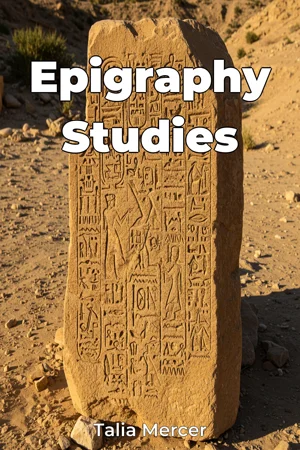
About This Book
Can the silent stones speak? "Epigraphy Studies" delves into the meticulous world of inscriptions—texts etched onto durable materials like stone, metal, and pottery—exploring how they unlock secrets of past civilizations and reshape our understanding of history. This book provides a comprehensive examination of epigraphy, positioning it not merely as a decipherment exercise but as a vital tool for reconstructing ancient societies, political landscapes, and cultural practices. The book focuses on two central themes: the evolution of writing systems and the socio-political contexts of inscription creation. Understanding the development of different scripts, from hieroglyphs to alphabets, is crucial for accurate interpretation. Furthermore, analyzing the context in which inscriptions were produced—who commissioned them, where they were placed, and what purpose they served—reveals power dynamics, religious beliefs, and daily life. These are important because they offer direct, contemporaneous insights into past events and mindsets, supplementing and sometimes challenging narratives derived from later literary sources. "Epigraphy Studies" offers a nuanced perspective on the processes by which ancient civilizations recorded their existence. Our central argument is that epigraphy provides a unique and unfiltered lens through which to view the past, offering insights unavailable through other historical sources. The book systematically examines how epigraphic evidence can either confirm or challenge existing historical interpretations. The book is structured to guide the reader through the intricate world of epigraphy. We begin by introducing the core principles, methodologies, and theoretical frameworks used in epigraphic analysis. The book then progresses to analyzing specific case studies, drawn from diverse geographical regions and historical periods, to illustrate the application of these principles. We will cover inscriptions from ancient Egypt, Greece, Rome, and Mesopotamia, among others. These case studies will emphasize various aspects such as royal decrees, religious dedications, private epitaphs, and commercial records. Each example highlights the unique challenges and rewards of working with epigraphic material. Finally, the book culminates in a discussion of the ethical considerations and future directions of epigraphic research, emphasizing the importance of preservation and collaboration. The evidence presented in this book is drawn from a wide range of primary sources, including photographs, drawings, and transcriptions of inscriptions. We also utilize secondary scholarship from leading epigraphers, historians, and archaeologists. A unique aspect of our research involves employing new digital tools for inscription analysis, such as 3D modeling and computational linguistics, to enhance accuracy and reveal previously unnoticed details. "Epigraphy Studies" connects to several other fields including archaeology, linguistics, art history, and religious studies. Archaeological context is often crucial for interpreting inscriptions, while linguistic analysis is essential for decipherment. Understanding the artistic style of an inscription can provide insights into cultural values, and religious studies benefits from the direct evidence of ancient beliefs found inscribed on temples and monuments. This book distinguishes itself by adopting an interdisciplinary approach that integrates epigraphy with material culture studies and social history. We emphasize the importance of considering inscriptions not just as texts but as objects embedded within specific social and cultural contexts. This perspective offers a more holistic understanding of the past. Written in a clear and accessible academic style, the book is aimed at students, researchers, and general readers interested in ancient history, archaeology, and classical studies. "Epigraphy Studies" caters to those seeking a thorough introduction to the field, as well as experienced scholars looking for fresh perspectives on established debates. As a work of historical scholarship, "Epigraphy Studies" prioritizes factual accuracy, rigorous analysis, and evidence-based arguments. We acknowledge the limitations of relying solely on epigraphic evidence, recognizing the fragmentary nature of many inscriptions and the potential for interpretive bias. The book focuses primarily on inscriptions from the ancient Mediterranean world and the Near East, but touches upon other regions for comparative purposes. The knowledge gained from this book has practical applications for heritage management, museum curation, and historical preservation. Understanding inscriptions helps us to better protect and interpret ancient sites and artifacts, ensuring that these invaluable resources are preserved for future generations. Epigraphic interpretation is not without its controversies. Debates often arise regarding the dating of inscriptions, the identity of their authors, and the intended meaning of specific phrases. The book addresses these controversies head-on, presenting different viewpoints and encouraging critical thinking.
Can the silent stones speak? "Epigraphy Studies" delves into the meticulous world of inscriptions—texts etched onto durable materials like stone, metal, and pottery—exploring how they unlock secrets of past civilizations and reshape our understanding of history. This book provides a comprehensive examination of epigraphy, positioning it not merely as a decipherment exercise but as a vital tool for reconstructing ancient societies, political landscapes, and cultural practices. The book focuses on two central themes: the evolution of writing systems and the socio-political contexts of inscription creation. Understanding the development of different scripts, from hieroglyphs to alphabets, is crucial for accurate interpretation. Furthermore, analyzing the context in which inscriptions were produced—who commissioned them, where they were placed, and what purpose they served—reveals power dynamics, religious beliefs, and daily life. These are important because they offer direct, contemporaneous insights into past events and mindsets, supplementing and sometimes challenging narratives derived from later literary sources. "Epigraphy Studies" offers a nuanced perspective on the processes by which ancient civilizations recorded their existence. Our central argument is that epigraphy provides a unique and unfiltered lens through which to view the past, offering insights unavailable through other historical sources. The book systematically examines how epigraphic evidence can either confirm or challenge existing historical interpretations. The book is structured to guide the reader through the intricate world of epigraphy. We begin by introducing the core principles, methodologies, and theoretical frameworks used in epigraphic analysis. The book then progresses to analyzing specific case studies, drawn from diverse geographical regions and historical periods, to illustrate the application of these principles. We will cover inscriptions from ancient Egypt, Greece, Rome, and Mesopotamia, among others. These case studies will emphasize various aspects such as royal decrees, religious dedications, private epitaphs, and commercial records. Each example highlights the unique challenges and rewards of working with epigraphic material. Finally, the book culminates in a discussion of the ethical considerations and future directions of epigraphic research, emphasizing the importance of preservation and collaboration. The evidence presented in this book is drawn from a wide range of primary sources, including photographs, drawings, and transcriptions of inscriptions. We also utilize secondary scholarship from leading epigraphers, historians, and archaeologists. A unique aspect of our research involves employing new digital tools for inscription analysis, such as 3D modeling and computational linguistics, to enhance accuracy and reveal previously unnoticed details. "Epigraphy Studies" connects to several other fields including archaeology, linguistics, art history, and religious studies. Archaeological context is often crucial for interpreting inscriptions, while linguistic analysis is essential for decipherment. Understanding the artistic style of an inscription can provide insights into cultural values, and religious studies benefits from the direct evidence of ancient beliefs found inscribed on temples and monuments. This book distinguishes itself by adopting an interdisciplinary approach that integrates epigraphy with material culture studies and social history. We emphasize the importance of considering inscriptions not just as texts but as objects embedded within specific social and cultural contexts. This perspective offers a more holistic understanding of the past. Written in a clear and accessible academic style, the book is aimed at students, researchers, and general readers interested in ancient history, archaeology, and classical studies. "Epigraphy Studies" caters to those seeking a thorough introduction to the field, as well as experienced scholars looking for fresh perspectives on established debates. As a work of historical scholarship, "Epigraphy Studies" prioritizes factual accuracy, rigorous analysis, and evidence-based arguments. We acknowledge the limitations of relying solely on epigraphic evidence, recognizing the fragmentary nature of many inscriptions and the potential for interpretive bias. The book focuses primarily on inscriptions from the ancient Mediterranean world and the Near East, but touches upon other regions for comparative purposes. The knowledge gained from this book has practical applications for heritage management, museum curation, and historical preservation. Understanding inscriptions helps us to better protect and interpret ancient sites and artifacts, ensuring that these invaluable resources are preserved for future generations. Epigraphic interpretation is not without its controversies. Debates often arise regarding the dating of inscriptions, the identity of their authors, and the intended meaning of specific phrases. The book addresses these controversies head-on, presenting different viewpoints and encouraging critical thinking.
"Epigraphy Studies" explores the world of inscriptions, texts carved into stone, metal, and pottery, and how these writings unlock secrets of ancient civilizations. Epigraphy offers direct insights into past societies, revealing details about political landscapes and cultural practices. For example, the location and purpose of an inscription, like a royal decree or religious dedication, can illuminate power dynamics and religious beliefs, providing a unique lens through which to view history. The book is structured to guide readers through the core principles and methodologies of epigraphic analysis, and then progresses to specific case studies from ancient Egypt, Greece, Rome, and Mesopotamia. These examples illustrate the challenges and rewards of working with epigraphic material, such as deciphering ancient writing systems and understanding the socio-political context of their creation. This approach emphasizes that inscriptions are not merely texts, but objects embedded within specific cultural contexts, offering a more holistic understanding of the past.
Book Details
ISBN
9788235298973
Publisher
Publifye AS
Your Licenses
You don't own any licenses for this book
Purchase a license below to unlock this book and download the EPUB.
Purchase License
Select a tier to unlock this book
Need bulk licensing?
Contact us for enterprise agreements.