
About This Book
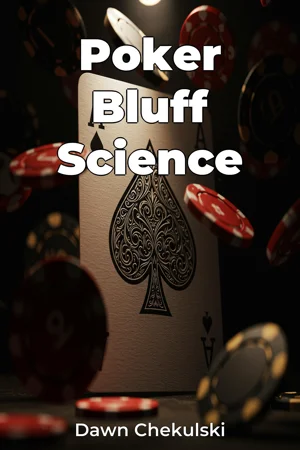
Do you want to elevate your poker game from relying on mere luck to mastering the art of strategic decision-making? "Poker Bluff Science" delves into the core principles that separate casual players from consistent winners, exploring the potent combination of psychological insight, probabilistic thinking, and the subtle art of deception. This book will serve as your guide to not only understand the game on a deeper level but to also gain a competitive edge through scientifically backed strategies. The book's central argument is that poker, at its heart, is a game of incomplete information, where mastering the bluff is not just a trick, but a fundamental strategic skill rooted in understanding human behavior and statistical probabilities. We posit that optimal poker play requires a synthesis of psychological awareness, rigorous quantitative analysis, and astute observation of opponents. The book unfolds in three primary sections. First, we lay the groundwork by introducing the psychological principles at play during a poker game. This includes detailed analyses of cognitive biases, emotional regulation, and the psychology of deception. We explore how players perceive risk, interpret tells, and react under pressure, providing a framework for understanding your own tendencies, and more importantly, those of your opponents. Second, we delve into the mathematics of poker, emphasizing probability, expected value, and game theory. We present practical tools for calculating pot odds, implied odds, and the likelihood of various outcomes, enabling you to make informed decisions based on data rather than intuition. This section explains how to quantify risk and reward, and how to optimize your betting strategy for maximum profitability. Finally, we synthesize these two core concepts in a comprehensive examination of the bluff. This section covers the art of constructing believable narratives, the science of detecting deception, and the strategic implications of balancing your range of hands. Readers will learn how to effectively use bluffs to control the flow of the game, extract value from weaker players, and protect themselves against aggressive opponents. "Poker Bluff Science" draws on a range of evidence, including experimental psychology research, game theory models, and observational studies of professional poker players. Further, we include unique data sets derived from online poker platforms to illustrate key concepts and strategies with real-world examples. This book connects to several interdisciplinary fields, including behavioral economics, cognitive science, and statistics. By integrating insights from these diverse areas, we provide a holistic understanding of poker strategy that goes beyond traditional approaches. Our approach emphasizes a data-driven, evidence-based perspective, encouraging readers to move beyond intuition and gut feelings toward a more analytical and strategic mindset. The tone is conversational yet informative, avoiding jargon while maintaining scientific rigor. "Poker Bluff Science" is aimed at poker players of all skill levels, from beginners looking to build a solid foundation to experienced players seeking to refine their game. Whether you are a casual player or a serious competitor, this book will provide you with the knowledge and tools you need to improve your win rate and make more profitable decisions at the table. The book addresses common misconceptions and controversies surrounding poker strategy, such as the relative importance of tells versus mathematical calculations, and the ethics of deception in competitive play. While we aim to provide a comprehensive overview of poker strategy, we focus specifically on no-limit hold'em, acknowledging that other variants may require different approaches. The practical applications of "Poker Bluff Science" extend beyond the poker table. The principles of psychological awareness, probabilistic thinking, and strategic communication can be applied to a wide range of real-world situations, from business negotiations to personal relationships. Learning to master the bluff not only makes you a better poker player but also a more effective decision-maker in all aspects of life.
Do you want to elevate your poker game from relying on mere luck to mastering the art of strategic decision-making? "Poker Bluff Science" delves into the core principles that separate casual players from consistent winners, exploring the potent combination of psychological insight, probabilistic thinking, and the subtle art of deception. This book will serve as your guide to not only understand the game on a deeper level but to also gain a competitive edge through scientifically backed strategies. The book's central argument is that poker, at its heart, is a game of incomplete information, where mastering the bluff is not just a trick, but a fundamental strategic skill rooted in understanding human behavior and statistical probabilities. We posit that optimal poker play requires a synthesis of psychological awareness, rigorous quantitative analysis, and astute observation of opponents. The book unfolds in three primary sections. First, we lay the groundwork by introducing the psychological principles at play during a poker game. This includes detailed analyses of cognitive biases, emotional regulation, and the psychology of deception. We explore how players perceive risk, interpret tells, and react under pressure, providing a framework for understanding your own tendencies, and more importantly, those of your opponents. Second, we delve into the mathematics of poker, emphasizing probability, expected value, and game theory. We present practical tools for calculating pot odds, implied odds, and the likelihood of various outcomes, enabling you to make informed decisions based on data rather than intuition. This section explains how to quantify risk and reward, and how to optimize your betting strategy for maximum profitability. Finally, we synthesize these two core concepts in a comprehensive examination of the bluff. This section covers the art of constructing believable narratives, the science of detecting deception, and the strategic implications of balancing your range of hands. Readers will learn how to effectively use bluffs to control the flow of the game, extract value from weaker players, and protect themselves against aggressive opponents. "Poker Bluff Science" draws on a range of evidence, including experimental psychology research, game theory models, and observational studies of professional poker players. Further, we include unique data sets derived from online poker platforms to illustrate key concepts and strategies with real-world examples. This book connects to several interdisciplinary fields, including behavioral economics, cognitive science, and statistics. By integrating insights from these diverse areas, we provide a holistic understanding of poker strategy that goes beyond traditional approaches. Our approach emphasizes a data-driven, evidence-based perspective, encouraging readers to move beyond intuition and gut feelings toward a more analytical and strategic mindset. The tone is conversational yet informative, avoiding jargon while maintaining scientific rigor. "Poker Bluff Science" is aimed at poker players of all skill levels, from beginners looking to build a solid foundation to experienced players seeking to refine their game. Whether you are a casual player or a serious competitor, this book will provide you with the knowledge and tools you need to improve your win rate and make more profitable decisions at the table. The book addresses common misconceptions and controversies surrounding poker strategy, such as the relative importance of tells versus mathematical calculations, and the ethics of deception in competitive play. While we aim to provide a comprehensive overview of poker strategy, we focus specifically on no-limit hold'em, acknowledging that other variants may require different approaches. The practical applications of "Poker Bluff Science" extend beyond the poker table. The principles of psychological awareness, probabilistic thinking, and strategic communication can be applied to a wide range of real-world situations, from business negotiations to personal relationships. Learning to master the bluff not only makes you a better poker player but also a more effective decision-maker in all aspects of life.
"Poker Bluff Science" explores the intersection of psychology, probability, and deception in poker, arguing that mastering the bluff is a core strategic skill. Going beyond luck, it delves into how understanding human behavior and statistical probabilities can significantly improve a player's decision-making. The book uniquely combines insights from experimental psychology, game theory, and data from online poker platforms to provide an evidence-based approach to poker strategy. Discover how cognitive biases influence players and how emotional regulation can be a game-changer. The book progresses through three sections: psychological principles, mathematical foundations, and the art of the bluff. It teaches readers to calculate pot odds, understand expected value, and construct believable narratives to control the game's flow. By understanding the math of poker, players can quantify risk and optimize betting strategies. Furthermore, "Poker Bluff Science" reveals how to detect deception and balance hand ranges for maximum profitability. Aimed at players of all levels, the book emphasizes a data-driven mindset, moving beyond intuition to provide practical tools for improving win rates. It addresses common misconceptions in poker strategy, such as the importance of tells versus mathematical calculations, and extends its teachings to real-world applications like business negotiations. Ultimately, mastering the bluff enhances decision-making skills in life.
Book Details
ISBN
9788235298577
Publisher
Publifye AS
Your Licenses
You don't own any licenses for this book
Purchase a license below to unlock this book and download the EPUB.
Purchase License
Select a tier to unlock this book
Need bulk licensing?
Contact us for enterprise agreements.