
About This Book
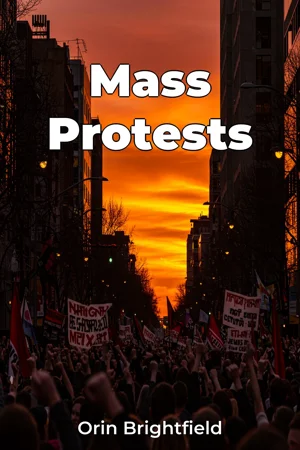
How have mass protests shaped the trajectory of the United States? "Mass Protests" explores the pivotal role large-scale demonstrations have played in driving political and social change throughout U.S. history, examining their causes, key movements, and lasting effects. This book considers the intricate relationship between popular mobilization, political response, and societal transformation. Understanding mass protests is crucial to grasping the evolution of American democracy and the ongoing struggle for a more just and equitable society. This study will delve into three primary areas: the underlying causes of mass protest, the strategies and dynamics of key protest movements, and the tangible political and social consequences that have resulted. The causes examined range from economic inequality and racial injustice to political disenfranchisement and government policies. The book analyzes how these grievances coalesce into collective action. We will explore how movements organize, recruit participants, frame their demands, and interact with power structures. The analysis extends to evaluating the legislative reforms, policy shifts, and broader cultural changes that can be traced back to the impact of mass protests. "Mass Protests" argues that these movements, while often disruptive, are essential mechanisms for holding power accountable and advancing social progress. It makes it clear that the U.S. has often progressed towards a more inclusive and representative nation only through sustained pressure from its citizenry, using collective action to overcome entrenched resistance to change. The book unfolds in a structured manner. First, it establishes a theoretical framework for understanding the emergence and evolution of mass protests, drawing on social movement theory and political science. Next, distinct historical periods are analyzed, each marked by significant waves of protest. Chapters will cover movements such as the abolitionist movement, the labor movement, the civil rights movement, the anti-war movement, and contemporary movements like Black Lives Matter and the climate justice movement. Each case study analyzes the specific catalysts for protest, the strategies employed by activists, the responses from government and opposition groups, and the ultimate outcomes in terms of policy changes and social transformations. The final section synthesizes the findings and considers the future of mass protest in an era of increasing political polarization and technological disruption. The book concludes by discussing the practical implications of these findings for policymakers, activists, and citizens seeking to understand and engage with social change. This work relies on a range of primary and secondary sources, including archival documents, government records, news reports, personal narratives, and quantitative data on protest participation and policy outcomes. Statistical analysis is used to assess the correlation between protest activity and legislative change, while qualitative analysis examines the narratives and strategies of protest movements. "Mass Protests" connects to several other fields of study, including sociology, political science, and communication studies. It draws on sociological theories of collective behavior and social stratification, political science theories of democracy and political participation, and communication studies theories of framing and agenda-setting. By integrating these perspectives, the book offers a comprehensive understanding of the dynamics of mass protest. A distinctive feature of this book is its comparative approach. By analyzing a diverse range of protest movements across different historical periods and social contexts, it identifies common patterns and unique characteristics, providing a nuanced understanding of the dynamics of collective action. Written in a clear and accessible style and grounded in rigorous research, "Mass Protests" is intended for students, scholars, policymakers, and anyone interested in understanding the role of mass protests in shaping American society. It offers valuable insights into the dynamics of social change and the ongoing struggle for a more just and equitable world. The scope of this book is confined to the United States, allowing for a more in-depth analysis of the specific historical, political, and social context. While acknowledging the global nature of protest movements, this focus allows for a more detailed examination of the nuances of American activism. The information presented in this book can be applied to contemporary challenges, offering insights into effective strategies for social change and the potential pitfalls of protest movements. It also provides a framework for understanding the ongoing debates surrounding issues such as free speech, civil disobedience, and the role of government in regulating protest activity.
How have mass protests shaped the trajectory of the United States? "Mass Protests" explores the pivotal role large-scale demonstrations have played in driving political and social change throughout U.S. history, examining their causes, key movements, and lasting effects. This book considers the intricate relationship between popular mobilization, political response, and societal transformation. Understanding mass protests is crucial to grasping the evolution of American democracy and the ongoing struggle for a more just and equitable society. This study will delve into three primary areas: the underlying causes of mass protest, the strategies and dynamics of key protest movements, and the tangible political and social consequences that have resulted. The causes examined range from economic inequality and racial injustice to political disenfranchisement and government policies. The book analyzes how these grievances coalesce into collective action. We will explore how movements organize, recruit participants, frame their demands, and interact with power structures. The analysis extends to evaluating the legislative reforms, policy shifts, and broader cultural changes that can be traced back to the impact of mass protests. "Mass Protests" argues that these movements, while often disruptive, are essential mechanisms for holding power accountable and advancing social progress. It makes it clear that the U.S. has often progressed towards a more inclusive and representative nation only through sustained pressure from its citizenry, using collective action to overcome entrenched resistance to change. The book unfolds in a structured manner. First, it establishes a theoretical framework for understanding the emergence and evolution of mass protests, drawing on social movement theory and political science. Next, distinct historical periods are analyzed, each marked by significant waves of protest. Chapters will cover movements such as the abolitionist movement, the labor movement, the civil rights movement, the anti-war movement, and contemporary movements like Black Lives Matter and the climate justice movement. Each case study analyzes the specific catalysts for protest, the strategies employed by activists, the responses from government and opposition groups, and the ultimate outcomes in terms of policy changes and social transformations. The final section synthesizes the findings and considers the future of mass protest in an era of increasing political polarization and technological disruption. The book concludes by discussing the practical implications of these findings for policymakers, activists, and citizens seeking to understand and engage with social change. This work relies on a range of primary and secondary sources, including archival documents, government records, news reports, personal narratives, and quantitative data on protest participation and policy outcomes. Statistical analysis is used to assess the correlation between protest activity and legislative change, while qualitative analysis examines the narratives and strategies of protest movements. "Mass Protests" connects to several other fields of study, including sociology, political science, and communication studies. It draws on sociological theories of collective behavior and social stratification, political science theories of democracy and political participation, and communication studies theories of framing and agenda-setting. By integrating these perspectives, the book offers a comprehensive understanding of the dynamics of mass protest. A distinctive feature of this book is its comparative approach. By analyzing a diverse range of protest movements across different historical periods and social contexts, it identifies common patterns and unique characteristics, providing a nuanced understanding of the dynamics of collective action. Written in a clear and accessible style and grounded in rigorous research, "Mass Protests" is intended for students, scholars, policymakers, and anyone interested in understanding the role of mass protests in shaping American society. It offers valuable insights into the dynamics of social change and the ongoing struggle for a more just and equitable world. The scope of this book is confined to the United States, allowing for a more in-depth analysis of the specific historical, political, and social context. While acknowledging the global nature of protest movements, this focus allows for a more detailed examination of the nuances of American activism. The information presented in this book can be applied to contemporary challenges, offering insights into effective strategies for social change and the potential pitfalls of protest movements. It also provides a framework for understanding the ongoing debates surrounding issues such as free speech, civil disobedience, and the role of government in regulating protest activity.
"Mass Protests" examines how large-scale demonstrations have propelled political and social change in United States history. It explores the causes and consequences of protest movements, highlighting their role in shaping American democracy and the pursuit of a more equitable society. The book argues that mass protests are vital for holding power accountable and advancing social progress, even when disruptive. For example, the civil rights movement demonstrated how sustained collective action can overcome resistance to change, just as the abolitionist movement did before it. The book progresses by first establishing a theoretical framework, then analyzing distinct historical periods marked by significant waves of protest, such as the labor movement and contemporary movements like Black Lives Matter. Each case study examines the catalysts, strategies, responses, and outcomes of these movements. A distinctive feature is its comparative approach, identifying common patterns and unique characteristics across different movements. By using archival documents, government records, and statistical analysis, the book connects to fields like sociology and political science, offering a comprehensive understanding of the dynamics of mass protest and political change. The book's value lies in its clear and accessible style, coupled with rigorous research, making it suitable for students, scholars, policymakers, and anyone interested in understanding the dynamics of social change. It provides insights into effective strategies for social change and the potential pitfalls of protest movements, making it a valuable resource for understanding the ongoing debates surrounding free speech, civil disobedience, and the role of government in regulating protest activity.
Book Details
ISBN
9788235297976
Publisher
Publifye AS
Your Licenses
You don't own any licenses for this book
Purchase a license below to unlock this book and download the EPUB.
Purchase License
Select a tier to unlock this book
Need bulk licensing?
Contact us for enterprise agreements.