
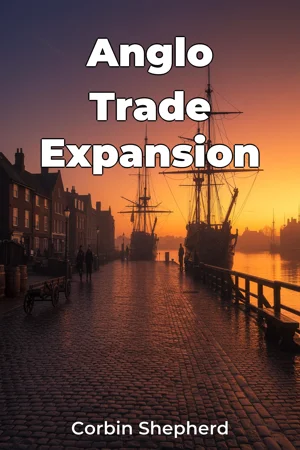
About This Book
How did a small island nation become a global trading power? "Anglo Trade Expansion" examines the policies and institutions that enabled England to establish its vast commercial network during the early modern period, focusing on the pivotal roles of mercantilism and chartered companies. These topics are crucial to understanding not only the mechanics of early globalization but also the lasting impact of English economic strategies on the modern world economy. This book places England’s trade expansion within the broader context of European mercantilism, analyzing how state policies aimed at maximizing exports and accumulating bullion fueled international competition. Readers should have a basic understanding of economic principles such as supply and demand, and a general familiarity with 16th- to 18th-century European history will be beneficial. The central argument posits that England's success in expanding its global trade reach was directly attributable to its pragmatic adaptation and implementation of mercantilist policies, coupled with the strategic use of chartered companies as instruments of both economic and political power. This approach fostered a unique synergy between state objectives and private enterprise, facilitating the establishment of trade routes and the accumulation of wealth on an unprecedented scale. The book unfolds in a structured manner. Initially, it introduces the theoretical underpinnings of mercantilism and their application in England. The second part is dedicated to the chartered companies, such as the East India Company and the Hudson's Bay Company, exploring their formation, operation, and impact on global trade networks. A third section analyzes key trade routes and commodities, including the transatlantic trade, the spice trade, and the trade in manufactured goods. It concludes by evaluating the long-term consequences of England's trade expansion, considering its effects on economic development, colonial relationships, and international power dynamics. The analysis draws upon diverse sources, including parliamentary records, company charters, trade statistics, and the correspondence of merchants and government officials. It also leverages recent scholarship in economic history and international relations to provide a nuanced understanding of the forces at play. This book connects to various fields, including political science, as it examines the relationship between state policy and economic activity; sociology, by exploring the social impacts of trade on both England and its colonies; and geography, by analyzing the spatial dimensions of trade networks. These interdisciplinary connections enrich the analysis and offer a more holistic perspective. "Anglo Trade Expansion" provides an in-depth look at the specific mechanisms through which England translated mercantilist theory into practical global dominance, offering a detailed micro-level analysis of policy implementation and its consequences. The book is written in a clear and accessible style, aimed at students, academics, and general readers interested in economic history, international trade, and the history of the British Empire. It will be valuable to anyone seeking a deeper understanding of the historical roots of globalization and the role of state-sponsored enterprises in shaping the modern world. In accordance with historical economics, the book emphasizes empirical evidence and quantitative analysis, adhering to the genre's focus on rigorous research and factual accuracy. The scope of the book is limited to the period between the 16th and 18th centuries, focusing primarily on England's trade relations with its colonies and other major trading partners. While it acknowledges the role of other European powers, its primary focus remains on the English experience. The lessons of England's early trade expansion continue to hold relevance today, offering insights into the challenges and opportunities of globalization, the role of government in promoting economic growth, and the complex relationship between trade, power, and development. Finally, the book addresses ongoing debates regarding the costs and benefits of mercantilism, the ethical implications of colonial trade, and the long-term impact of English economic policies on global inequality.
How did a small island nation become a global trading power? "Anglo Trade Expansion" examines the policies and institutions that enabled England to establish its vast commercial network during the early modern period, focusing on the pivotal roles of mercantilism and chartered companies. These topics are crucial to understanding not only the mechanics of early globalization but also the lasting impact of English economic strategies on the modern world economy. This book places England’s trade expansion within the broader context of European mercantilism, analyzing how state policies aimed at maximizing exports and accumulating bullion fueled international competition. Readers should have a basic understanding of economic principles such as supply and demand, and a general familiarity with 16th- to 18th-century European history will be beneficial. The central argument posits that England's success in expanding its global trade reach was directly attributable to its pragmatic adaptation and implementation of mercantilist policies, coupled with the strategic use of chartered companies as instruments of both economic and political power. This approach fostered a unique synergy between state objectives and private enterprise, facilitating the establishment of trade routes and the accumulation of wealth on an unprecedented scale. The book unfolds in a structured manner. Initially, it introduces the theoretical underpinnings of mercantilism and their application in England. The second part is dedicated to the chartered companies, such as the East India Company and the Hudson's Bay Company, exploring their formation, operation, and impact on global trade networks. A third section analyzes key trade routes and commodities, including the transatlantic trade, the spice trade, and the trade in manufactured goods. It concludes by evaluating the long-term consequences of England's trade expansion, considering its effects on economic development, colonial relationships, and international power dynamics. The analysis draws upon diverse sources, including parliamentary records, company charters, trade statistics, and the correspondence of merchants and government officials. It also leverages recent scholarship in economic history and international relations to provide a nuanced understanding of the forces at play. This book connects to various fields, including political science, as it examines the relationship between state policy and economic activity; sociology, by exploring the social impacts of trade on both England and its colonies; and geography, by analyzing the spatial dimensions of trade networks. These interdisciplinary connections enrich the analysis and offer a more holistic perspective. "Anglo Trade Expansion" provides an in-depth look at the specific mechanisms through which England translated mercantilist theory into practical global dominance, offering a detailed micro-level analysis of policy implementation and its consequences. The book is written in a clear and accessible style, aimed at students, academics, and general readers interested in economic history, international trade, and the history of the British Empire. It will be valuable to anyone seeking a deeper understanding of the historical roots of globalization and the role of state-sponsored enterprises in shaping the modern world. In accordance with historical economics, the book emphasizes empirical evidence and quantitative analysis, adhering to the genre's focus on rigorous research and factual accuracy. The scope of the book is limited to the period between the 16th and 18th centuries, focusing primarily on England's trade relations with its colonies and other major trading partners. While it acknowledges the role of other European powers, its primary focus remains on the English experience. The lessons of England's early trade expansion continue to hold relevance today, offering insights into the challenges and opportunities of globalization, the role of government in promoting economic growth, and the complex relationship between trade, power, and development. Finally, the book addresses ongoing debates regarding the costs and benefits of mercantilism, the ethical implications of colonial trade, and the long-term impact of English economic policies on global inequality.
"Anglo Trade Expansion" explores how England, despite its small size, became a dominant global trading power between the 16th and 18th centuries. The book examines the nation's adept use of mercantilism, a system where state policies maximized exports and bullion accumulation, and the strategic deployment of chartered companies like the East India Company. These companies served as instruments of both economic and political power, creating a synergy between state goals and private enterprise that fostered unprecedented wealth accumulation. Understanding these historical strategies offers valuable insights into the roots of modern globalization and the lasting impacts of early economic policies. The book unfolds by first introducing the theoretical foundations of mercantilism and their specific application within England. Following this, the narrative delves into the operations and global impact of chartered companies. Finally, the book analyzes key trade routes and commodities, such as the transatlantic trade and the spice trade, before concluding with an evaluation of the long-term consequences of England's trade expansion on colonial relationships and international power dynamics. The book provides a detailed analysis of England's policy implementation and its far-reaching consequences.
Book Details
ISBN
9788235297747
Publisher
Publifye AS
Your Licenses
You don't own any licenses for this book
Purchase a license below to unlock this book and download the EPUB.
Purchase License
Select a tier to unlock this book
Need bulk licensing?
Contact us for enterprise agreements.