
About This Book
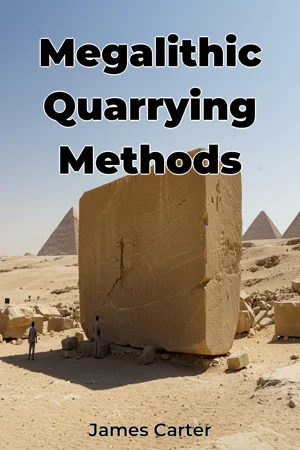
How did ancient civilizations, without the aid of modern technology, manage to quarry, transport, and erect colossal stone structures that still stand as testaments to human ingenuity? This book, "Megalithic Quarrying Methods," delves into the fascinating world of ancient construction, exploring the innovative and often surprising techniques employed by builders across various cultures and time periods. This exploration hinges on three key topics. First, the extraction processes themselves, examining the tools, strategies, and physical labor involved in separating massive stone blocks from the earth. Second, the monumental challenge of transporting these blocks, often weighing several tons, over considerable distances. Finally, the integration of quarrying and transport with the overall architectural design and societal needs of the time. Understanding these elements provides invaluable insight into the technological capabilities, organizational structures, and societal priorities of ancient civilizations. The historical context is crucial. From the pyramids of Egypt to the megalithic structures of Europe and the temples of South America, societies around the world faced similar challenges in working with enormous stones. This book assumes no prior knowledge of engineering or geology, offering clear explanations of relevant concepts. The central proposition is that the success of megalithic construction was not solely dependent on brute force, but rather on a deep understanding of material properties, innovative tool designs, and highly organized labor systems. This argument challenges simplistic notions of ancient builders as primitive, highlighting their sophisticated problem-solving abilities and engineering expertise. The book unfolds in a structured manner. It begins with an introduction to the different types of stone used in megalithic construction and their inherent properties, followed by a detailed examination of quarrying methods, categorizing them by geographical region and geological conditions. A significant portion focuses on transportation, analyzing different methods like rolling, dragging, and the use of waterways, supported by case studies and experimental archaeology. It culminates by examining the societal implications of megalithic construction, exploring how these projects shaped social hierarchies, religious beliefs, and technological advancements. The evidence presented is drawn from archaeological excavations, geological surveys, and experimental reconstructions. Unique data sources include detailed analyses of tool marks on ancient stones, records of ancient trade routes, and ethnographic studies of modern-day stone workers. This book bridges the gap between archaeology, engineering, and history, finding connections in geology by identifying available resources, and in sociology when understanding the labor systems. These interdisciplinary connections provide a richer understanding of the complexities involved in megalithic construction. A unique aspect of the book is its emphasis on experimental archaeology. By replicating ancient techniques, researchers have gained valuable insights into the practical challenges and potential solutions faced by ancient builders. These experiments provide concrete evidence to support theoretical interpretations. The writing style is factual and analytical while remaining accessible to a general audience. Complex technical terms are clearly defined, and numerous illustrations and diagrams are included to aid comprehension. The target audience includes students of archaeology, architecture, and history, as well as anyone with an interest in ancient technology and engineering. It will be valuable for those seeking a deeper understanding of how ancient societies achieved remarkable feats of construction. The book adheres to the conventions of non-fiction academic writing, emphasizing evidence-based arguments and rigorous analysis. The scope of the book is limited to the extraction and transportation of stone, focusing primarily on the technological aspects of megalithic construction and avoiding a comprehensive discussion of the social or religious significance. The information in this book can be applied practically by researchers studying ancient sites, as well as by engineers and architects interested in learning from the past. The book also touches on ongoing debates surrounding the construction of specific megalithic sites, such as the Great Pyramid of Giza or Stonehenge, discussing different theories and presenting evidence to support various interpretations.
How did ancient civilizations, without the aid of modern technology, manage to quarry, transport, and erect colossal stone structures that still stand as testaments to human ingenuity? This book, "Megalithic Quarrying Methods," delves into the fascinating world of ancient construction, exploring the innovative and often surprising techniques employed by builders across various cultures and time periods. This exploration hinges on three key topics. First, the extraction processes themselves, examining the tools, strategies, and physical labor involved in separating massive stone blocks from the earth. Second, the monumental challenge of transporting these blocks, often weighing several tons, over considerable distances. Finally, the integration of quarrying and transport with the overall architectural design and societal needs of the time. Understanding these elements provides invaluable insight into the technological capabilities, organizational structures, and societal priorities of ancient civilizations. The historical context is crucial. From the pyramids of Egypt to the megalithic structures of Europe and the temples of South America, societies around the world faced similar challenges in working with enormous stones. This book assumes no prior knowledge of engineering or geology, offering clear explanations of relevant concepts. The central proposition is that the success of megalithic construction was not solely dependent on brute force, but rather on a deep understanding of material properties, innovative tool designs, and highly organized labor systems. This argument challenges simplistic notions of ancient builders as primitive, highlighting their sophisticated problem-solving abilities and engineering expertise. The book unfolds in a structured manner. It begins with an introduction to the different types of stone used in megalithic construction and their inherent properties, followed by a detailed examination of quarrying methods, categorizing them by geographical region and geological conditions. A significant portion focuses on transportation, analyzing different methods like rolling, dragging, and the use of waterways, supported by case studies and experimental archaeology. It culminates by examining the societal implications of megalithic construction, exploring how these projects shaped social hierarchies, religious beliefs, and technological advancements. The evidence presented is drawn from archaeological excavations, geological surveys, and experimental reconstructions. Unique data sources include detailed analyses of tool marks on ancient stones, records of ancient trade routes, and ethnographic studies of modern-day stone workers. This book bridges the gap between archaeology, engineering, and history, finding connections in geology by identifying available resources, and in sociology when understanding the labor systems. These interdisciplinary connections provide a richer understanding of the complexities involved in megalithic construction. A unique aspect of the book is its emphasis on experimental archaeology. By replicating ancient techniques, researchers have gained valuable insights into the practical challenges and potential solutions faced by ancient builders. These experiments provide concrete evidence to support theoretical interpretations. The writing style is factual and analytical while remaining accessible to a general audience. Complex technical terms are clearly defined, and numerous illustrations and diagrams are included to aid comprehension. The target audience includes students of archaeology, architecture, and history, as well as anyone with an interest in ancient technology and engineering. It will be valuable for those seeking a deeper understanding of how ancient societies achieved remarkable feats of construction. The book adheres to the conventions of non-fiction academic writing, emphasizing evidence-based arguments and rigorous analysis. The scope of the book is limited to the extraction and transportation of stone, focusing primarily on the technological aspects of megalithic construction and avoiding a comprehensive discussion of the social or religious significance. The information in this book can be applied practically by researchers studying ancient sites, as well as by engineers and architects interested in learning from the past. The book also touches on ongoing debates surrounding the construction of specific megalithic sites, such as the Great Pyramid of Giza or Stonehenge, discussing different theories and presenting evidence to support various interpretations.
"Megalithic Quarrying Methods" explores how ancient civilizations, lacking modern technology, quarried, moved, and erected massive stone structures. It investigates the sophisticated techniques used to extract colossal blocks, often weighing tons, and transport them across vast distances. The book reveals that successful megalithic construction depended on understanding material properties, innovative tool designs, and organized labor, challenging the perception of ancient builders as primitive. The book examines quarrying methods across different regions and geological conditions, using archaeological excavations and geological surveys as evidence. It highlights experimental archaeology, where replicating ancient techniques provides insights into the practical challenges faced by builders. For example, researchers have recreated ancient methods to understand how Egyptians moved massive stones for the Pyramids. The book progresses by first introducing stone types, then detailing quarrying methods, analyzing transportation techniques, and finally examining the societal impacts of megalithic construction. It bridges archaeology, engineering, and history, offering a comprehensive understanding of ancient technology and construction.
Book Details
ISBN
9788235297723
Publisher
Publifye AS
Your Licenses
You don't own any licenses for this book
Purchase a license below to unlock this book and download the EPUB.
Purchase License
Select a tier to unlock this book
Need bulk licensing?
Contact us for enterprise agreements.