
About This Book
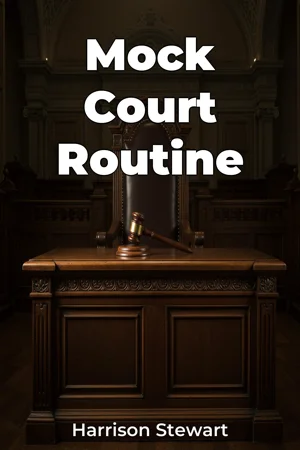
Have you ever wondered how future legal professionals hone their skills before stepping into a real courtroom? This book, "Mock Court Routine," delves into the multifaceted world of mock court exercises, revealing their pivotal role in shaping the next generation of legal minds. This work aims to dissect the structure, benefits, and practical applications of mock court, offering a comprehensive guide for students, educators, and anyone interested in the intricacies of legal education. The core topics explored revolve around three key areas: the simulation of courtroom experiences, the development of legal reasoning and procedural accuracy, and the cultivation of courtroom confidence. These topics are significant because they address the essential pillars of effective legal advocacy. Mock court provides a safe yet challenging environment where students can translate theoretical knowledge into practical skills. It is a space where mistakes become learning opportunities and abstract legal concepts are brought to life. The book offers historical context by tracing the evolution of mock trials from simple classroom exercises to sophisticated simulations involving complex case files and detailed rules of evidence. We examine the social importance of these exercises, highlighting how participation can foster critical thinking, public speaking skills, and a deeper understanding of the justice system. While no prior legal expertise is required, a basic familiarity with legal terminology will enhance the reader’s comprehension. The central argument of "Mock Court Routine" posits that well-designed and effectively executed mock court exercises are indispensable tools for legal education. They not only enhance students’ understanding of legal principles, but they also equip them with the practical skills and confidence needed to excel in real-world legal settings. This argument is crucial because criticisms of traditional legal education often cite a disconnect between theory and practice. This book advocates for a practical, hands-on approach to bridge that gap. The book is structured to provide a logical and progressive journey through the world of mock court. It begins by defining the fundamental concepts and outlining the various types of mock court exercises. It then dedicates chapters to the development of critical skills, such as case analysis, legal writing, oral advocacy, and witness examination. The work culminates in a discussion of the practical implications of mock court training, including its impact on career readiness and professional development. The conclusion also offers guidance on how to design and implement effective mock court programs, drawing from best practices and empirical research. The evidence presented in this book draws from a range of sources, including empirical studies on the effectiveness of mock court, case studies of successful mock court programs, and interviews with experienced mock trial coaches and participants. Unique data sources include transcripts of mock trial performances, surveys of student experiences, and analyses of grading rubrics used in mock court competitions. "Mock Court Routine" connects to several other fields of study, including communication, education, and political science. The emphasis on public speaking and persuasive communication links it to communication studies. The pedagogical strategies employed in mock court connect it to education. The exploration of legal procedures and the justice system links it to political science. These interdisciplinary connections enrich the book’s argument by highlighting the broader relevance and impact of mock court exercises. One unique perspective offered is a comprehensive analysis of common pitfalls in mock court design and execution, along with practical solutions to overcome these challenges. This book stands out by providing concrete strategies for creating realistic, engaging, and pedagogically sound mock court experiences. The writing style is academic yet accessible, blending rigorous analysis with practical advice. It balances theoretical frameworks with real-world examples to create a compelling and informative reading experience. The target audience includes law students, pre-law students, paralegal students, legal educators, and mock trial coaches. This book would be valuable to them because it offers a comprehensive guide to understanding, implementing, and improving mock court exercises. As a textbook in the fields of Politics and Legal Studies, "Mock Court Routine" adheres to the conventions of academic rigor and scholarly inquiry. It presents information in a clear, organized, and well-documented manner, with appropriate citations and references to relevant sources. The scope of this book is limited to the study and application of mock court exercises within the context of legal education. While it acknowledges the broader implications of mock court for civic engagement and public understanding of the law, it does not delve into these areas in great detail. The information in this book can be applied practically by readers in several ways. Law students can use it to prepare for mock trials and improve their advocacy skills. Educators can use it to design and implement effective mock court programs. Mock trial coaches can use it to train and mentor their students. While mock court is generally viewed as a positive educational tool, there are ongoing debates about the best methods for assessing student performance and ensuring fairness in competitions. This book addresses these debates by exploring alternative assessment methods and advocating for inclusive and equitable practices.
Have you ever wondered how future legal professionals hone their skills before stepping into a real courtroom? This book, "Mock Court Routine," delves into the multifaceted world of mock court exercises, revealing their pivotal role in shaping the next generation of legal minds. This work aims to dissect the structure, benefits, and practical applications of mock court, offering a comprehensive guide for students, educators, and anyone interested in the intricacies of legal education. The core topics explored revolve around three key areas: the simulation of courtroom experiences, the development of legal reasoning and procedural accuracy, and the cultivation of courtroom confidence. These topics are significant because they address the essential pillars of effective legal advocacy. Mock court provides a safe yet challenging environment where students can translate theoretical knowledge into practical skills. It is a space where mistakes become learning opportunities and abstract legal concepts are brought to life. The book offers historical context by tracing the evolution of mock trials from simple classroom exercises to sophisticated simulations involving complex case files and detailed rules of evidence. We examine the social importance of these exercises, highlighting how participation can foster critical thinking, public speaking skills, and a deeper understanding of the justice system. While no prior legal expertise is required, a basic familiarity with legal terminology will enhance the reader’s comprehension. The central argument of "Mock Court Routine" posits that well-designed and effectively executed mock court exercises are indispensable tools for legal education. They not only enhance students’ understanding of legal principles, but they also equip them with the practical skills and confidence needed to excel in real-world legal settings. This argument is crucial because criticisms of traditional legal education often cite a disconnect between theory and practice. This book advocates for a practical, hands-on approach to bridge that gap. The book is structured to provide a logical and progressive journey through the world of mock court. It begins by defining the fundamental concepts and outlining the various types of mock court exercises. It then dedicates chapters to the development of critical skills, such as case analysis, legal writing, oral advocacy, and witness examination. The work culminates in a discussion of the practical implications of mock court training, including its impact on career readiness and professional development. The conclusion also offers guidance on how to design and implement effective mock court programs, drawing from best practices and empirical research. The evidence presented in this book draws from a range of sources, including empirical studies on the effectiveness of mock court, case studies of successful mock court programs, and interviews with experienced mock trial coaches and participants. Unique data sources include transcripts of mock trial performances, surveys of student experiences, and analyses of grading rubrics used in mock court competitions. "Mock Court Routine" connects to several other fields of study, including communication, education, and political science. The emphasis on public speaking and persuasive communication links it to communication studies. The pedagogical strategies employed in mock court connect it to education. The exploration of legal procedures and the justice system links it to political science. These interdisciplinary connections enrich the book’s argument by highlighting the broader relevance and impact of mock court exercises. One unique perspective offered is a comprehensive analysis of common pitfalls in mock court design and execution, along with practical solutions to overcome these challenges. This book stands out by providing concrete strategies for creating realistic, engaging, and pedagogically sound mock court experiences. The writing style is academic yet accessible, blending rigorous analysis with practical advice. It balances theoretical frameworks with real-world examples to create a compelling and informative reading experience. The target audience includes law students, pre-law students, paralegal students, legal educators, and mock trial coaches. This book would be valuable to them because it offers a comprehensive guide to understanding, implementing, and improving mock court exercises. As a textbook in the fields of Politics and Legal Studies, "Mock Court Routine" adheres to the conventions of academic rigor and scholarly inquiry. It presents information in a clear, organized, and well-documented manner, with appropriate citations and references to relevant sources. The scope of this book is limited to the study and application of mock court exercises within the context of legal education. While it acknowledges the broader implications of mock court for civic engagement and public understanding of the law, it does not delve into these areas in great detail. The information in this book can be applied practically by readers in several ways. Law students can use it to prepare for mock trials and improve their advocacy skills. Educators can use it to design and implement effective mock court programs. Mock trial coaches can use it to train and mentor their students. While mock court is generally viewed as a positive educational tool, there are ongoing debates about the best methods for assessing student performance and ensuring fairness in competitions. This book addresses these debates by exploring alternative assessment methods and advocating for inclusive and equitable practices.
"Mock Court Routine" offers a deep dive into the world of mock court exercises, emphasizing their crucial role in legal education for students in legal studies and political science. The book explores how these simulations not only help translate legal theory into practice, but also cultivate essential courtroom skills and courtroom confidence. It traces the evolution of mock trials, highlighting their importance in fostering critical thinking and public speaking abilities. One key insight is that mock court provides a safe space for students to learn from mistakes, bridging the gap between academic knowledge and real-world application. The book progresses logically, starting with fundamental concepts and different types of mock court exercises. Chapters are dedicated to developing skills like case analysis, legal writing, and oral advocacy. It uniquely addresses common pitfalls in mock court design, offering practical solutions for creating engaging and pedagogically sound experiences. The approach is academic yet accessible, blending rigorous analysis with practical advice. This textbook is particularly valuable for law students, pre-law students, legal educators, and mock trial coaches. It serves as a comprehensive guide to understanding, implementing, and improving mock court exercises, ultimately impacting career readiness and professional development within the justice system.
Book Details
ISBN
9788235296368
Publisher
Publifye AS
Your Licenses
You don't own any licenses for this book
Purchase a license below to unlock this book and download the EPUB.
Purchase License
Select a tier to unlock this book
Need bulk licensing?
Contact us for enterprise agreements.