
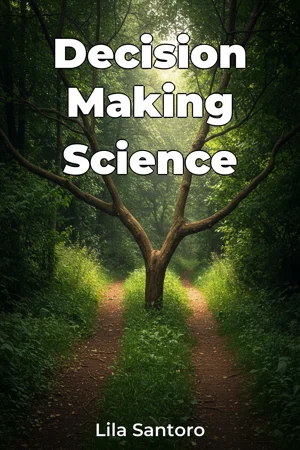
About This Book
Are you confident in the choices you make every day? Do you understand the subtle biases that influence your judgments, potentially leading you down paths you never intended? "Decision Making Science" delves into the intricate mechanisms of the human brain to reveal the science behind our choices, exploring the psychological factors at play and providing concrete techniques to enhance your decision-making skills. This book tackles three key areas: understanding the neuroscience of decision-making, identifying and mitigating psychological biases, and implementing practical strategies for improved outcomes. These topics are crucial because, in an increasingly complex world, the ability to make sound judgments is paramount for personal and professional success. We aim to equip you with the knowledge and tools to navigate uncertainty and make choices that align with your goals. Drawing upon decades of research in cognitive psychology, behavioral economics, and neuroscience, this book provides a comprehensive overview of the decision-making process. From the early philosophical debates surrounding free will to modern neuroimaging studies that map brain activity during choice, we trace the scientific journey to understand how decisions are formed. No specific prior knowledge is required; we build from the ground up, ensuring accessibility for all readers interested in understanding their own minds. The central argument of "Decision Making Science" is that decision-making, while seemingly intuitive, is a skill that can be significantly improved through awareness and application of scientific principles. By understanding the brain's inherent biases and limitations, and by employing structured techniques, individuals can consistently make better choices and achieve more favorable results. The book is structured to guide you through a progressive learning experience. We begin by introducing the fundamental concepts of decision theory and exploring the neural pathways involved. Then, we dedicate substantial attention to the cognitive biases that frequently distort our judgments, such as confirmation bias, anchoring bias, and loss aversion, explaining how these biases manifest and offering strategies to counteract them. Next, the book develops effective decision-making frameworks, including the use of decision trees, cost-benefit analysis, and scenario planning. Real-world case studies and examples illustrate how these frameworks can be applied across various contexts, from personal finance to strategic business planning. The argument culminates in a practical guide to developing personalized decision-making protocols, empowering you to implement these strategies in your daily life. Throughout the book, we present evidence-based research from peer-reviewed journals, landmark studies in behavioral science, and statistical analyses of real-world decision outcomes. We also incorporate findings from original research, including meta-analyses of existing literature and experimental results from behavioral studies. "Decision Making Science" also recognizes the interdisciplinary nature of decision-making. Therefore, it connects to several fields, including economics, marketing, and public policy. For example, understanding cognitive biases is crucial for designing effective marketing campaigns, while insights from behavioral economics can inform public policy decisions aimed at promoting positive behavior change. This interdisciplinary approach enriches the book's argument by highlighting the broad applicability of decision-making science. This book offers a unique perspective by combining rigorous scientific research with practical, actionable advice. While many self-help books offer anecdotal advice, this book grounds its recommendations in solid empirical evidence. The writing style is professional yet accessible, avoiding jargon and presenting complex concepts in a clear, engaging manner. The intended audience is broad, encompassing anyone seeking to improve their decision-making abilities. This includes professionals, students, entrepreneurs, and individuals interested in self-improvement. The book is valuable to them because it provides a scientific foundation for understanding and optimizing their choices. As a work of non-fiction in the realms of self-help and psychology, "Decision Making Science" adheres to the conventions of clarity, accuracy, and evidence-based reasoning. It aims to provide readers with practical tools and insights they can immediately apply to their lives. The scope of the book is intentionally broad, covering a wide range of decision-making contexts. However, it does not delve into specific medical or legal decision-making scenarios, focusing instead on general principles that can be applied across various domains. Ultimately, "Decision Making Science" offers a practical roadmap for improving your decision-making skills and achieving better outcomes in all areas of your life. By understanding the science behind your choices, you can take control and make decisions that lead to a more fulfilling and successful future. The controversies that exist are mostly relating to the degree to which decisions are rational, versus emotional, and we address the ongoing developments to bridge the gaps between these schools of thought.
Are you confident in the choices you make every day? Do you understand the subtle biases that influence your judgments, potentially leading you down paths you never intended? "Decision Making Science" delves into the intricate mechanisms of the human brain to reveal the science behind our choices, exploring the psychological factors at play and providing concrete techniques to enhance your decision-making skills. This book tackles three key areas: understanding the neuroscience of decision-making, identifying and mitigating psychological biases, and implementing practical strategies for improved outcomes. These topics are crucial because, in an increasingly complex world, the ability to make sound judgments is paramount for personal and professional success. We aim to equip you with the knowledge and tools to navigate uncertainty and make choices that align with your goals. Drawing upon decades of research in cognitive psychology, behavioral economics, and neuroscience, this book provides a comprehensive overview of the decision-making process. From the early philosophical debates surrounding free will to modern neuroimaging studies that map brain activity during choice, we trace the scientific journey to understand how decisions are formed. No specific prior knowledge is required; we build from the ground up, ensuring accessibility for all readers interested in understanding their own minds. The central argument of "Decision Making Science" is that decision-making, while seemingly intuitive, is a skill that can be significantly improved through awareness and application of scientific principles. By understanding the brain's inherent biases and limitations, and by employing structured techniques, individuals can consistently make better choices and achieve more favorable results. The book is structured to guide you through a progressive learning experience. We begin by introducing the fundamental concepts of decision theory and exploring the neural pathways involved. Then, we dedicate substantial attention to the cognitive biases that frequently distort our judgments, such as confirmation bias, anchoring bias, and loss aversion, explaining how these biases manifest and offering strategies to counteract them. Next, the book develops effective decision-making frameworks, including the use of decision trees, cost-benefit analysis, and scenario planning. Real-world case studies and examples illustrate how these frameworks can be applied across various contexts, from personal finance to strategic business planning. The argument culminates in a practical guide to developing personalized decision-making protocols, empowering you to implement these strategies in your daily life. Throughout the book, we present evidence-based research from peer-reviewed journals, landmark studies in behavioral science, and statistical analyses of real-world decision outcomes. We also incorporate findings from original research, including meta-analyses of existing literature and experimental results from behavioral studies. "Decision Making Science" also recognizes the interdisciplinary nature of decision-making. Therefore, it connects to several fields, including economics, marketing, and public policy. For example, understanding cognitive biases is crucial for designing effective marketing campaigns, while insights from behavioral economics can inform public policy decisions aimed at promoting positive behavior change. This interdisciplinary approach enriches the book's argument by highlighting the broad applicability of decision-making science. This book offers a unique perspective by combining rigorous scientific research with practical, actionable advice. While many self-help books offer anecdotal advice, this book grounds its recommendations in solid empirical evidence. The writing style is professional yet accessible, avoiding jargon and presenting complex concepts in a clear, engaging manner. The intended audience is broad, encompassing anyone seeking to improve their decision-making abilities. This includes professionals, students, entrepreneurs, and individuals interested in self-improvement. The book is valuable to them because it provides a scientific foundation for understanding and optimizing their choices. As a work of non-fiction in the realms of self-help and psychology, "Decision Making Science" adheres to the conventions of clarity, accuracy, and evidence-based reasoning. It aims to provide readers with practical tools and insights they can immediately apply to their lives. The scope of the book is intentionally broad, covering a wide range of decision-making contexts. However, it does not delve into specific medical or legal decision-making scenarios, focusing instead on general principles that can be applied across various domains. Ultimately, "Decision Making Science" offers a practical roadmap for improving your decision-making skills and achieving better outcomes in all areas of your life. By understanding the science behind your choices, you can take control and make decisions that lead to a more fulfilling and successful future. The controversies that exist are mostly relating to the degree to which decisions are rational, versus emotional, and we address the ongoing developments to bridge the gaps between these schools of thought.
"Decision Making Science" explores the fascinating science behind our everyday choices, delving into the psychological factors and cognitive biases that subtly influence our judgments. This self-help psychology book helps readers understand the neuroscience of decision making and provides techniques to enhance decision-making skills for improved outcomes. For example, the book reveals how our brains are wired to make quick decisions, often relying on mental shortcuts that can lead to predictable errors. The book uniquely combines rigorous scientific research from behavioral economics with practical, actionable advice, moving beyond anecdotal self-help to ground its recommendations in solid empirical evidence. It progresses systematically, starting with fundamental concepts of decision theory and neural pathways, then moves into cognitive biases like confirmation bias and loss aversion, and culminates in effective decision-making frameworks such as decision trees. By understanding these principles, readers can strategically mitigate psychological factors and make better choices in personal finance, strategic business planning, and beyond.
Book Details
ISBN
9788235295767
Publisher
Publifye AS
Your Licenses
You don't own any licenses for this book
Purchase a license below to unlock this book and download the EPUB.
Purchase License
Select a tier to unlock this book
Need bulk licensing?
Contact us for enterprise agreements.