
About This Book
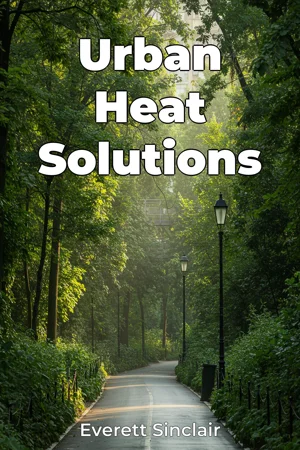
Can our cities be redesigned to beat the heat? "Urban Heat Solutions" examines the escalating crisis of urban heat islands (UHIs) and offers a comprehensive exploration of legal and architectural strategies for mitigating their effects. This book is a vital resource for understanding and addressing one of the most pressing environmental challenges facing urban centers globally. The book focuses on three core strategies: green building codes, tree coverage mandates, and reflective surface requirements. Green building codes, encompassing energy efficiency and sustainable material use, are explored for their potential to reduce waste heat generation from buildings. Tree coverage mandates, aimed at increasing urban vegetation, are analyzed for their cooling effects through evapotranspiration and shading. Reflective surface requirements, promoting the use of materials with high albedo, are investigated for their ability to reduce heat absorption from solar radiation. Understanding the interplay between these strategies is crucial for developing effective UHI mitigation policies. We begin by establishing the context of UHI formation and its far-reaching consequences, including increased energy consumption, elevated air pollution levels, and adverse health impacts, especially for vulnerable populations. We trace the historical progression of urban development patterns that have exacerbated UHIs and review the scientific principles underlying heat transfer and urban climate. No prior expertise in urban planning or environmental science is required, as foundational concepts are clearly explained. Our central argument proposes that a multi-faceted legal framework, integrating green infrastructure and reflective technologies, is essential for achieving significant and sustainable reductions in UHI intensity. This argument is supported by evidence demonstrating that isolated interventions are less effective than comprehensive, coordinated policies. This book is built around the premise that only through integrated policy and design can the negative impacts of UHIs be addressed effectively. The book is structured into three main sections: understanding UHIs, legal and policy frameworks, and architectural and design solutions. The initial section defines UHIs, their causes, and their impacts. The subsequent section analyzes existing legal and policy mechanisms, including zoning regulations, building codes, and environmental ordinances, assessing their effectiveness in promoting green infrastructure and reflective surfaces. We scrutinize case studies of cities that have successfully implemented UHI mitigation strategies, analyzing the legal and regulatory approaches they adopted. The third section delves into specific architectural strategies, such as green roofs, cool pavements, and building orientation, and explore how these can be integrated into urban design. The concluding chapter synthesizes the findings and proposes a model legal framework for UHI mitigation, adaptable to diverse urban contexts. The book draws upon a range of empirical data, including temperature measurements from urban weather stations, satellite imagery analysis of land surface temperatures, and statistical modeling of the relationships between urban form and UHI intensity. In addition, we incorporate legal analyses of relevant statutes and regulations, as well as economic assessments of the costs and benefits of different mitigation strategies. "Urban Heat Solutions" bridges the disciplines of law, architecture, and environmental science. It connects to urban planning by informing sustainable development strategies, and public health by addressing heat-related illnesses. The book's distinctive contribution lies in its integrated approach, combining legal and design perspectives to offer practical solutions for UHI mitigation. The book adopts a professional yet accessible tone, making complex information understandable to a broad audience. It is targeted towards policymakers, urban planners, architects, environmental advocates, and students interested in sustainable urban development. This book provides practical guidance for creating more livable and resilient cities in the face of climate change. The scope of the book focuses on legal and architectural strategies applicable to a wide range of urban environments, while acknowledging the limitations of applying uniform solutions across diverse geographic contexts. While technological solutions are reviewed, the emphasis is on legal and regulatory mechanisms to promote their adoption. The information is relevant for policymakers developing UHI mitigation plans, architects designing climate-responsive buildings, and urban planners seeking to integrate green infrastructure into urban landscapes. The ongoing debates surrounding the effectiveness of different mitigation strategies, such as the use of artificial turf versus natural grass in parks, are addressed. We present evidence-based analyses to inform these discussions.
Can our cities be redesigned to beat the heat? "Urban Heat Solutions" examines the escalating crisis of urban heat islands (UHIs) and offers a comprehensive exploration of legal and architectural strategies for mitigating their effects. This book is a vital resource for understanding and addressing one of the most pressing environmental challenges facing urban centers globally. The book focuses on three core strategies: green building codes, tree coverage mandates, and reflective surface requirements. Green building codes, encompassing energy efficiency and sustainable material use, are explored for their potential to reduce waste heat generation from buildings. Tree coverage mandates, aimed at increasing urban vegetation, are analyzed for their cooling effects through evapotranspiration and shading. Reflective surface requirements, promoting the use of materials with high albedo, are investigated for their ability to reduce heat absorption from solar radiation. Understanding the interplay between these strategies is crucial for developing effective UHI mitigation policies. We begin by establishing the context of UHI formation and its far-reaching consequences, including increased energy consumption, elevated air pollution levels, and adverse health impacts, especially for vulnerable populations. We trace the historical progression of urban development patterns that have exacerbated UHIs and review the scientific principles underlying heat transfer and urban climate. No prior expertise in urban planning or environmental science is required, as foundational concepts are clearly explained. Our central argument proposes that a multi-faceted legal framework, integrating green infrastructure and reflective technologies, is essential for achieving significant and sustainable reductions in UHI intensity. This argument is supported by evidence demonstrating that isolated interventions are less effective than comprehensive, coordinated policies. This book is built around the premise that only through integrated policy and design can the negative impacts of UHIs be addressed effectively. The book is structured into three main sections: understanding UHIs, legal and policy frameworks, and architectural and design solutions. The initial section defines UHIs, their causes, and their impacts. The subsequent section analyzes existing legal and policy mechanisms, including zoning regulations, building codes, and environmental ordinances, assessing their effectiveness in promoting green infrastructure and reflective surfaces. We scrutinize case studies of cities that have successfully implemented UHI mitigation strategies, analyzing the legal and regulatory approaches they adopted. The third section delves into specific architectural strategies, such as green roofs, cool pavements, and building orientation, and explore how these can be integrated into urban design. The concluding chapter synthesizes the findings and proposes a model legal framework for UHI mitigation, adaptable to diverse urban contexts. The book draws upon a range of empirical data, including temperature measurements from urban weather stations, satellite imagery analysis of land surface temperatures, and statistical modeling of the relationships between urban form and UHI intensity. In addition, we incorporate legal analyses of relevant statutes and regulations, as well as economic assessments of the costs and benefits of different mitigation strategies. "Urban Heat Solutions" bridges the disciplines of law, architecture, and environmental science. It connects to urban planning by informing sustainable development strategies, and public health by addressing heat-related illnesses. The book's distinctive contribution lies in its integrated approach, combining legal and design perspectives to offer practical solutions for UHI mitigation. The book adopts a professional yet accessible tone, making complex information understandable to a broad audience. It is targeted towards policymakers, urban planners, architects, environmental advocates, and students interested in sustainable urban development. This book provides practical guidance for creating more livable and resilient cities in the face of climate change. The scope of the book focuses on legal and architectural strategies applicable to a wide range of urban environments, while acknowledging the limitations of applying uniform solutions across diverse geographic contexts. While technological solutions are reviewed, the emphasis is on legal and regulatory mechanisms to promote their adoption. The information is relevant for policymakers developing UHI mitigation plans, architects designing climate-responsive buildings, and urban planners seeking to integrate green infrastructure into urban landscapes. The ongoing debates surrounding the effectiveness of different mitigation strategies, such as the use of artificial turf versus natural grass in parks, are addressed. We present evidence-based analyses to inform these discussions.
"Urban Heat Solutions" tackles the growing problem of urban heat islands (UHIs), where cities experience significantly higher temperatures than surrounding areas. This book examines how legal and architectural strategies can mitigate these effects, focusing on green building codes, tree coverage mandates, and reflective surfaces. Did you know that UHIs not only drive up energy consumption but also worsen air pollution and pose health risks, particularly for vulnerable populations? The book uniquely combines law, architecture, and environmental science to offer integrated, practical solutions. The book argues for a multi-faceted legal framework that incorporates green infrastructure and reflective technologies, highlighting that isolated efforts are less effective than coordinated policies. It emphasizes the importance of understanding UHI formation and its consequences, before diving into existing legal and policy mechanisms such as zoning regulations and building codes. Case studies of cities successfully implementing UHI mitigation strategies provide real-world examples. The book progresses through understanding UHIs, exploring legal and policy frameworks, and detailing architectural and design solutions. By bridging disciplines and offering evidence-based analyses, "Urban Heat Solutions" provides valuable guidance for policymakers, urban planners, architects, and anyone interested in creating more sustainable and resilient urban environments.
Book Details
ISBN
9788235295446
Publisher
Publifye AS
Your Licenses
You don't own any licenses for this book
Purchase a license below to unlock this book and download the EPUB.
Purchase License
Select a tier to unlock this book
Need bulk licensing?
Contact us for enterprise agreements.