
About This Book
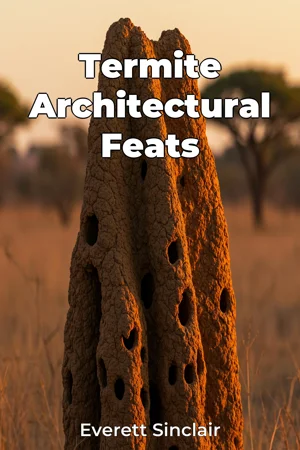
Have you ever considered that some of the most sophisticated architectural designs on Earth are not the product of human intellect, but of tiny insects working collectively? "Termite Architectural Feats" delves into the intricate world of termite mounds, revealing the biological and physical principles that underpin their remarkable structures. We will explore the sophistication of termite ventilation systems and how they regulate temperature, making their mounds marvels of natural engineering. These topics are significant because they offer insights into sustainable design, biomimicry, and the collective intelligence found in nature. This book situates termite architecture within the broader context of bio-inspired design and environmental science, as well as current research in biology. No prior architectural or entomological expertise is required; we gradually introduce key concepts, starting with basic termite biology and progressing to more complex topics in thermodynamics and fluid dynamics as they relate to mound structure. The book presents a central argument: termite mounds are not merely haphazard collections of soil, but are carefully engineered structures optimized for climate control and resource management within the colony. The importance of this argument lies in demonstrating how a seemingly simple organism can create such complex solutions to environmental challenges. This has implications for our own approach to building design in the face of climate change. The book is structured in three parts. In the first part, we introduce the basic biology of termites, describing different species and their mound-building behaviors, highlighting their social organization and division of labor. The second part is dedicated to the physics of termite mounds, including detailed analyses of ventilation and temperature regulation, as well as the materials that are used in construction. This section will explore the thermodynamics and aerodynamics within the mound. The third part culminates this exploration with the application of ecological principles to understanding how termites optimize their mound structure to maximize survival and reproductive success. There are considerations for human architecture, where we address applying termite strategies to human designs. Evidence and research presented includes data from field studies, laboratory experiments, and computational models to illustrate the principles of termite architecture. The book sources information from scientific journals, entomological databases, and architectural case studies. Interdisciplinary connections exist, with the book tying in architectural design, biology, and environmental science. The book connects to architecture by showing how termite mounds can inspire sustainable building designs. In biology, it provides a case study of collective behavior and environmental adaptation. In environmental science, it illustrates how nature solves climate control problems. The book offers a unique approach by combining detailed scientific analysis with practical architectural insights. It uses computational fluid dynamics models to simulate airflow within termite mounds and relates these simulations to real-world building designs. The tone of the book maintains a professional yet accessible style, balancing scientific rigor with clear and concise language. The target audience includes architects, biologists, engineers, and anyone interested in sustainable design and bio-inspired solutions. The book's value lies in its comprehensive coverage of termite architecture and its practical insights for addressing contemporary environmental challenges. As a fact-based, non-fiction book, there is an expectation of accuracy, comprehensive investigation, and balanced presentation of information along with clear citations. The scope of the book covers termite mounds globally, but with a concentration on several prominent species known for their complex structures. It does not cover every termite species, focusing on those that offer the clearest examples of architectural and physiological adaptations. The information in the book can be applied to the design of passive cooling systems, sustainable building materials, and strategies for energy-efficient construction. While there is not significant controversy, there are ongoing debates about the extent to which termites actively "design" their mounds versus the degree to which mound structure emerges from self-organized behavior. This book will address these debates by presenting both perspectives and synthesizing the current state of research.
Have you ever considered that some of the most sophisticated architectural designs on Earth are not the product of human intellect, but of tiny insects working collectively? "Termite Architectural Feats" delves into the intricate world of termite mounds, revealing the biological and physical principles that underpin their remarkable structures. We will explore the sophistication of termite ventilation systems and how they regulate temperature, making their mounds marvels of natural engineering. These topics are significant because they offer insights into sustainable design, biomimicry, and the collective intelligence found in nature. This book situates termite architecture within the broader context of bio-inspired design and environmental science, as well as current research in biology. No prior architectural or entomological expertise is required; we gradually introduce key concepts, starting with basic termite biology and progressing to more complex topics in thermodynamics and fluid dynamics as they relate to mound structure. The book presents a central argument: termite mounds are not merely haphazard collections of soil, but are carefully engineered structures optimized for climate control and resource management within the colony. The importance of this argument lies in demonstrating how a seemingly simple organism can create such complex solutions to environmental challenges. This has implications for our own approach to building design in the face of climate change. The book is structured in three parts. In the first part, we introduce the basic biology of termites, describing different species and their mound-building behaviors, highlighting their social organization and division of labor. The second part is dedicated to the physics of termite mounds, including detailed analyses of ventilation and temperature regulation, as well as the materials that are used in construction. This section will explore the thermodynamics and aerodynamics within the mound. The third part culminates this exploration with the application of ecological principles to understanding how termites optimize their mound structure to maximize survival and reproductive success. There are considerations for human architecture, where we address applying termite strategies to human designs. Evidence and research presented includes data from field studies, laboratory experiments, and computational models to illustrate the principles of termite architecture. The book sources information from scientific journals, entomological databases, and architectural case studies. Interdisciplinary connections exist, with the book tying in architectural design, biology, and environmental science. The book connects to architecture by showing how termite mounds can inspire sustainable building designs. In biology, it provides a case study of collective behavior and environmental adaptation. In environmental science, it illustrates how nature solves climate control problems. The book offers a unique approach by combining detailed scientific analysis with practical architectural insights. It uses computational fluid dynamics models to simulate airflow within termite mounds and relates these simulations to real-world building designs. The tone of the book maintains a professional yet accessible style, balancing scientific rigor with clear and concise language. The target audience includes architects, biologists, engineers, and anyone interested in sustainable design and bio-inspired solutions. The book's value lies in its comprehensive coverage of termite architecture and its practical insights for addressing contemporary environmental challenges. As a fact-based, non-fiction book, there is an expectation of accuracy, comprehensive investigation, and balanced presentation of information along with clear citations. The scope of the book covers termite mounds globally, but with a concentration on several prominent species known for their complex structures. It does not cover every termite species, focusing on those that offer the clearest examples of architectural and physiological adaptations. The information in the book can be applied to the design of passive cooling systems, sustainable building materials, and strategies for energy-efficient construction. While there is not significant controversy, there are ongoing debates about the extent to which termites actively "design" their mounds versus the degree to which mound structure emerges from self-organized behavior. This book will address these debates by presenting both perspectives and synthesizing the current state of research.
"Termite Architectural Feats" explores the fascinating world of termite mounds, revealing how these structures exemplify bio-inspired design and sustainable practices. Termite mounds aren't just piles of dirt; they're sophisticated feats of natural engineering, showcasing collective intelligence and environmental adaptation. For example, some species construct ventilation systems so effective they maintain remarkably stable internal temperatures, even in harsh climates. The book progresses from basic termite biology to complex concepts like thermodynamics and fluid dynamics within the mounds. It highlights how termites optimize mound structure for survival and reproduction. Through field studies, lab experiments, and computational models, the book demonstrates how lessons from termite architecture can inform the development of passive cooling systems and sustainable building materials, offering practical solutions for contemporary environmental challenges.
Book Details
ISBN
9788235295163
Publisher
Publifye AS
Your Licenses
You don't own any licenses for this book
Purchase a license below to unlock this book and download the EPUB.
Purchase License
Select a tier to unlock this book
Need bulk licensing?
Contact us for enterprise agreements.