
About This Book
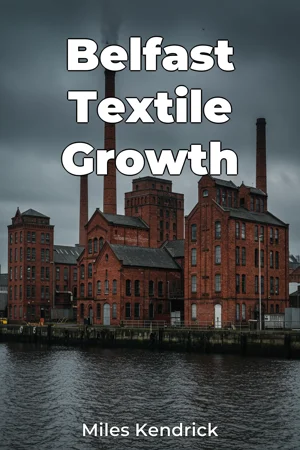
How did a small port city become a global powerhouse in linen production, and what were the human costs behind that transformation? *Belfast Textile Growth* delves into the intricate history of Belfast’s linen and textile industry, examining its rise, its impact on labor dynamics, and its entanglement with global trade networks. This book argues that Belfast's textile industry, while a driver of significant economic growth, simultaneously fostered a complex web of social and economic inequalities, shaped by the ebb and flow of global market forces and technological advancements. Understanding this history is crucial for grasping the long-term impacts of industrial development and the persistent challenges of labor equity in a globalized world. The book situates Belfast's textile boom within the broader context of the Industrial Revolution and the expansion of the British Empire. The readily available water power, coupled with entrepreneurial spirit, initially propelled the industry. However, the narrative moves beyond simplistic economic explanations to explore the social fabric woven by the textile mills. Readers will gain insight into the technological innovations that revolutionized linen production, from the introduction of flax spinning mills to the development of power looms, and how these changes impacted skilled and unskilled labor. No prior knowledge of economics or Irish history is presumed; the book provides accessible explanations of key concepts and historical events. *Belfast Textile Growth* unfolds in three distinct sections. First, it introduces the origins of the linen industry in Ulster, tracing its evolution from a cottage industry to a factory-based system. This section details the early adoption of technology and the emergence of Belfast as the epicenter of Irish linen. Second, the book analyzes the changing nature of work within the textile industry, exploring the experiences of mill workers, particularly women and children, and the rise of labor movements seeking to improve working conditions and wages. This section presents detailed accounts of strikes, unionization efforts, and the legislative changes that gradually reshaped the labor landscape. The third section examines Belfast's position within the global textile trade, analyzing its relationships with suppliers of raw materials, such as flax from the Baltic region, and its export markets across the British Empire and beyond. This section highlights the impact of global events, such as wars and economic depressions, on the industry's fortunes. The book culminates by assessing the long-term consequences of the textile boom on Belfast’s social, economic, and physical environment, discussing its legacy in the 20th and 21st centuries. The arguments presented are supported by a wealth of primary source material, including factory records, government reports, trade statistics, personal letters, and newspaper articles. Quantitative data on production levels, wages, and trade flows are analyzed alongside qualitative accounts of worker experiences to provide a nuanced understanding of the industry’s impact. This book bridges the disciplines of economic history, labor history, and social history. It connects to broader debates about the effects of industrialization, the role of global trade in shaping local economies, and the ongoing struggle for social justice. A unique aspect of this book is its focus on the human dimension of industrial change. It moves beyond aggregate economic data to tell the stories of the individuals who lived and worked in the shadow of the textile mills, giving voice to their experiences and perspectives. Written in a clear and accessible style, *Belfast Textile Growth* is intended for a broad audience, including students of history, economics, and Irish studies, as well as general readers interested in the history of industrialization and the lives of working people. It will be of particular value to those seeking to understand the complex relationship between economic growth and social equity. This book aligns with the conventions of historical non-fiction, emphasizing factual accuracy, rigorous analysis, and clear presentation of evidence. The book focuses specifically on the linen and textile industry in Belfast and its immediate surrounding areas, limiting its scope to this geographically and sectorally defined area. While the experiences of other textile centers are acknowledged, they are not explored in detail. The lessons of *Belfast Textile Growth* are highly relevant to contemporary debates about globalization, labor rights, and sustainable development. By understanding the historical consequences of industrial change, we can better address the challenges of creating a more just and equitable global economy today. The study also touches upon the socio-political controversies prevalent in Belfast during the period and how these affected the textile industry and its workforce.
How did a small port city become a global powerhouse in linen production, and what were the human costs behind that transformation? *Belfast Textile Growth* delves into the intricate history of Belfast’s linen and textile industry, examining its rise, its impact on labor dynamics, and its entanglement with global trade networks. This book argues that Belfast's textile industry, while a driver of significant economic growth, simultaneously fostered a complex web of social and economic inequalities, shaped by the ebb and flow of global market forces and technological advancements. Understanding this history is crucial for grasping the long-term impacts of industrial development and the persistent challenges of labor equity in a globalized world. The book situates Belfast's textile boom within the broader context of the Industrial Revolution and the expansion of the British Empire. The readily available water power, coupled with entrepreneurial spirit, initially propelled the industry. However, the narrative moves beyond simplistic economic explanations to explore the social fabric woven by the textile mills. Readers will gain insight into the technological innovations that revolutionized linen production, from the introduction of flax spinning mills to the development of power looms, and how these changes impacted skilled and unskilled labor. No prior knowledge of economics or Irish history is presumed; the book provides accessible explanations of key concepts and historical events. *Belfast Textile Growth* unfolds in three distinct sections. First, it introduces the origins of the linen industry in Ulster, tracing its evolution from a cottage industry to a factory-based system. This section details the early adoption of technology and the emergence of Belfast as the epicenter of Irish linen. Second, the book analyzes the changing nature of work within the textile industry, exploring the experiences of mill workers, particularly women and children, and the rise of labor movements seeking to improve working conditions and wages. This section presents detailed accounts of strikes, unionization efforts, and the legislative changes that gradually reshaped the labor landscape. The third section examines Belfast's position within the global textile trade, analyzing its relationships with suppliers of raw materials, such as flax from the Baltic region, and its export markets across the British Empire and beyond. This section highlights the impact of global events, such as wars and economic depressions, on the industry's fortunes. The book culminates by assessing the long-term consequences of the textile boom on Belfast’s social, economic, and physical environment, discussing its legacy in the 20th and 21st centuries. The arguments presented are supported by a wealth of primary source material, including factory records, government reports, trade statistics, personal letters, and newspaper articles. Quantitative data on production levels, wages, and trade flows are analyzed alongside qualitative accounts of worker experiences to provide a nuanced understanding of the industry’s impact. This book bridges the disciplines of economic history, labor history, and social history. It connects to broader debates about the effects of industrialization, the role of global trade in shaping local economies, and the ongoing struggle for social justice. A unique aspect of this book is its focus on the human dimension of industrial change. It moves beyond aggregate economic data to tell the stories of the individuals who lived and worked in the shadow of the textile mills, giving voice to their experiences and perspectives. Written in a clear and accessible style, *Belfast Textile Growth* is intended for a broad audience, including students of history, economics, and Irish studies, as well as general readers interested in the history of industrialization and the lives of working people. It will be of particular value to those seeking to understand the complex relationship between economic growth and social equity. This book aligns with the conventions of historical non-fiction, emphasizing factual accuracy, rigorous analysis, and clear presentation of evidence. The book focuses specifically on the linen and textile industry in Belfast and its immediate surrounding areas, limiting its scope to this geographically and sectorally defined area. While the experiences of other textile centers are acknowledged, they are not explored in detail. The lessons of *Belfast Textile Growth* are highly relevant to contemporary debates about globalization, labor rights, and sustainable development. By understanding the historical consequences of industrial change, we can better address the challenges of creating a more just and equitable global economy today. The study also touches upon the socio-political controversies prevalent in Belfast during the period and how these affected the textile industry and its workforce.
"Belfast Textile Growth" explores how Belfast transformed into a global linen production hub during the Industrial Revolution, examining the economic boom and its profound social consequences. The book argues that while the textile industry spurred economic growth, it also created social inequalities. For example, the introduction of power looms revolutionized production but significantly altered the demand for skilled labor. The book traces the linen industry's evolution from cottage production to factory-based systems, highlighting technological innovations and Belfast's rise as a textile epicenter. It then analyzes the changing nature of work, particularly the experiences of women and child laborers, and the rise of labor movements. Finally, it examines Belfast's role in global trade networks, analyzing its relationships with raw material suppliers and export markets within the British Empire. This approach, supported by factory records and personal accounts, provides a nuanced understanding of the industry's intertwined economic, labor, and social history.
Book Details
ISBN
9788235294562
Publisher
Publifye AS
Your Licenses
You don't own any licenses for this book
Purchase a license below to unlock this book and download the EPUB.
Purchase License
Select a tier to unlock this book
Need bulk licensing?
Contact us for enterprise agreements.