
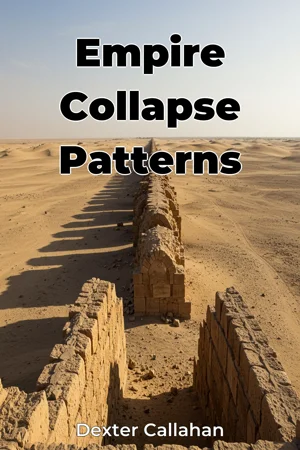
About This Book
Why do empires, seemingly invincible in their prime, eventually crumble? *Empire Collapse Patterns* investigates the recurring factors contributing to the decline of major empires across diverse historical periods and geographical locations, offering a comparative analysis to identify systemic vulnerabilities inherent in imperial structures. This book is crucial for understanding not only the past but also the potential challenges facing contemporary global powers. The book centers on three key areas: resource management, socio-political fragmentation, and external pressures. Resource management examines how empires, dependent on vast resources, often exhaust or mismanage them, leading to economic instability and internal strife. Socio-political fragmentation explores the internal divisions, be they ethnic, religious, or economic, which weaken an empire's cohesion and create opportunities for rebellion or secession. External pressures analyze the impact of rival empires, nomadic incursions, and environmental changes on imperial stability, demonstrating how these factors can exploit existing weaknesses or create entirely new ones. Understanding these patterns requires a grasp of basic historical frameworks, including the rise and fall of empires like Rome, the Ottomans, and the Mayans, and how political structures, economic systems, and social dynamics interacted within each case. *Empire Collapse Patterns* argues that while each empire's downfall is unique, identifiable patterns of resource mismanagement, internal fragmentation, and external pressures consistently recur, acting as leading indicators of potential collapse. This understanding allows for a predictive model to assess the stability of current nations and international systems. The book is structured in three parts. The first part introduces the theoretical framework and methodological approach, defining key terms like "resource depletion," "elite competition," and "geopolitical stress." The second part examines several case studies, each dedicated to a major empire and focusing on the interplay of the three key areas identified. These detailed analyses draw on historical texts, archaeological findings, and economic data. The third part synthesizes the findings, identifying common patterns and exploring their relevance to the modern world. The book culminates in a discussion of potential strategies for mitigating the risks of imperial decline, applicable both to nation-states and to global organizations. The evidence presented is drawn from a wide array of primary and secondary sources, including administrative records, diplomatic correspondence, archaeological reports, and scholarly analyses. A novel element is the application of quantitative methods, such as network analysis and statistical modeling, to assess the relative importance of different factors contributing to collapse. *Empire Collapse Patterns* connects to several other fields, including economics (examining the role of resource depletion and trade imbalances), sociology (analyzing social stratification and identity politics), and environmental science (assessing the impact of climate change and ecological degradation). These interdisciplinary connections enrich the analysis and provide a more nuanced understanding of imperial decline. A unique perspective offered by this book is the emphasis on the interconnectedness of internal and external factors, moving beyond simplistic explanations that focus solely on one or the other. It emphasizes that internal vulnerabilities often make empires susceptible to external pressures, and vice versa. The book adopts a fact-based, analytical tone. This book will appeal to students and scholars of history, political science, and international relations, as well as policymakers and anyone interested in understanding the dynamics of power and the fragility of even the most dominant empires. As a work of World History and Politics, the book expects to provide detailed case studies and rigorous analysis based on factual evidence. The scope of *Empire Collapse Patterns* encompasses a broad range of empires across different time periods and geographical regions, but it intentionally limits its focus to land-based empires, excluding maritime empires like the British Empire to maintain analytical coherence. The insights from *Empire Collapse Patterns* can be applied to analyzing the stability of contemporary nation-states, predicting potential conflicts, and developing strategies for sustainable development and international cooperation. The book addresses ongoing debates about the relative importance of different factors contributing to imperial collapse, such as the role of climate change versus political corruption, offering a balanced and evidence-based perspective.
Why do empires, seemingly invincible in their prime, eventually crumble? *Empire Collapse Patterns* investigates the recurring factors contributing to the decline of major empires across diverse historical periods and geographical locations, offering a comparative analysis to identify systemic vulnerabilities inherent in imperial structures. This book is crucial for understanding not only the past but also the potential challenges facing contemporary global powers. The book centers on three key areas: resource management, socio-political fragmentation, and external pressures. Resource management examines how empires, dependent on vast resources, often exhaust or mismanage them, leading to economic instability and internal strife. Socio-political fragmentation explores the internal divisions, be they ethnic, religious, or economic, which weaken an empire's cohesion and create opportunities for rebellion or secession. External pressures analyze the impact of rival empires, nomadic incursions, and environmental changes on imperial stability, demonstrating how these factors can exploit existing weaknesses or create entirely new ones. Understanding these patterns requires a grasp of basic historical frameworks, including the rise and fall of empires like Rome, the Ottomans, and the Mayans, and how political structures, economic systems, and social dynamics interacted within each case. *Empire Collapse Patterns* argues that while each empire's downfall is unique, identifiable patterns of resource mismanagement, internal fragmentation, and external pressures consistently recur, acting as leading indicators of potential collapse. This understanding allows for a predictive model to assess the stability of current nations and international systems. The book is structured in three parts. The first part introduces the theoretical framework and methodological approach, defining key terms like "resource depletion," "elite competition," and "geopolitical stress." The second part examines several case studies, each dedicated to a major empire and focusing on the interplay of the three key areas identified. These detailed analyses draw on historical texts, archaeological findings, and economic data. The third part synthesizes the findings, identifying common patterns and exploring their relevance to the modern world. The book culminates in a discussion of potential strategies for mitigating the risks of imperial decline, applicable both to nation-states and to global organizations. The evidence presented is drawn from a wide array of primary and secondary sources, including administrative records, diplomatic correspondence, archaeological reports, and scholarly analyses. A novel element is the application of quantitative methods, such as network analysis and statistical modeling, to assess the relative importance of different factors contributing to collapse. *Empire Collapse Patterns* connects to several other fields, including economics (examining the role of resource depletion and trade imbalances), sociology (analyzing social stratification and identity politics), and environmental science (assessing the impact of climate change and ecological degradation). These interdisciplinary connections enrich the analysis and provide a more nuanced understanding of imperial decline. A unique perspective offered by this book is the emphasis on the interconnectedness of internal and external factors, moving beyond simplistic explanations that focus solely on one or the other. It emphasizes that internal vulnerabilities often make empires susceptible to external pressures, and vice versa. The book adopts a fact-based, analytical tone. This book will appeal to students and scholars of history, political science, and international relations, as well as policymakers and anyone interested in understanding the dynamics of power and the fragility of even the most dominant empires. As a work of World History and Politics, the book expects to provide detailed case studies and rigorous analysis based on factual evidence. The scope of *Empire Collapse Patterns* encompasses a broad range of empires across different time periods and geographical regions, but it intentionally limits its focus to land-based empires, excluding maritime empires like the British Empire to maintain analytical coherence. The insights from *Empire Collapse Patterns* can be applied to analyzing the stability of contemporary nation-states, predicting potential conflicts, and developing strategies for sustainable development and international cooperation. The book addresses ongoing debates about the relative importance of different factors contributing to imperial collapse, such as the role of climate change versus political corruption, offering a balanced and evidence-based perspective.
*Empire Collapse Patterns* explores why powerful empires decline, identifying recurring vulnerabilities across history. Resource management, socio-political fragmentation, and external pressures emerge as critical factors. Intriguingly, empires often mismanage resources, leading to economic decline and internal conflicts, while internal divisions such as ethnic or economic disparities weaken cohesion. The book analyzes political structures, economic systems, and social dynamics of empires like Rome and the Ottomans, revealing identifiable patterns. It argues that while each collapse is unique, recurring themes of resource mismanagement, internal fragmentation, and external pressures consistently signal potential decline. This comparative approach uses historical texts, archaeological findings, and even quantitative methods to identify common patterns and their relevance to the modern world. Structured in three parts, the book introduces a framework, examines case studies, and synthesizes findings. It uniquely emphasizes the interconnectedness of internal and external factors, offering a more nuanced understanding of imperial decline and its applicability to contemporary global powers and international relations.
Book Details
ISBN
9788235294463
Publisher
Publifye AS
Your Licenses
You don't own any licenses for this book
Purchase a license below to unlock this book and download the EPUB.
Purchase License
Select a tier to unlock this book
Need bulk licensing?
Contact us for enterprise agreements.