
About This Book
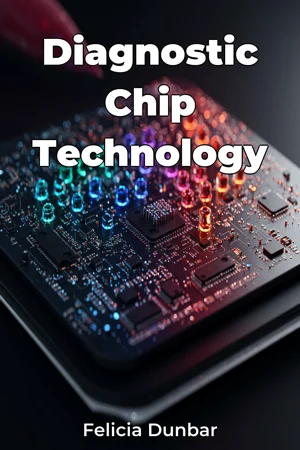
Imagine a world where rapid, accurate disease detection is accessible anywhere, from remote clinics to bustling city centers. This book, "Diagnostic Chip Technology," explores the revolutionary potential of microfluidic lab-on-chip systems to transform diagnostic testing. It delves into the science, engineering, and applications driving this exciting field, detailing how these miniature devices are poised to revolutionize healthcare, environmental monitoring, and beyond. The book focuses on two key concepts: the integration of complex laboratory procedures onto a single microfluidic chip and the application of these chips for rapid and portable detection of infectious diseases and biochemical markers. These are crucial because traditional diagnostic methods are often time-consuming, expensive, and require specialized laboratory equipment and trained personnel. Lab-on-chip systems offer a solution by miniaturizing and automating these processes, enabling faster results, lower costs, and point-of-care testing. To understand the advancements in diagnostic chip technology, the book provides essential background information on microfluidics, materials science, and bioengineering. It explores the history of microfluidic devices, tracing their development from early research prototypes to the sophisticated diagnostic tools available today. The central argument is that microfluidic lab-on-chip systems represent a paradigm shift in diagnostics, offering unprecedented speed, portability, and accessibility, ultimately leading to improved patient outcomes and enhanced public health surveillance. The book is structured to guide the reader through the complexities of this technology. It begins by introducing the fundamental principles of microfluidics, including fluid dynamics at the microscale, microfabrication techniques, and sensor integration. It then dives deep into specific applications, dedicating chapters to the detection of infectious diseases such as influenza, HIV, and malaria, as well as the measurement of critical biochemical markers indicative of cardiac events, cancer, and other conditions. The final sections explore the challenges and opportunities for commercialization, regulatory considerations, and future trends in the field. Supporting the arguments are detailed case studies, experimental data, and performance comparisons against conventional diagnostic methods. The book also draws from a wide range of research articles, patents, and industry reports to provide a comprehensive overview of the current state-of-the-art. "Diagnostic Chip Technology" connects to several other disciplines, including medicine, public health, engineering, and chemistry. The medical community benefits from faster and more accurate diagnostic tools, while public health officials gain access to improved surveillance capabilities. Engineers contribute to the design and fabrication of these devices, and chemists develop the sensitive reagents and detection methods that make them effective. This book distinguishes itself by providing a balanced perspective that covers both the theoretical foundations and practical applications of diagnostic chip technology. It not only explains the underlying science but also addresses the challenges of translating these technologies from the laboratory to real-world settings. Written in a clear and concise style, the book is tailored for researchers, engineers, clinicians, and anyone interested in the future of diagnostics. It offers valuable insights for graduate students, postdoctoral fellows, and industry professionals working in the fields of microfluidics, biotechnology, and medical diagnostics. As a work of science and medical general genre, the book upholds standards of accuracy, objectivity, and clarity. It presents evidence-based information and avoids sensationalism or unsubstantiated claims. The scope of this book is intentionally broad, covering a wide range of diagnostic applications and technological approaches. However, it does not delve into the specific details of regulatory approval processes for individual diagnostic devices, as these vary significantly across different countries and applications. The real-world applications of the technologies discussed are vast. Imagine point-of-care HIV testing in resource-limited settings, rapid diagnosis of sepsis in emergency rooms, or continuous monitoring of glucose levels for diabetic patients. These are just a few examples of how diagnostic chip technology can improve healthcare outcomes and transform lives. While the field of diagnostic chip technology is rapidly advancing, some debates persist regarding the cost-effectiveness and scalability of these devices. The book addresses these concerns by providing a realistic assessment of the challenges and opportunities facing the industry. "Diagnostic Chip Technology" provides a comprehensive exploration of microfluidic lab-on-chip systems, detailing their potential to revolutionize diagnostic testing and improve global health.
Imagine a world where rapid, accurate disease detection is accessible anywhere, from remote clinics to bustling city centers. This book, "Diagnostic Chip Technology," explores the revolutionary potential of microfluidic lab-on-chip systems to transform diagnostic testing. It delves into the science, engineering, and applications driving this exciting field, detailing how these miniature devices are poised to revolutionize healthcare, environmental monitoring, and beyond. The book focuses on two key concepts: the integration of complex laboratory procedures onto a single microfluidic chip and the application of these chips for rapid and portable detection of infectious diseases and biochemical markers. These are crucial because traditional diagnostic methods are often time-consuming, expensive, and require specialized laboratory equipment and trained personnel. Lab-on-chip systems offer a solution by miniaturizing and automating these processes, enabling faster results, lower costs, and point-of-care testing. To understand the advancements in diagnostic chip technology, the book provides essential background information on microfluidics, materials science, and bioengineering. It explores the history of microfluidic devices, tracing their development from early research prototypes to the sophisticated diagnostic tools available today. The central argument is that microfluidic lab-on-chip systems represent a paradigm shift in diagnostics, offering unprecedented speed, portability, and accessibility, ultimately leading to improved patient outcomes and enhanced public health surveillance. The book is structured to guide the reader through the complexities of this technology. It begins by introducing the fundamental principles of microfluidics, including fluid dynamics at the microscale, microfabrication techniques, and sensor integration. It then dives deep into specific applications, dedicating chapters to the detection of infectious diseases such as influenza, HIV, and malaria, as well as the measurement of critical biochemical markers indicative of cardiac events, cancer, and other conditions. The final sections explore the challenges and opportunities for commercialization, regulatory considerations, and future trends in the field. Supporting the arguments are detailed case studies, experimental data, and performance comparisons against conventional diagnostic methods. The book also draws from a wide range of research articles, patents, and industry reports to provide a comprehensive overview of the current state-of-the-art. "Diagnostic Chip Technology" connects to several other disciplines, including medicine, public health, engineering, and chemistry. The medical community benefits from faster and more accurate diagnostic tools, while public health officials gain access to improved surveillance capabilities. Engineers contribute to the design and fabrication of these devices, and chemists develop the sensitive reagents and detection methods that make them effective. This book distinguishes itself by providing a balanced perspective that covers both the theoretical foundations and practical applications of diagnostic chip technology. It not only explains the underlying science but also addresses the challenges of translating these technologies from the laboratory to real-world settings. Written in a clear and concise style, the book is tailored for researchers, engineers, clinicians, and anyone interested in the future of diagnostics. It offers valuable insights for graduate students, postdoctoral fellows, and industry professionals working in the fields of microfluidics, biotechnology, and medical diagnostics. As a work of science and medical general genre, the book upholds standards of accuracy, objectivity, and clarity. It presents evidence-based information and avoids sensationalism or unsubstantiated claims. The scope of this book is intentionally broad, covering a wide range of diagnostic applications and technological approaches. However, it does not delve into the specific details of regulatory approval processes for individual diagnostic devices, as these vary significantly across different countries and applications. The real-world applications of the technologies discussed are vast. Imagine point-of-care HIV testing in resource-limited settings, rapid diagnosis of sepsis in emergency rooms, or continuous monitoring of glucose levels for diabetic patients. These are just a few examples of how diagnostic chip technology can improve healthcare outcomes and transform lives. While the field of diagnostic chip technology is rapidly advancing, some debates persist regarding the cost-effectiveness and scalability of these devices. The book addresses these concerns by providing a realistic assessment of the challenges and opportunities facing the industry. "Diagnostic Chip Technology" provides a comprehensive exploration of microfluidic lab-on-chip systems, detailing their potential to revolutionize diagnostic testing and improve global health.
"Diagnostic Chip Technology" explores the transformative potential of microfluidic lab-on-chip systems in modern diagnostics. These miniature devices integrate complex lab procedures onto a single chip, promising rapid, portable, and cost-effective solutions for detecting infectious diseases and biochemical markers. One intriguing fact is their ability to perform point-of-care testing, bringing diagnostics directly to the patient. Another is their potential to drastically reduce the time and resources required for traditional laboratory analysis, offering faster results and lower costs. The book uniquely balances theoretical foundations with practical applications, guiding readers through the principles of microfluidics, microfabrication, and sensor integration. It then delves into specific applications like infectious disease detection, including HIV and malaria, and the measurement of biochemical markers for conditions like cardiac events and cancer. The final sections address commercialization challenges and future trends, providing a comprehensive overview of this rapidly evolving field.
Book Details
ISBN
9788235294425
Publisher
Publifye AS
Your Licenses
You don't own any licenses for this book
Purchase a license below to unlock this book and download the EPUB.
Purchase License
Select a tier to unlock this book
Need bulk licensing?
Contact us for enterprise agreements.