
About This Book
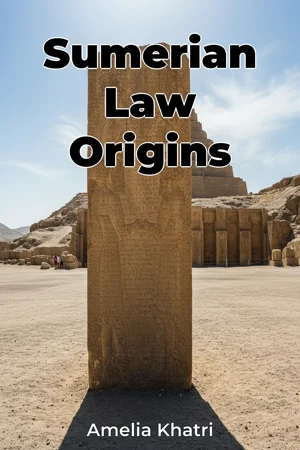
Did the seeds of modern law germinate in the fertile crescent of Mesopotamia? "Sumerian Law Origins" delves into the fascinating world of early Sumerian legal codes, exploring their creation, enforcement, and profound influence on neighboring city-states and, ultimately, Western legal tradition. This book addresses a fundamental question: how did a society, emerging from prehistory, develop systems of justice and governance that continue to resonate millennia later? Two key topics comprise the heart of this inquiry: the evolution of legal thought in Sumer and the practical mechanisms of its implementation. Understanding the philosophical underpinnings of Sumerian law reveals their concept of justice, divine authority, and social order. Examining court records and administrative practices highlights the real-world application of these principles, exposing the nuances of Sumerian society and the challenges of maintaining stability. These topics are significant because they offer a crucial prehistory of Western legal thought, demonstrating that many concepts we take for granted have roots in ancient Mesopotamia. The book places Sumerian legal development within the broader context of Mesopotamian history, society, and religion. Readers will gain an understanding of the political landscape of the region, the economic structures that shaped daily life, and the religious beliefs that influenced moral codes. No prior knowledge of Sumerian history is strictly required, although a basic understanding of ancient Near Eastern civilizations would be beneficial. The central argument of "Sumerian Law Origins" is that Sumerian legal codes represent a pivotal moment in human history: the transition from informal customary law to systematized, written law. This transition was not merely a change in form but a profound shift in the nature of governance, social interaction, and the very concept of justice. It argues that the Sumerian innovations in law served as primary source material and inspiration for later legal systems in the ancient world. "Sumerian Law Origins" is structured to guide the reader through this complex history systematically. The book begins by introducing the historical context of Sumerian civilization and the concept of law in early societies. It then explores the development of Sumerian legal codes, examining the major collections such as the Code of Ur-Nammu, the Laws of Eshnunna, and the Code of Hammurabi (viewed in its Sumerian context). The central chapters analyze the content of these codes, focusing on specific areas such as property rights, family law, contracts, and criminal justice. Particular attention is paid to court procedures, the role of judges and scribes, and the enforcement mechanisms available to the state. The book concludes by assessing the legacy of Sumerian law, tracing its influence on later Mesopotamian legal traditions and its potential contributions to Western legal thought. The book relies on a range of evidence, including cuneiform texts of legal codes, court records, administrative documents, and archaeological findings. It incorporates recent scholarship in Assyriology and legal history, drawing on both primary source analysis and secondary interpretations to provide a comprehensive and nuanced picture of Sumerian law. "Sumerian Law Origins" connects to other fields such as anthropology, sociology, and political science. Anthropological insights help us understand how law functions within a society. Sociological perspectives shed light on the social structures that shaped legal development. Political science theory informs our understanding of the relationship between law, power, and governance. This book offers a fresh perspective by focusing on the legal codes as products of a specific historical and social context. The book delves into the nuances of Sumerian society as it transitioned from a preliterate setting to a more regulated and structured culture. Written in a clear and accessible style, "Sumerian Law Origins" is designed for a broad audience, including students, legal scholars, historians, and anyone interested in the origins of law and civilization. It avoids technical jargon and provides clear explanations of complex concepts, making it accessible to non-specialists. The book's scope is limited to Sumerian legal codes and their immediate influence in Mesopotamia. While it touches on later developments, it does not provide a comprehensive history of law in the ancient world. The information presented in "Sumerian Law Origins" can be applied to contemporary discussions about law, justice, and governance. It demonstrates that legal systems are not static entities but are constantly evolving in response to social, economic, and political changes.
Did the seeds of modern law germinate in the fertile crescent of Mesopotamia? "Sumerian Law Origins" delves into the fascinating world of early Sumerian legal codes, exploring their creation, enforcement, and profound influence on neighboring city-states and, ultimately, Western legal tradition. This book addresses a fundamental question: how did a society, emerging from prehistory, develop systems of justice and governance that continue to resonate millennia later? Two key topics comprise the heart of this inquiry: the evolution of legal thought in Sumer and the practical mechanisms of its implementation. Understanding the philosophical underpinnings of Sumerian law reveals their concept of justice, divine authority, and social order. Examining court records and administrative practices highlights the real-world application of these principles, exposing the nuances of Sumerian society and the challenges of maintaining stability. These topics are significant because they offer a crucial prehistory of Western legal thought, demonstrating that many concepts we take for granted have roots in ancient Mesopotamia. The book places Sumerian legal development within the broader context of Mesopotamian history, society, and religion. Readers will gain an understanding of the political landscape of the region, the economic structures that shaped daily life, and the religious beliefs that influenced moral codes. No prior knowledge of Sumerian history is strictly required, although a basic understanding of ancient Near Eastern civilizations would be beneficial. The central argument of "Sumerian Law Origins" is that Sumerian legal codes represent a pivotal moment in human history: the transition from informal customary law to systematized, written law. This transition was not merely a change in form but a profound shift in the nature of governance, social interaction, and the very concept of justice. It argues that the Sumerian innovations in law served as primary source material and inspiration for later legal systems in the ancient world. "Sumerian Law Origins" is structured to guide the reader through this complex history systematically. The book begins by introducing the historical context of Sumerian civilization and the concept of law in early societies. It then explores the development of Sumerian legal codes, examining the major collections such as the Code of Ur-Nammu, the Laws of Eshnunna, and the Code of Hammurabi (viewed in its Sumerian context). The central chapters analyze the content of these codes, focusing on specific areas such as property rights, family law, contracts, and criminal justice. Particular attention is paid to court procedures, the role of judges and scribes, and the enforcement mechanisms available to the state. The book concludes by assessing the legacy of Sumerian law, tracing its influence on later Mesopotamian legal traditions and its potential contributions to Western legal thought. The book relies on a range of evidence, including cuneiform texts of legal codes, court records, administrative documents, and archaeological findings. It incorporates recent scholarship in Assyriology and legal history, drawing on both primary source analysis and secondary interpretations to provide a comprehensive and nuanced picture of Sumerian law. "Sumerian Law Origins" connects to other fields such as anthropology, sociology, and political science. Anthropological insights help us understand how law functions within a society. Sociological perspectives shed light on the social structures that shaped legal development. Political science theory informs our understanding of the relationship between law, power, and governance. This book offers a fresh perspective by focusing on the legal codes as products of a specific historical and social context. The book delves into the nuances of Sumerian society as it transitioned from a preliterate setting to a more regulated and structured culture. Written in a clear and accessible style, "Sumerian Law Origins" is designed for a broad audience, including students, legal scholars, historians, and anyone interested in the origins of law and civilization. It avoids technical jargon and provides clear explanations of complex concepts, making it accessible to non-specialists. The book's scope is limited to Sumerian legal codes and their immediate influence in Mesopotamia. While it touches on later developments, it does not provide a comprehensive history of law in the ancient world. The information presented in "Sumerian Law Origins" can be applied to contemporary discussions about law, justice, and governance. It demonstrates that legal systems are not static entities but are constantly evolving in response to social, economic, and political changes.
"Sumerian Law Origins" explores the dawn of codified law in ancient Mesopotamia, investigating how the Sumerian civilization transitioned from informal customs to systematized legal codes. The book highlights the critical role of these early laws in shaping justice, governance, and social order in the ancient Near East. Intriguingly, these codes reveal a sophisticated understanding of concepts like property rights and contracts, ideas that continue to resonate in modern legal systems. By examining court records and administrative practices, the book reveals the practical application of these principles in Sumerian society. The book traces the evolution of Sumerian legal thought, examining key collections like the Code of Ur-Nammu and the Laws of Eshnunna, placing them within the context of Mesopotamian history, society, and religion. It argues that Sumerian law represents a pivotal moment: the shift to written law, influencing later legal systems. Each chapter builds upon the last, starting with the historical context of Sumerian civilization. It progresses through the development of Sumerian legal codes, analyzes their contents, and concludes by assessing their lasting legacy and potential contributions to Western legal thought.
Book Details
ISBN
9788235294340
Publisher
Publifye AS
Your Licenses
You don't own any licenses for this book
Purchase a license below to unlock this book and download the EPUB.
Purchase License
Select a tier to unlock this book
Need bulk licensing?
Contact us for enterprise agreements.