
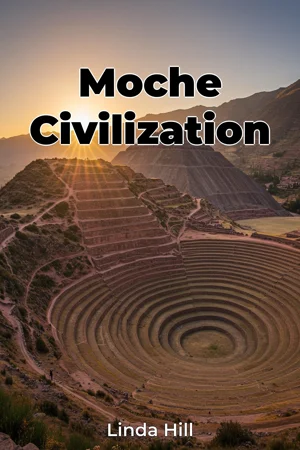
About This Book
How did a civilization, flourishing for over six centuries in the arid lands of ancient Peru, not only survive but thrive, leaving behind a legacy of intricate artistry and engineering prowess? This book, "Moche Civilization," delves into the heart of the Moche culture, exploring the complex interplay of advanced irrigation systems, elaborate pottery traditions, and a dominant warrior ethos that shaped their society. These facets are not isolated elements but are intrinsically linked, revealing a sophisticated and dynamic culture that warrants deeper understanding. This exploration is vital because comprehending the Moche provides valuable insights into the adaptability of societies to environmental challenges, the role of art as a medium for cultural expression and power negotiation, and the impact of militarism on societal structures. The book offers a comprehensive account of the Moche civilization, contextualizing its rise and fall within the broader timeline of pre-Columbian Andean history. Readers are expected to have a basic understanding of ancient civilizations and archaeological principles. The central argument of "Moche Civilization" is that their success stemmed from a carefully balanced synergy between sophisticated environmental management, artistic expression, and a powerful military. Furthermore, the book will argue that understanding this balance is crucial to reappraising the Moche not simply as a "warrior culture," but as a complex society with sophisticated social, economic, and ideological systems. The book is structured in four major parts. Part 1 introduces the geographical and historical context of the Moche civilization, outlining their origins, expansion, and eventual decline. Part 2 examines Moche agricultural practices, with a focus on their advanced irrigation systems that allowed them to cultivate crops in an otherwise arid environment. This section analyzes the engineering behind these systems, their impact on agricultural productivity, and the social organization required to maintain them. Part 3 delves into Moche pottery, analyzing its artistic techniques, iconographic themes, and significance as a medium for conveying religious beliefs, social hierarchies, and historical narratives. Part 4 explores the warrior culture of the Moche, detailing their military organization, weaponry, and the role of warfare in their society. Special attention is given to the depiction of warfare in Moche art and its implications for understanding Moche ideology. This book draws upon a diverse range of evidence, including archaeological excavations of Moche settlements, analysis of Moche artifacts (particularly pottery), and interpretations of iconography. Further, it revisits early excavation reports and compares the interpretations to current cultural understanding. It incorporates recent findings from archaeological sites along the northern coast of Peru, offering fresh perspectives on Moche society. The methodologies employed include stylistic analysis of pottery, spatial analysis of settlement patterns, and contextual analysis of archaeological finds. "Moche Civilization" also connects to other fields of study, such as environmental science (through the analysis of irrigation systems), art history (through the study of Moche pottery), and political science (through the examination of Moche social and political organization). By integrating these perspectives, the book offers a more holistic understanding of this ancient culture. This book stands out due to its interdisciplinary approach and its emphasis on the interconnectedness of the Moche's irrigation systems, artistic traditions, and warrior culture. It moves beyond simplistic portrayals of the Moche as solely a warrior society, offering a nuanced and comprehensive analysis of their complex social, economic, and ideological systems. The tone is academic yet accessible, aiming to present complex information in a clear and engaging manner. The writing style is fact-based and analytical, drawing upon scholarly research to support its claims. The intended audience includes students of archaeology, anthropology, history, and art history, as well as general readers interested in ancient civilizations and pre-Columbian cultures. The book is valuable to them because it provides a comprehensive and up-to-date account of the Moche civilization, incorporating recent discoveries and offering fresh perspectives on their culture. As a work of history, this book adheres to the genre's conventions by presenting a chronological narrative, analyzing primary and secondary sources, and providing a balanced and objective account of the Moche civilization. The book focuses specifically on the Moche civilization, avoiding broad generalizations about other Andean cultures. This allows for a more in-depth and nuanced analysis of their unique characteristics. The study of Moche irrigation systems offers valuable lessons for modern-day agricultural practices in arid regions, while their artistic achievements continue to inspire artists and designers. The ongoing debate surrounding the nature and extent of Moche political organization is also addressed, presenting different viewpoints and offering a balanced assessment of the evidence.
How did a civilization, flourishing for over six centuries in the arid lands of ancient Peru, not only survive but thrive, leaving behind a legacy of intricate artistry and engineering prowess? This book, "Moche Civilization," delves into the heart of the Moche culture, exploring the complex interplay of advanced irrigation systems, elaborate pottery traditions, and a dominant warrior ethos that shaped their society. These facets are not isolated elements but are intrinsically linked, revealing a sophisticated and dynamic culture that warrants deeper understanding. This exploration is vital because comprehending the Moche provides valuable insights into the adaptability of societies to environmental challenges, the role of art as a medium for cultural expression and power negotiation, and the impact of militarism on societal structures. The book offers a comprehensive account of the Moche civilization, contextualizing its rise and fall within the broader timeline of pre-Columbian Andean history. Readers are expected to have a basic understanding of ancient civilizations and archaeological principles. The central argument of "Moche Civilization" is that their success stemmed from a carefully balanced synergy between sophisticated environmental management, artistic expression, and a powerful military. Furthermore, the book will argue that understanding this balance is crucial to reappraising the Moche not simply as a "warrior culture," but as a complex society with sophisticated social, economic, and ideological systems. The book is structured in four major parts. Part 1 introduces the geographical and historical context of the Moche civilization, outlining their origins, expansion, and eventual decline. Part 2 examines Moche agricultural practices, with a focus on their advanced irrigation systems that allowed them to cultivate crops in an otherwise arid environment. This section analyzes the engineering behind these systems, their impact on agricultural productivity, and the social organization required to maintain them. Part 3 delves into Moche pottery, analyzing its artistic techniques, iconographic themes, and significance as a medium for conveying religious beliefs, social hierarchies, and historical narratives. Part 4 explores the warrior culture of the Moche, detailing their military organization, weaponry, and the role of warfare in their society. Special attention is given to the depiction of warfare in Moche art and its implications for understanding Moche ideology. This book draws upon a diverse range of evidence, including archaeological excavations of Moche settlements, analysis of Moche artifacts (particularly pottery), and interpretations of iconography. Further, it revisits early excavation reports and compares the interpretations to current cultural understanding. It incorporates recent findings from archaeological sites along the northern coast of Peru, offering fresh perspectives on Moche society. The methodologies employed include stylistic analysis of pottery, spatial analysis of settlement patterns, and contextual analysis of archaeological finds. "Moche Civilization" also connects to other fields of study, such as environmental science (through the analysis of irrigation systems), art history (through the study of Moche pottery), and political science (through the examination of Moche social and political organization). By integrating these perspectives, the book offers a more holistic understanding of this ancient culture. This book stands out due to its interdisciplinary approach and its emphasis on the interconnectedness of the Moche's irrigation systems, artistic traditions, and warrior culture. It moves beyond simplistic portrayals of the Moche as solely a warrior society, offering a nuanced and comprehensive analysis of their complex social, economic, and ideological systems. The tone is academic yet accessible, aiming to present complex information in a clear and engaging manner. The writing style is fact-based and analytical, drawing upon scholarly research to support its claims. The intended audience includes students of archaeology, anthropology, history, and art history, as well as general readers interested in ancient civilizations and pre-Columbian cultures. The book is valuable to them because it provides a comprehensive and up-to-date account of the Moche civilization, incorporating recent discoveries and offering fresh perspectives on their culture. As a work of history, this book adheres to the genre's conventions by presenting a chronological narrative, analyzing primary and secondary sources, and providing a balanced and objective account of the Moche civilization. The book focuses specifically on the Moche civilization, avoiding broad generalizations about other Andean cultures. This allows for a more in-depth and nuanced analysis of their unique characteristics. The study of Moche irrigation systems offers valuable lessons for modern-day agricultural practices in arid regions, while their artistic achievements continue to inspire artists and designers. The ongoing debate surrounding the nature and extent of Moche political organization is also addressed, presenting different viewpoints and offering a balanced assessment of the evidence.
"Moche Civilization" explores the fascinating pre-Columbian Andean society that thrived in ancient Peru for over six centuries. Going beyond the traditional view of the Moche as just a "warrior culture", the book delves into the intricate connections between their advanced irrigation systems, distinctive pottery, and societal structure. The Moche people were remarkably adept at environmental management, building sophisticated irrigation networks to cultivate crops in an arid landscape, demonstrating a crucial aspect of their ingenuity and helping sustain a thriving population. The book examines the Moche's artistic prowess through their pottery, which served as a medium for religious expression, social hierarchy, and historical narratives. This pottery reveals a complex society with deeply ingrained beliefs and social strata. The book is structured in four parts, beginning with the historical context, then progressing to their agricultural practices, artistic achievements, and finally, an exploration of their warrior ethos. This approach provides a holistic view of Moche society, its achievements, and its eventual decline. By drawing upon archaeological evidence and recent findings, the book offers a fresh perspective on the Moche, emphasizing the interconnectedness of their environmental adaptations, artistic traditions, and militaristic culture. It provides a nuanced understanding of their social, economic, and ideological systems, making it a valuable resource for students and anyone interested in ancient civilizations and pre-Columbian history.
Book Details
ISBN
9788235294067
Publisher
Publifye AS
Your Licenses
You don't own any licenses for this book
Purchase a license below to unlock this book and download the EPUB.
Purchase License
Select a tier to unlock this book
Need bulk licensing?
Contact us for enterprise agreements.