
About This Book
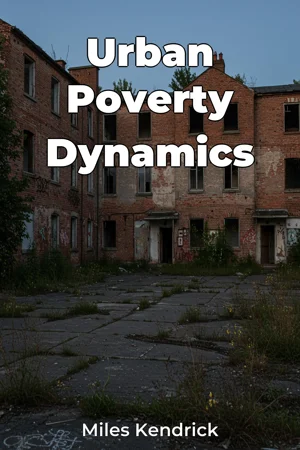
Why do stark disparities in opportunity persist amidst the concentrated wealth of urban centers? *Urban Poverty Dynamics* delves into the intricate web of factors that contribute to the concentration of poverty within urban environments, examining its profound relationship with rural-urban migration patterns and the resultant strains on economic and social structures. This book is vital because understanding these dynamics is crucial for crafting effective policies that promote equitable urban development and break cycles of disadvantage. At its core, this book addresses three principal themes: the evolving structure of economic opportunities in cities, the persistent challenges surrounding housing access and affordability for low-income populations, and the barriers that impede social mobility for residents mired in concentrated poverty. Each of these factors is inextricably linked, forming a complex system that either reinforces or alleviates urban poverty. Contextually, this analysis acknowledges the legacies of deindustrialization, discriminatory housing policies, and uneven economic growth that have shaped contemporary urban landscapes. Understanding these historical forces is essential for grappling with present-day challenges. The central argument of *Urban Poverty Dynamics* is that spatial concentration of poverty in urban areas is not a random phenomenon but rather a consequence of systemic inequalities and policy choices that disproportionately affect marginalized communities. Recognizing this requires moving beyond individual-level explanations of poverty and focusing on the structural forces that perpetuate it. The book is structured to provide a comprehensive examination of these issues. It begins by defining key concepts such as poverty concentration, social mobility, and urban inequality. Subsequent chapters explore the changing landscape of urban labor markets, focusing on the decline of manufacturing jobs and the rise of low-wage service sector employment. Other sections analyze the complexities of housing markets, including the role of zoning regulations, public housing policies, and gentrification in shaping residential segregation and limiting housing options for low-income families. The book includes a detailed examination of the social and economic barriers that hinder upward mobility, such as inadequate educational opportunities, limited access to healthcare, and discriminatory practices in hiring. The concluding chapters synthesize these findings to offer practical recommendations for policymakers and community stakeholders seeking to promote more inclusive and equitable urban development. The analysis relies on a mixed-methods approach, drawing on quantitative data from sources like the U.S. Census Bureau and the American Community Survey, as well as qualitative insights from in-depth interviews with residents, community leaders, and policy experts. Case studies of several major U.S. cities will illustrate the diverse manifestations of urban poverty and the varying effectiveness of different intervention strategies. *Urban Poverty Dynamics* connects with various fields of study, including sociology, urban planning, and public policy, providing a holistic perspective on urban poverty. This interdisciplinary approach enriches the analysis by considering the social, spatial, and political dimensions of poverty. A unique aspect of this book lies in its emphasis on the spatial dynamics of poverty, examining how neighborhood characteristics, access to transportation, and proximity to employment centers affect individual outcomes. It challenges conventional wisdom by highlighting the limitations of place-based strategies and advocating for a more comprehensive approach that addresses both individual and structural barriers to opportunity. The book maintains an academic yet accessible tone, presenting complex data and concepts in a clear and engaging manner. It is intended for a broad audience, including students, researchers, policymakers, urban planners, and community advocates interested in understanding and addressing urban poverty. Adhering to the conventions of social science and economics writing, evidence is presented transparently, ensuring the validity and replicability of findings. While the book focuses primarily on the United States, it also draws on international examples to provide a broader context for understanding urban poverty dynamics. However, it acknowledges the limitations of generalizing findings across different national contexts due to variations in economic structures, social welfare systems, and cultural norms. Ultimately, *Urban Poverty Dynamics* offers practical insights for policymakers and community stakeholders seeking to promote more inclusive and equitable urban development. It provides a framework for analyzing the root causes of urban poverty and designing effective interventions that address both individual and structural barriers to opportunity. Ongoing debates surrounding the role of government intervention in addressing poverty, the effectiveness of different anti-poverty programs, and the trade-offs between economic growth and social equity are directly addressed, offering a nuanced perspective on these complex issues.
Why do stark disparities in opportunity persist amidst the concentrated wealth of urban centers? *Urban Poverty Dynamics* delves into the intricate web of factors that contribute to the concentration of poverty within urban environments, examining its profound relationship with rural-urban migration patterns and the resultant strains on economic and social structures. This book is vital because understanding these dynamics is crucial for crafting effective policies that promote equitable urban development and break cycles of disadvantage. At its core, this book addresses three principal themes: the evolving structure of economic opportunities in cities, the persistent challenges surrounding housing access and affordability for low-income populations, and the barriers that impede social mobility for residents mired in concentrated poverty. Each of these factors is inextricably linked, forming a complex system that either reinforces or alleviates urban poverty. Contextually, this analysis acknowledges the legacies of deindustrialization, discriminatory housing policies, and uneven economic growth that have shaped contemporary urban landscapes. Understanding these historical forces is essential for grappling with present-day challenges. The central argument of *Urban Poverty Dynamics* is that spatial concentration of poverty in urban areas is not a random phenomenon but rather a consequence of systemic inequalities and policy choices that disproportionately affect marginalized communities. Recognizing this requires moving beyond individual-level explanations of poverty and focusing on the structural forces that perpetuate it. The book is structured to provide a comprehensive examination of these issues. It begins by defining key concepts such as poverty concentration, social mobility, and urban inequality. Subsequent chapters explore the changing landscape of urban labor markets, focusing on the decline of manufacturing jobs and the rise of low-wage service sector employment. Other sections analyze the complexities of housing markets, including the role of zoning regulations, public housing policies, and gentrification in shaping residential segregation and limiting housing options for low-income families. The book includes a detailed examination of the social and economic barriers that hinder upward mobility, such as inadequate educational opportunities, limited access to healthcare, and discriminatory practices in hiring. The concluding chapters synthesize these findings to offer practical recommendations for policymakers and community stakeholders seeking to promote more inclusive and equitable urban development. The analysis relies on a mixed-methods approach, drawing on quantitative data from sources like the U.S. Census Bureau and the American Community Survey, as well as qualitative insights from in-depth interviews with residents, community leaders, and policy experts. Case studies of several major U.S. cities will illustrate the diverse manifestations of urban poverty and the varying effectiveness of different intervention strategies. *Urban Poverty Dynamics* connects with various fields of study, including sociology, urban planning, and public policy, providing a holistic perspective on urban poverty. This interdisciplinary approach enriches the analysis by considering the social, spatial, and political dimensions of poverty. A unique aspect of this book lies in its emphasis on the spatial dynamics of poverty, examining how neighborhood characteristics, access to transportation, and proximity to employment centers affect individual outcomes. It challenges conventional wisdom by highlighting the limitations of place-based strategies and advocating for a more comprehensive approach that addresses both individual and structural barriers to opportunity. The book maintains an academic yet accessible tone, presenting complex data and concepts in a clear and engaging manner. It is intended for a broad audience, including students, researchers, policymakers, urban planners, and community advocates interested in understanding and addressing urban poverty. Adhering to the conventions of social science and economics writing, evidence is presented transparently, ensuring the validity and replicability of findings. While the book focuses primarily on the United States, it also draws on international examples to provide a broader context for understanding urban poverty dynamics. However, it acknowledges the limitations of generalizing findings across different national contexts due to variations in economic structures, social welfare systems, and cultural norms. Ultimately, *Urban Poverty Dynamics* offers practical insights for policymakers and community stakeholders seeking to promote more inclusive and equitable urban development. It provides a framework for analyzing the root causes of urban poverty and designing effective interventions that address both individual and structural barriers to opportunity. Ongoing debates surrounding the role of government intervention in addressing poverty, the effectiveness of different anti-poverty programs, and the trade-offs between economic growth and social equity are directly addressed, offering a nuanced perspective on these complex issues.
"Urban Poverty Dynamics" explores the complex web of factors driving concentrated poverty in urban areas, linking it to rural-urban migration and strains on social structures. The book examines economic opportunities, housing affordability, and social mobility, highlighting how deindustrialization and discriminatory housing policies have shaped urban landscapes. One key insight is that the spatial concentration of poverty isn't random but results from systemic inequalities. The book argues for moving beyond individual explanations of poverty to address the structural forces that perpetuate it. Analyzing data from sources like the U.S. Census Bureau alongside interviews with residents and policy experts, the book reveals how zoning regulations, public housing policies, and gentrification limit housing options for low-income families. It also emphasizes the limitations of place-based strategies. Structured to provide a comprehensive examination, the book begins by defining key concepts, explores urban labor markets, analyzes housing markets, and examines barriers to upward mobility. The concluding chapters offer recommendations for policymakers and stakeholders, providing a framework for analyzing root causes and designing effective interventions promoting inclusive urban development. The book directly addresses ongoing debates surrounding government intervention and the effectiveness of anti-poverty programs.
Book Details
ISBN
9788235294029
Publisher
Publifye AS
Your Licenses
You don't own any licenses for this book
Purchase a license below to unlock this book and download the EPUB.
Purchase License
Select a tier to unlock this book
Need bulk licensing?
Contact us for enterprise agreements.