
About This Book
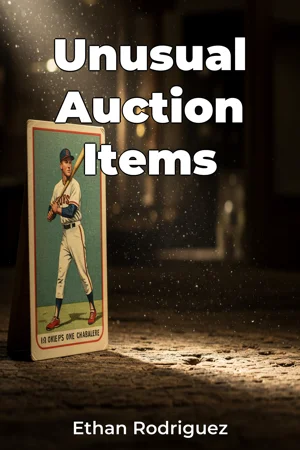
Have you ever wondered why a common object can sometimes fetch a price that defies all logic at auction? "Unusual Auction Items" explores the captivating world where history, finance, and human fascination collide, revealing the stories behind some of the most surprising and significant sales in auction history. This book delves into the specific circumstances that propel seemingly ordinary items to attain valuations far exceeding expectations. We'll examine historical oddities – artifacts steeped in unique provenance and capable of unlocking forgotten stories of the past. We will also investigate instances where the mundane transforms into the magnificent due to shifts in cultural perception, rarity, or unexpected demand. Why does a dress worn by a celebrity become worth more than a house? Or a first edition of a relatively unknown book command a king's ransom? Understanding these dynamics is critical for anyone interested in collecting, investing, or simply understanding the often-bizarre world of art and collectibles. The book provides a comprehensive look at the auction market, outlining the historical context in which this market developed. It traces how auction houses evolved from simple marketplaces to influential arbiters of value, shaping tastes and driving cultural trends. No specific prior knowledge is needed to understand the content, as all necessary background information will be provided. The central thesis posits that the value of auction items is not solely determined by intrinsic worth but is instead a complex interplay of historical significance, rarity, market forces, and emotional investment. The arguments will be supported by detailed case studies of specific auction lots, meticulous price analyses, and historical context. The book's structure unfolds logically. First, we introduce the fundamental principles of auction theory and the factors influencing valuation. The middle section offers a detailed exploration of key categories: historical artifacts (letters, documents, personal effects of historical figures), everyday objects transformed by unique circumstances (signed sports memorabilia, vintage toys, items associated with famous events), and artistic creations whose value appreciation defies traditional metrics. We will investigate major points of value for each. The concluding chapters synthesize these case studies, providing a framework for understanding how these factors combine to create exceptional prices. Finally, we will explore the practical applications for collectors and investors. The evidence presented is drawn from auction house catalogs, historical records, financial data, and expert interviews. This includes analysis of pricing data from major auction houses such as Sotheby's and Christie's, as well as smaller regional auctioneers. "Unusual Auction Items" connects to diverse fields such as economics (supply and demand, behavioral finance), history (social and cultural trends), and art history (provenance, artistic movements). By connecting these disciplines, the book offers a richer and more nuanced understanding of value creation. The book offers a fresh perspective by focusing not just on high-end art or antiques, but on the democratization of value, highlighting how even common items can become coveted treasures. The tone is informative and engaging, aiming for an accessible style suitable for a broad audience. The intended readership includes collectors, investors, history enthusiasts, and anyone curious about the hidden dynamics of the auction market. This book will be invaluable to anyone who wants to understand the stories behind these sales and gain insights into the factors driving value in the world of auctions. Consistent with the non-fiction genre, the book maintains accuracy and relies on verifiable sources. The scope is intentionally broad, covering a range of unusual auction items, but it does not delve into highly specialized areas such as fine art or precious gems, which are well-covered elsewhere. The knowledge contained within can be applied to real-world situations, such as assessing the potential value of personal collections, making informed investment decisions in collectibles, and understanding the cultural forces driving market trends. While the book examines the underlying factors that can lead to extreme valuations, the volatile nature of the market means that our findings do not constitute investment recommendations.
Have you ever wondered why a common object can sometimes fetch a price that defies all logic at auction? "Unusual Auction Items" explores the captivating world where history, finance, and human fascination collide, revealing the stories behind some of the most surprising and significant sales in auction history. This book delves into the specific circumstances that propel seemingly ordinary items to attain valuations far exceeding expectations. We'll examine historical oddities – artifacts steeped in unique provenance and capable of unlocking forgotten stories of the past. We will also investigate instances where the mundane transforms into the magnificent due to shifts in cultural perception, rarity, or unexpected demand. Why does a dress worn by a celebrity become worth more than a house? Or a first edition of a relatively unknown book command a king's ransom? Understanding these dynamics is critical for anyone interested in collecting, investing, or simply understanding the often-bizarre world of art and collectibles. The book provides a comprehensive look at the auction market, outlining the historical context in which this market developed. It traces how auction houses evolved from simple marketplaces to influential arbiters of value, shaping tastes and driving cultural trends. No specific prior knowledge is needed to understand the content, as all necessary background information will be provided. The central thesis posits that the value of auction items is not solely determined by intrinsic worth but is instead a complex interplay of historical significance, rarity, market forces, and emotional investment. The arguments will be supported by detailed case studies of specific auction lots, meticulous price analyses, and historical context. The book's structure unfolds logically. First, we introduce the fundamental principles of auction theory and the factors influencing valuation. The middle section offers a detailed exploration of key categories: historical artifacts (letters, documents, personal effects of historical figures), everyday objects transformed by unique circumstances (signed sports memorabilia, vintage toys, items associated with famous events), and artistic creations whose value appreciation defies traditional metrics. We will investigate major points of value for each. The concluding chapters synthesize these case studies, providing a framework for understanding how these factors combine to create exceptional prices. Finally, we will explore the practical applications for collectors and investors. The evidence presented is drawn from auction house catalogs, historical records, financial data, and expert interviews. This includes analysis of pricing data from major auction houses such as Sotheby's and Christie's, as well as smaller regional auctioneers. "Unusual Auction Items" connects to diverse fields such as economics (supply and demand, behavioral finance), history (social and cultural trends), and art history (provenance, artistic movements). By connecting these disciplines, the book offers a richer and more nuanced understanding of value creation. The book offers a fresh perspective by focusing not just on high-end art or antiques, but on the democratization of value, highlighting how even common items can become coveted treasures. The tone is informative and engaging, aiming for an accessible style suitable for a broad audience. The intended readership includes collectors, investors, history enthusiasts, and anyone curious about the hidden dynamics of the auction market. This book will be invaluable to anyone who wants to understand the stories behind these sales and gain insights into the factors driving value in the world of auctions. Consistent with the non-fiction genre, the book maintains accuracy and relies on verifiable sources. The scope is intentionally broad, covering a range of unusual auction items, but it does not delve into highly specialized areas such as fine art or precious gems, which are well-covered elsewhere. The knowledge contained within can be applied to real-world situations, such as assessing the potential value of personal collections, making informed investment decisions in collectibles, and understanding the cultural forces driving market trends. While the book examines the underlying factors that can lead to extreme valuations, the volatile nature of the market means that our findings do not constitute investment recommendations.
"Unusual Auction Items" explores the intriguing intersection of finance, history, and human fascination by examining sales where ordinary objects command extraordinary prices. Delving into the auction market, the book reveals how historical significance, rarity, and market forces combine to inflate the value of collectibles. For instance, a celebrity's dress or a rare book edition can fetch exorbitant sums, far surpassing their intrinsic worth. It examines the historical context that has allowed auction houses to become not just marketplaces, but influential arbiters of value, shaping tastes and driving cultural trends. The book progresses logically, beginning with the fundamental principles of auction theory and valuation. It then explores case studies of historical artifacts, everyday objects transformed by unique circumstances, and artistic creations, each demonstrating major points of value. The book emphasizes the democratization of value, as it is not just high-end art or antiques that are covered, but how common items can become coveted treasures. Finally, "Unusual Auction Items" synthesizes these case studies, providing a framework for understanding how historical significance, rarity, market forces, and emotional investment combine to create exceptional prices. This unique approach provides practical applications for collectors and investors, offering insights into assessing the potential value of collections and understanding the cultural trends driving the auction market.
Book Details
ISBN
9788235293879
Publisher
Publifye AS
Your Licenses
You don't own any licenses for this book
Purchase a license below to unlock this book and download the EPUB.
Purchase License
Select a tier to unlock this book
Need bulk licensing?
Contact us for enterprise agreements.