
About This Book
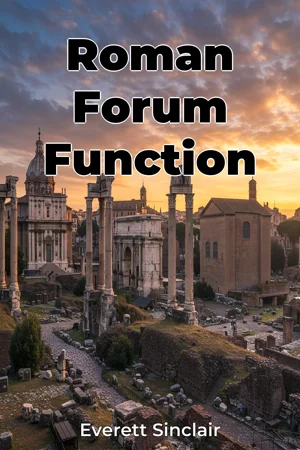
How did a muddy valley transform into the pulsating heart of an empire that shaped Western civilization? This book, "Roman Forum Function," explores the Roman Forum not merely as a collection of ruins, but as a dynamic nexus where architecture, economics, and law converged to forge Roman civic identity and revolutionize urban planning. We delve into the Forum's multifaceted functions, revealing its crucial role in the daily lives of Roman citizens and the broader trajectory of Roman society. This book addresses key questions: How did the architectural design of the Forum reflect and reinforce Roman values? What economic activities thrived within its boundaries, and how did these contribute to Rome's prosperity? In what ways did legal proceedings and public debates within the Forum shape Roman law and governance? These questions are vital because understanding the Forum is essential to comprehending the foundations of Roman civilization and its enduring legacy. To fully appreciate the Forum's significance, we examine the historical context of its development, from its humble beginnings as a marketplace to its transformation into a monumental center of power. Readers will gain insights into the evolution of Roman political structures, social hierarchies, and economic practices. Prior knowledge of basic Roman history will be beneficial, but the book will provide sufficient background to make the material accessible to a wide audience. The central argument of "Roman Forum Function" is that the Roman Forum was not just a physical space but a carefully constructed environment that actively shaped Roman civic identity by integrating architectural, economic, and legal functions into a cohesive whole. This integration fostered a shared sense of community, reinforced Roman values, and facilitated the administration of a vast empire. The book unfolds by first introducing the Forum's origins and its initial functions. It then progresses through three central sections: an in-depth analysis of the Forum's architecture, examining how its buildings served both practical and symbolic purposes; a detailed exploration of the economic activities that took place within the Forum, from commerce to banking; and an investigation into the legal and political functions of the Forum, including court proceedings, senatorial debates, and public assemblies. The book culminates by demonstrating how the Forum's integrated functions contributed to the creation of a distinct Roman civic identity and its influence on the development of urban planning principles that continue to resonate today. The evidence presented in this book draws from a wide range of sources, including archaeological excavations, inscriptions, literary accounts, and legal texts. It incorporates recent scholarship and offers fresh interpretations of existing data. "Roman Forum Function" interfaces with several disciplines, including classical archaeology, legal history, and urban studies. By examining the Forum from multiple perspectives, the book offers a more comprehensive understanding of its complexities. This book offers an innovative perspective by analyzing the Forum as an integrated system where architectural, economic, and legal functions reinforced each other. This holistic approach provides a more nuanced understanding of the Forum's role in shaping Roman society. The tone is academic yet accessible, aiming to engage both scholars and general readers interested in Roman history and culture. The writing style emphasizes clarity and precision, making complex concepts understandable to a broad audience. The target audience is scholars and students of Roman history, archaeology, and architecture, as well as general readers with an interest in ancient civilizations and urban planning. The book will appeal to those seeking a deeper understanding of the Roman Forum and its significance in shaping Western culture. As a work of non-fiction history and architecture, this book adheres to the conventions of rigorous scholarship, including detailed citations, thorough research, and objective analysis. The book's scope is limited to the Roman Forum itself, with a focus on its functions and their impact on Roman society. It does not delve into the broader history of Rome or the details of Roman politics, except where directly relevant to understanding the Forum. The information presented in this book can be applied to modern urban planning, historical preservation, and the study of civic identity. Understanding how the Romans created a functional and meaningful public space can inform contemporary efforts to design vibrant and inclusive cities. While the Forum's importance is widely recognized, there are ongoing debates about the precise nature of its functions and the relative importance of its various components. This book engages with these debates, offering new perspectives and interpretations.
How did a muddy valley transform into the pulsating heart of an empire that shaped Western civilization? This book, "Roman Forum Function," explores the Roman Forum not merely as a collection of ruins, but as a dynamic nexus where architecture, economics, and law converged to forge Roman civic identity and revolutionize urban planning. We delve into the Forum's multifaceted functions, revealing its crucial role in the daily lives of Roman citizens and the broader trajectory of Roman society. This book addresses key questions: How did the architectural design of the Forum reflect and reinforce Roman values? What economic activities thrived within its boundaries, and how did these contribute to Rome's prosperity? In what ways did legal proceedings and public debates within the Forum shape Roman law and governance? These questions are vital because understanding the Forum is essential to comprehending the foundations of Roman civilization and its enduring legacy. To fully appreciate the Forum's significance, we examine the historical context of its development, from its humble beginnings as a marketplace to its transformation into a monumental center of power. Readers will gain insights into the evolution of Roman political structures, social hierarchies, and economic practices. Prior knowledge of basic Roman history will be beneficial, but the book will provide sufficient background to make the material accessible to a wide audience. The central argument of "Roman Forum Function" is that the Roman Forum was not just a physical space but a carefully constructed environment that actively shaped Roman civic identity by integrating architectural, economic, and legal functions into a cohesive whole. This integration fostered a shared sense of community, reinforced Roman values, and facilitated the administration of a vast empire. The book unfolds by first introducing the Forum's origins and its initial functions. It then progresses through three central sections: an in-depth analysis of the Forum's architecture, examining how its buildings served both practical and symbolic purposes; a detailed exploration of the economic activities that took place within the Forum, from commerce to banking; and an investigation into the legal and political functions of the Forum, including court proceedings, senatorial debates, and public assemblies. The book culminates by demonstrating how the Forum's integrated functions contributed to the creation of a distinct Roman civic identity and its influence on the development of urban planning principles that continue to resonate today. The evidence presented in this book draws from a wide range of sources, including archaeological excavations, inscriptions, literary accounts, and legal texts. It incorporates recent scholarship and offers fresh interpretations of existing data. "Roman Forum Function" interfaces with several disciplines, including classical archaeology, legal history, and urban studies. By examining the Forum from multiple perspectives, the book offers a more comprehensive understanding of its complexities. This book offers an innovative perspective by analyzing the Forum as an integrated system where architectural, economic, and legal functions reinforced each other. This holistic approach provides a more nuanced understanding of the Forum's role in shaping Roman society. The tone is academic yet accessible, aiming to engage both scholars and general readers interested in Roman history and culture. The writing style emphasizes clarity and precision, making complex concepts understandable to a broad audience. The target audience is scholars and students of Roman history, archaeology, and architecture, as well as general readers with an interest in ancient civilizations and urban planning. The book will appeal to those seeking a deeper understanding of the Roman Forum and its significance in shaping Western culture. As a work of non-fiction history and architecture, this book adheres to the conventions of rigorous scholarship, including detailed citations, thorough research, and objective analysis. The book's scope is limited to the Roman Forum itself, with a focus on its functions and their impact on Roman society. It does not delve into the broader history of Rome or the details of Roman politics, except where directly relevant to understanding the Forum. The information presented in this book can be applied to modern urban planning, historical preservation, and the study of civic identity. Understanding how the Romans created a functional and meaningful public space can inform contemporary efforts to design vibrant and inclusive cities. While the Forum's importance is widely recognized, there are ongoing debates about the precise nature of its functions and the relative importance of its various components. This book engages with these debates, offering new perspectives and interpretations.
"Roman Forum Function" explores the heart of ancient Rome, revealing how a once-modest valley became the epicenter of an empire. This book examines the Forum not just as ruins, but as a dynamic hub where architecture, economics, and law shaped Roman civic identity and revolutionized urban planning. Intriguingly, the architectural design of the Forum reflected and reinforced Roman values, while its legal proceedings shaped Roman law and governance. The book delves into the Forum's evolution, from its origins as a marketplace to its role as a monumental center of power. It analyzes the Forum's architecture, economic activities, and legal functions, demonstrating how these elements integrated to create a distinct Roman civic identity. This approach offers a unique perspective on the Forum's role in shaping Roman society. The book progresses from the Forum's origins to its architectural significance, economic activities, and legal functions, culminating in an understanding of its impact on Roman civic identity. By integrating insights from archaeology, legal history, and urban studies, "Roman Forum Function" provides a comprehensive understanding of this vital space.
Book Details
ISBN
9788235293053
Publisher
Publifye AS
Your Licenses
You don't own any licenses for this book
Purchase a license below to unlock this book and download the EPUB.
Purchase License
Select a tier to unlock this book
Need bulk licensing?
Contact us for enterprise agreements.