
About This Book
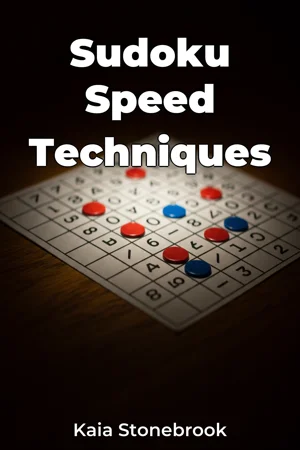
Can mastering Sudoku unlock a deeper understanding of logical problem-solving? "Sudoku Speed Techniques" delves into the advanced strategies and cognitive shortcuts employed by expert Sudoku solvers, revealing how seemingly simple grids demand sophisticated techniques. This book explores the core principles that separate casual players from those capable of completing even the most challenging puzzles with remarkable speed and accuracy. Central to mastering Sudoku is understanding advanced scanning techniques and pattern recognition. We will examine methodologies that go beyond basic pencil marking, including identifying hidden singles, locked candidates, and advanced subset strategies. The book demonstrates how to effectively utilize these techniques to reduce the search space and pinpoint the correct placement of numbers with greater efficiency. Another vital area explored is the application of logical shortcuts. Instead of brute-force trial and error, top solvers use techniques like forcing chains and Nishio's technique to deduce solutions based on inherent grid constraints. "Sudoku Speed Techniques" will explain the theoretical underpinnings of these shortcuts and provide practical examples for immediate application. Finally, the book analyzes the significance of strategic number placement. Focusing on numbers with limited placement options and understanding the impact of each digit on the overall grid are crucial skills. The book illustrates how to prioritize number selection based on the puzzle's current state, leading to more efficient and error-free solving. The book's central argument is that Sudoku is more than just a game; it is a powerful tool for enhancing logical reasoning and pattern recognition skills. By deconstructing the techniques of expert solvers, "Sudoku Speed Techniques" empowers readers to elevate their problem-solving capabilities not only in Sudoku but also in various domains. The structure of this book will begin by introducing fundamental Sudoku rules and basic solving techniques. From there, we'll progressively introduce advanced scanning methods, covering techniques like X-wings, Swordfish, and Jellyfish. A major point will be a detailed exploration of logical shortcuts, including forcing chains, Nishio, and various types of coloring. Another chapter focuses on strategic number placement, emphasizing the importance of candidate selection and grid analysis to identify fruitful avenues for solving. The book culminates in a synthesis of these techniques, offering strategies for tackling the most challenging Sudoku puzzles and demonstrating how to apply these skills to other problem-solving scenarios. The insights in this book are supported by analysis of thousands of Sudoku puzzles, identifying the most effective techniques for various difficulty levels. We draw data from published puzzles in newspapers, magazines, and online platforms, as well as puzzles designed specifically to test and showcase advanced solving techniques. The book also connects to fields like cognitive psychology, particularly concerning pattern recognition and working memory. Furthermore, mathematical set theory is a component in understanding candidate relationships and constraint satisfaction within the grid. An innovative aspect of "Sudoku Speed Techniques" is its structured approach to teaching advanced techniques, breaking them down into manageable steps and providing visual aids to enhance understanding and application. The target audience is Sudoku enthusiasts who seek to improve their solving speed and accuracy, as well as those interested in the logical and mathematical principles underlying the game. Readers valuing reference-based and general science genres will appreciate the structured, fact-based approach to the subject. While the book aims for comprehensive coverage, it focuses primarily on logical deduction techniques, excluding computer-based solving algorithms. In conclusion, "Sudoku Speed Techniques" offers a deep dive into the world of expert Sudoku, providing readers with the tools and knowledge to transform their solving skills. The information can be directly applied to improve puzzle completion times and to enhance logical thinking abilities applicable in multiple facets of life; there are no gimmicks or shortcuts, only the solid application of refined technique.
Can mastering Sudoku unlock a deeper understanding of logical problem-solving? "Sudoku Speed Techniques" delves into the advanced strategies and cognitive shortcuts employed by expert Sudoku solvers, revealing how seemingly simple grids demand sophisticated techniques. This book explores the core principles that separate casual players from those capable of completing even the most challenging puzzles with remarkable speed and accuracy. Central to mastering Sudoku is understanding advanced scanning techniques and pattern recognition. We will examine methodologies that go beyond basic pencil marking, including identifying hidden singles, locked candidates, and advanced subset strategies. The book demonstrates how to effectively utilize these techniques to reduce the search space and pinpoint the correct placement of numbers with greater efficiency. Another vital area explored is the application of logical shortcuts. Instead of brute-force trial and error, top solvers use techniques like forcing chains and Nishio's technique to deduce solutions based on inherent grid constraints. "Sudoku Speed Techniques" will explain the theoretical underpinnings of these shortcuts and provide practical examples for immediate application. Finally, the book analyzes the significance of strategic number placement. Focusing on numbers with limited placement options and understanding the impact of each digit on the overall grid are crucial skills. The book illustrates how to prioritize number selection based on the puzzle's current state, leading to more efficient and error-free solving. The book's central argument is that Sudoku is more than just a game; it is a powerful tool for enhancing logical reasoning and pattern recognition skills. By deconstructing the techniques of expert solvers, "Sudoku Speed Techniques" empowers readers to elevate their problem-solving capabilities not only in Sudoku but also in various domains. The structure of this book will begin by introducing fundamental Sudoku rules and basic solving techniques. From there, we'll progressively introduce advanced scanning methods, covering techniques like X-wings, Swordfish, and Jellyfish. A major point will be a detailed exploration of logical shortcuts, including forcing chains, Nishio, and various types of coloring. Another chapter focuses on strategic number placement, emphasizing the importance of candidate selection and grid analysis to identify fruitful avenues for solving. The book culminates in a synthesis of these techniques, offering strategies for tackling the most challenging Sudoku puzzles and demonstrating how to apply these skills to other problem-solving scenarios. The insights in this book are supported by analysis of thousands of Sudoku puzzles, identifying the most effective techniques for various difficulty levels. We draw data from published puzzles in newspapers, magazines, and online platforms, as well as puzzles designed specifically to test and showcase advanced solving techniques. The book also connects to fields like cognitive psychology, particularly concerning pattern recognition and working memory. Furthermore, mathematical set theory is a component in understanding candidate relationships and constraint satisfaction within the grid. An innovative aspect of "Sudoku Speed Techniques" is its structured approach to teaching advanced techniques, breaking them down into manageable steps and providing visual aids to enhance understanding and application. The target audience is Sudoku enthusiasts who seek to improve their solving speed and accuracy, as well as those interested in the logical and mathematical principles underlying the game. Readers valuing reference-based and general science genres will appreciate the structured, fact-based approach to the subject. While the book aims for comprehensive coverage, it focuses primarily on logical deduction techniques, excluding computer-based solving algorithms. In conclusion, "Sudoku Speed Techniques" offers a deep dive into the world of expert Sudoku, providing readers with the tools and knowledge to transform their solving skills. The information can be directly applied to improve puzzle completion times and to enhance logical thinking abilities applicable in multiple facets of life; there are no gimmicks or shortcuts, only the solid application of refined technique.
"Sudoku Speed Techniques" explores the advanced methods used by expert Sudoku solvers, revealing how logical reasoning and pattern recognition are key to mastering this popular puzzle. Did you know that advanced scanning techniques, like identifying hidden singles and locked candidates, can significantly reduce search time? The book emphasizes logical shortcuts such as forcing chains and the Nishio technique, moving beyond basic trial and error to deduce solutions. The book progresses from fundamental rules to advanced strategies, including X-wings, Swordfish, and Jellyfish, culminating in techniques for tackling the most challenging puzzles. It demonstrates how to prioritize number selection based on the puzzle's current state, leading to more efficient solving. By breaking down advanced techniques into manageable steps, this reference guide aims to help enthusiasts improve their problem-solving skills, showing that Sudoku is more than just a game; it's a tool for enhancing logical thinking.
Book Details
ISBN
9788235292810
Publisher
Publifye AS
Your Licenses
You don't own any licenses for this book
Purchase a license below to unlock this book and download the EPUB.
Purchase License
Select a tier to unlock this book
Need bulk licensing?
Contact us for enterprise agreements.