
About This Book
How did a small island nation exert control over a quarter of the world's population and landmass? "British Empire Zones" examines the intricate architecture of British colonial territories, dissecting the administrative styles and trade routes that underpinned its global dominance. This book is crucial because understanding the British Empire offers invaluable insight into contemporary geopolitics, global trade networks, and the enduring legacies of colonialism still reverberating across the world. Our exploration centers on three key topics. First, the structural organization of the empire, including the distinctions between crown colonies, protectorates, and dominions, will illuminate the diverse methods of governance employed. Second, the geographical spread and zoning of British territories, from the Caribbean sugar plantations to the Indian subcontinent and the African continent, will show regional variations in imperial policy and economic exploitation. Third, we will analyze the complex trade routes, including the trade in enslaved people, raw materials, and manufactured goods, that fueled the empire's expansion and shaped global economic systems. The central argument is that the British Empire was not a monolithic entity but a collection of distinct zones each governed by unique administrative practices and integrated into specific trade networks. Examining these regional variations provides a more nuanced understanding of the empire's impact. This book is structured to progressively build this argument. The introduction will establish the historical context and theoretical framework for analyzing the empire. Major points will be developed across three key sections: (1) Analyzing Administrative Structures, which examines the varying degrees of control exerted in different colonies; (2) Mapping Geographic Zones, which illustrates how the empire's economic and strategic priorities varied across regions; and (3) Tracing Trade Networks, which elucidates the flow of goods, capital, and labor that connected the empire and the world. The culmination of these analyses will reveal how the empire's legacy continues to influence global power dynamics and economic inequalities. The evidence presented will draw from a wide range of primary sources, including official government documents, colonial records, trade statistics, and personal accounts of both colonizers and colonized populations. We will also use quantitative data to map trade flows and analyze the economic impact of colonial policies. This book intersects with various fields, including economics (analyzing trade imbalances and resource extraction), political science (examining governance structures and international relations), and sociology (understanding the social and cultural impacts of colonialism). These interdisciplinary connections enrich the analysis and provide a holistic perspective. A unique aspect of this book is its emphasis on regional variations within the British Empire, moving beyond generalized accounts to provide a more granular analysis. It highlights the diverse experiences of people living under colonial rule. The tone is academic and analytical, yet accessible to a broad audience. The writing style is clear and concise, avoiding jargon and prioritizing evidence-based arguments. The target audience includes students and scholars of history, political science, and international relations, as well as anyone interested in understanding the historical roots of global inequalities. This book offers valuable insights for policymakers, economists, and anyone seeking a deeper understanding of the forces shaping the modern world. As a work of history, this book adheres to the genre's standards of rigorous research, accurate interpretation, and clear presentation of evidence. It acknowledges the complexities and controversies surrounding the British Empire, including debates over its ethical implications and long-term consequences. The scope of this book is limited to the structural organization, geographic spread, and trade routes of the British Empire, focusing primarily on the 18th to 20th centuries. It does not delve into detailed cultural histories of individual colonies, although it acknowledges the diversity of experiences within the empire. The information in this book can be applied to understand current global trade relationships, the legacies of colonialism in post-colonial societies, and the ongoing debates about reparations and social justice. "British Empire Zones" tackles the ongoing debate surrounding the empire's legacy, acknowledging the diverse perspectives. It aims to provide a balanced and nuanced account of a complex and controversial period in world history.
How did a small island nation exert control over a quarter of the world's population and landmass? "British Empire Zones" examines the intricate architecture of British colonial territories, dissecting the administrative styles and trade routes that underpinned its global dominance. This book is crucial because understanding the British Empire offers invaluable insight into contemporary geopolitics, global trade networks, and the enduring legacies of colonialism still reverberating across the world. Our exploration centers on three key topics. First, the structural organization of the empire, including the distinctions between crown colonies, protectorates, and dominions, will illuminate the diverse methods of governance employed. Second, the geographical spread and zoning of British territories, from the Caribbean sugar plantations to the Indian subcontinent and the African continent, will show regional variations in imperial policy and economic exploitation. Third, we will analyze the complex trade routes, including the trade in enslaved people, raw materials, and manufactured goods, that fueled the empire's expansion and shaped global economic systems. The central argument is that the British Empire was not a monolithic entity but a collection of distinct zones each governed by unique administrative practices and integrated into specific trade networks. Examining these regional variations provides a more nuanced understanding of the empire's impact. This book is structured to progressively build this argument. The introduction will establish the historical context and theoretical framework for analyzing the empire. Major points will be developed across three key sections: (1) Analyzing Administrative Structures, which examines the varying degrees of control exerted in different colonies; (2) Mapping Geographic Zones, which illustrates how the empire's economic and strategic priorities varied across regions; and (3) Tracing Trade Networks, which elucidates the flow of goods, capital, and labor that connected the empire and the world. The culmination of these analyses will reveal how the empire's legacy continues to influence global power dynamics and economic inequalities. The evidence presented will draw from a wide range of primary sources, including official government documents, colonial records, trade statistics, and personal accounts of both colonizers and colonized populations. We will also use quantitative data to map trade flows and analyze the economic impact of colonial policies. This book intersects with various fields, including economics (analyzing trade imbalances and resource extraction), political science (examining governance structures and international relations), and sociology (understanding the social and cultural impacts of colonialism). These interdisciplinary connections enrich the analysis and provide a holistic perspective. A unique aspect of this book is its emphasis on regional variations within the British Empire, moving beyond generalized accounts to provide a more granular analysis. It highlights the diverse experiences of people living under colonial rule. The tone is academic and analytical, yet accessible to a broad audience. The writing style is clear and concise, avoiding jargon and prioritizing evidence-based arguments. The target audience includes students and scholars of history, political science, and international relations, as well as anyone interested in understanding the historical roots of global inequalities. This book offers valuable insights for policymakers, economists, and anyone seeking a deeper understanding of the forces shaping the modern world. As a work of history, this book adheres to the genre's standards of rigorous research, accurate interpretation, and clear presentation of evidence. It acknowledges the complexities and controversies surrounding the British Empire, including debates over its ethical implications and long-term consequences. The scope of this book is limited to the structural organization, geographic spread, and trade routes of the British Empire, focusing primarily on the 18th to 20th centuries. It does not delve into detailed cultural histories of individual colonies, although it acknowledges the diversity of experiences within the empire. The information in this book can be applied to understand current global trade relationships, the legacies of colonialism in post-colonial societies, and the ongoing debates about reparations and social justice. "British Empire Zones" tackles the ongoing debate surrounding the empire's legacy, acknowledging the diverse perspectives. It aims to provide a balanced and nuanced account of a complex and controversial period in world history.
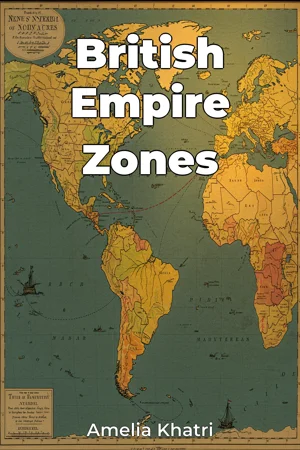
"British Empire Zones" explores how a relatively small nation controlled a vast global empire, examining the unique administrative and economic systems that enabled its dominance. The book reveals that the British Empire was not a uniform entity but rather a collection of distinct zones, each managed with specific colonial policies and integrated into global trade networks. Understanding this intricate structure provides critical insights into current geopolitical dynamics and the lasting impacts of colonialism. The book progresses methodically, starting with an overview of the empire's administrative structures, distinguishing between crown colonies, protectorates, and dominions. It then maps the geographic zones, illustrating regional variations in imperial policy and economic exploitation across areas from the Caribbean to India and Africa. Finally, it traces the complex trade routes that fueled the empire's expansion, including the trade in raw materials like cotton and sugar, demonstrating how these routes shaped global economic systems. This approach highlights the diverse experiences of people living under colonial rule and the enduring legacies of British colonialism.
Book Details
ISBN
9788235291165
Publisher
Publifye AS
Your Licenses
You don't own any licenses for this book
Purchase a license below to unlock this book and download the EPUB.
Purchase License
Select a tier to unlock this book
Need bulk licensing?
Contact us for enterprise agreements.