
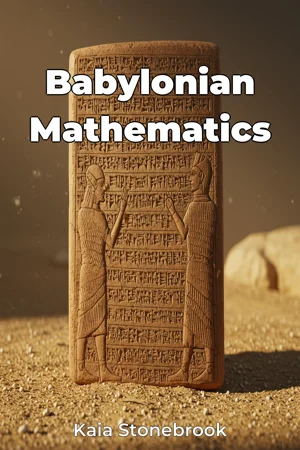
About This Book
How did a civilization over four thousand years ago develop mathematical tools so sophisticated that echoes of them resonate even today? "Babylonian Mathematics" delves into the remarkable mathematical achievements of ancient Babylonia, revealing the intricacies of their number system, algebra, and geometry, and demonstrating their lasting impact on modern mathematics and science. This book explores three key topics: the Babylonian base-60 number system, their algebraic techniques for solving equations, and their geometric understanding and calculations. These topics are important because they showcase the advanced mathematical thinking of the Babylonians, challenging common misconceptions that mathematical innovation originated solely with the Greeks. Understanding Babylonian mathematics provides a broader perspective on the history of mathematical thought and its diverse origins. We will reconstruct the historical and social context in which Babylonian mathematics flourished. This includes examining the role of scribes, the development of cuneiform writing, and the economic and administrative needs of Babylonian society that drove mathematical innovation. No prior advanced mathematical knowledge is required; we will build from fundamental concepts. Our central argument is that Babylonian mathematics represents a sophisticated and independent mathematical tradition that significantly influenced the development of mathematics in the ancient world and continues to influence us today. We will demonstrate this by analyzing primary source material: translated Babylonian clay tablets. This argument is important because it challenges Eurocentric views of mathematical history and highlights the contributions of a non-Western civilization to a fundamental area of human knowledge. The book is structured as follows: First, we introduce the cuneiform number system and its place value notation, showcasing how the Babylonians performed arithmetic operations. Second, we delve into Babylonian algebra, examining their methods for solving linear, quadratic, and cubic equations, often presented in the form of word problems. Third, we explore Babylonian geometry, analyzing their calculations of areas, volumes, and their understanding of the Pythagorean theorem (predating Pythagoras). Finally, we conclude by tracing the influence of Babylonian mathematics on subsequent cultures, particularly in areas such as astronomy and timekeeping. The evidence presented is drawn from translations of Babylonian clay tablets containing mathematical texts. These tablets, meticulously excavated and analyzed by historians of mathematics, provide direct insight into Babylonian mathematical practices. We will also utilize secondary sources, including scholarly articles and books, to contextualize and interpret the primary source material. Our methodology involves a close reading of these texts, combined with modern mathematical analysis, to reconstruct the Babylonian approach to problem-solving. This book connects to several other fields of study. It intersects with history by providing insights into the social and economic life of ancient Babylonia. Its connection to linguistics is evident in the analysis of cuneiform texts. It also has strong ties to computer science, particularly in the study of numerical representation and algorithms. These interdisciplinary connections enhance our understanding of Babylonian mathematics as a product of its environment and as a precursor to modern computational methods. A unique aspect of this book is its focus on the practical applications of Babylonian mathematics. By examining the word problems found on the clay tablets, we gain insight into how the Babylonians used mathematics to solve real-world problems related to agriculture, construction, and commerce. This approach provides a tangible and engaging way to understand the significance of their mathematical achievements. The tone of the book is both academic and accessible. While rigorously grounded in historical and mathematical scholarship, the presentation is designed to be clear and engaging for a general audience. "Babylonian Mathematics" is targeted towards readers interested in the history of mathematics, ancient history, and anyone curious about the origins of mathematical ideas. It would be valuable to students, educators, and anyone seeking a deeper understanding of the human story behind mathematical discovery. As a work of history and science, this book adheres to the conventions of providing verifiable evidence, clear explanations, and balanced interpretations of historical sources. The scope of the book is limited to the mathematical achievements of Babylonia, primarily focusing on the Old Babylonian period (c. 1800-1600 BCE), which represents the peak of Babylonian mathematical innovation. We will not extensively cover other aspects of Babylonian civilization. The enduring legacy of the Babylonian base-60 system is evident in our modern system of measuring time (60 seconds in a minute, 60 minutes in an hour) and angles (360 degrees in a circle). Understanding this connection provides a concrete example of the practical relevance of Babylonian mathematics to our daily lives. While there's no particular "controversy" surrounding Babylonian Mathematics, there are ongoing discussions among historians of mathematics concerning the extent of Babylonian influence upon later Greek mathematics, and the interpretation of certain mathematical texts. We will engage with these discussions, presenting different viewpoints and offering our own informed analysis.
How did a civilization over four thousand years ago develop mathematical tools so sophisticated that echoes of them resonate even today? "Babylonian Mathematics" delves into the remarkable mathematical achievements of ancient Babylonia, revealing the intricacies of their number system, algebra, and geometry, and demonstrating their lasting impact on modern mathematics and science. This book explores three key topics: the Babylonian base-60 number system, their algebraic techniques for solving equations, and their geometric understanding and calculations. These topics are important because they showcase the advanced mathematical thinking of the Babylonians, challenging common misconceptions that mathematical innovation originated solely with the Greeks. Understanding Babylonian mathematics provides a broader perspective on the history of mathematical thought and its diverse origins. We will reconstruct the historical and social context in which Babylonian mathematics flourished. This includes examining the role of scribes, the development of cuneiform writing, and the economic and administrative needs of Babylonian society that drove mathematical innovation. No prior advanced mathematical knowledge is required; we will build from fundamental concepts. Our central argument is that Babylonian mathematics represents a sophisticated and independent mathematical tradition that significantly influenced the development of mathematics in the ancient world and continues to influence us today. We will demonstrate this by analyzing primary source material: translated Babylonian clay tablets. This argument is important because it challenges Eurocentric views of mathematical history and highlights the contributions of a non-Western civilization to a fundamental area of human knowledge. The book is structured as follows: First, we introduce the cuneiform number system and its place value notation, showcasing how the Babylonians performed arithmetic operations. Second, we delve into Babylonian algebra, examining their methods for solving linear, quadratic, and cubic equations, often presented in the form of word problems. Third, we explore Babylonian geometry, analyzing their calculations of areas, volumes, and their understanding of the Pythagorean theorem (predating Pythagoras). Finally, we conclude by tracing the influence of Babylonian mathematics on subsequent cultures, particularly in areas such as astronomy and timekeeping. The evidence presented is drawn from translations of Babylonian clay tablets containing mathematical texts. These tablets, meticulously excavated and analyzed by historians of mathematics, provide direct insight into Babylonian mathematical practices. We will also utilize secondary sources, including scholarly articles and books, to contextualize and interpret the primary source material. Our methodology involves a close reading of these texts, combined with modern mathematical analysis, to reconstruct the Babylonian approach to problem-solving. This book connects to several other fields of study. It intersects with history by providing insights into the social and economic life of ancient Babylonia. Its connection to linguistics is evident in the analysis of cuneiform texts. It also has strong ties to computer science, particularly in the study of numerical representation and algorithms. These interdisciplinary connections enhance our understanding of Babylonian mathematics as a product of its environment and as a precursor to modern computational methods. A unique aspect of this book is its focus on the practical applications of Babylonian mathematics. By examining the word problems found on the clay tablets, we gain insight into how the Babylonians used mathematics to solve real-world problems related to agriculture, construction, and commerce. This approach provides a tangible and engaging way to understand the significance of their mathematical achievements. The tone of the book is both academic and accessible. While rigorously grounded in historical and mathematical scholarship, the presentation is designed to be clear and engaging for a general audience. "Babylonian Mathematics" is targeted towards readers interested in the history of mathematics, ancient history, and anyone curious about the origins of mathematical ideas. It would be valuable to students, educators, and anyone seeking a deeper understanding of the human story behind mathematical discovery. As a work of history and science, this book adheres to the conventions of providing verifiable evidence, clear explanations, and balanced interpretations of historical sources. The scope of the book is limited to the mathematical achievements of Babylonia, primarily focusing on the Old Babylonian period (c. 1800-1600 BCE), which represents the peak of Babylonian mathematical innovation. We will not extensively cover other aspects of Babylonian civilization. The enduring legacy of the Babylonian base-60 system is evident in our modern system of measuring time (60 seconds in a minute, 60 minutes in an hour) and angles (360 degrees in a circle). Understanding this connection provides a concrete example of the practical relevance of Babylonian mathematics to our daily lives. While there's no particular "controversy" surrounding Babylonian Mathematics, there are ongoing discussions among historians of mathematics concerning the extent of Babylonian influence upon later Greek mathematics, and the interpretation of certain mathematical texts. We will engage with these discussions, presenting different viewpoints and offering our own informed analysis.
"Babylonian Mathematics" explores the sophisticated mathematical system developed in ancient Babylonia, highlighting its lasting influence on modern science and mathematics. The book delves into their innovative base-60 number system, which remarkably survives today in our measurement of time and angles, and their advanced algebraic techniques. Discover how the Babylonians solved complex equations and understood geometric principles, including a version of the Pythagorean Theorem predating Pythagoras himself. The book carefully reconstructs the historical context of Babylonian mathematical innovation, examining cuneiform texts and the role of scribes in developing mathematical tools for administration and commerce. By analyzing translated clay tablets, the author reveals the practical applications of their mathematics, offering a unique perspective on how they tackled real-world problems. Each chapter progresses from the number system to algebra, geometry, and finally, the lasting legacy of Babylonian contributions.
Book Details
ISBN
9788235290991
Publisher
Publifye AS
Your Licenses
You don't own any licenses for this book
Purchase a license below to unlock this book and download the EPUB.
Purchase License
Select a tier to unlock this book
Need bulk licensing?
Contact us for enterprise agreements.