
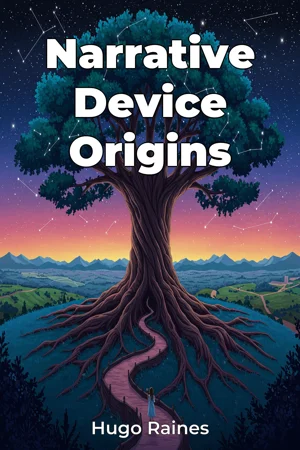
About This Book
How did humanity begin telling stories, and why do specific narrative patterns resonate across drastically different cultures? "Narrative Device Origins" examines the foundational structures underlying global storytelling traditions, tracing the historical emergence and cultural evolution of key narrative devices. This book delves into the origins and adaptations of such elements as archetypal characters, plot structures, and thematic motifs. Understanding these narrative underpinnings is crucial for literary scholars, writers, and anyone seeking a deeper appreciation of the power and universality of stories. We begin by exploring the earliest manifestations of narrative structures in oral traditions and ancient texts from diverse regions. This exploration provides crucial context, revealing how early societies used stories to transmit knowledge, values, and cultural identity. Further, we will trace the development of common narrative frameworks such as the hero's journey, the quest narrative, and the cyclical nature of stories, examining their presence and transformations across geographically and culturally disparate literary traditions. The central argument of "Narrative Device Origins" is that despite surface-level differences in setting, character names, and cultural details, fundamental narrative structures demonstrate a common origin point, or independent invention driven by universal human experiences. We posit that the enduring appeal of certain stories stems from their ability to tap into deeply ingrained psychological and societal patterns. The book is structured in three major parts. First, we introduce core narrative theories and analytical tools, setting the stage for a detailed examination of specific devices. Second, using case studies spanning ancient Mesopotamia, classical Greece, dynastic China and pre-Columbian America, we analyze the historical development and cultural adaptation of chosen narrative devices. Finally, we synthesize our findings, discussing the implications of these widespread narrative patterns for understanding human cognition, cultural transmission, and the ongoing evolution of storytelling. The evidence presented is drawn from a broad range of primary sources, including ancient epics, folk tales, religious texts, and early literary works. We employ comparative analysis, historical linguistics, and cultural anthropology to trace the development and transmission of narrative devices. Further, we consider interdisciplinary connections to fields such as psychology, sociology, and mythology to enhance our understanding of the underlying mechanisms that drive narrative invention and adaptation. "Narrative Device Origins" offers a unique perspective by integrating historical analysis with contemporary narrative theory. It stands apart from traditional literary studies by emphasizing the cross-cultural parallels and universal elements of storytelling, rather than focusing on specific national literatures in isolation. Written in an accessible yet scholarly style, this book is intended for students and scholars of literature, folklore, mythology, and cultural studies. It will also appeal to writers and storytellers seeking to understand the fundamental building blocks of compelling narratives. The scope of this book is intentionally broad, encompassing a global range of literary traditions. However, due to limitations of space and expertise, we focus on selected case studies to illustrate our central arguments. The book provides practical applications of the insights presented for writers seeking inspiration from the foundational elements of story, or those in fields such as marketing and public relations who seek to better understand framing narratives. While the universality of some narrative structures might spark debate about cultural appropriation, the book presents a respectful and nuanced approach, focusing on shared human experiences rather than promoting cultural homogenization.
How did humanity begin telling stories, and why do specific narrative patterns resonate across drastically different cultures? "Narrative Device Origins" examines the foundational structures underlying global storytelling traditions, tracing the historical emergence and cultural evolution of key narrative devices. This book delves into the origins and adaptations of such elements as archetypal characters, plot structures, and thematic motifs. Understanding these narrative underpinnings is crucial for literary scholars, writers, and anyone seeking a deeper appreciation of the power and universality of stories. We begin by exploring the earliest manifestations of narrative structures in oral traditions and ancient texts from diverse regions. This exploration provides crucial context, revealing how early societies used stories to transmit knowledge, values, and cultural identity. Further, we will trace the development of common narrative frameworks such as the hero's journey, the quest narrative, and the cyclical nature of stories, examining their presence and transformations across geographically and culturally disparate literary traditions. The central argument of "Narrative Device Origins" is that despite surface-level differences in setting, character names, and cultural details, fundamental narrative structures demonstrate a common origin point, or independent invention driven by universal human experiences. We posit that the enduring appeal of certain stories stems from their ability to tap into deeply ingrained psychological and societal patterns. The book is structured in three major parts. First, we introduce core narrative theories and analytical tools, setting the stage for a detailed examination of specific devices. Second, using case studies spanning ancient Mesopotamia, classical Greece, dynastic China and pre-Columbian America, we analyze the historical development and cultural adaptation of chosen narrative devices. Finally, we synthesize our findings, discussing the implications of these widespread narrative patterns for understanding human cognition, cultural transmission, and the ongoing evolution of storytelling. The evidence presented is drawn from a broad range of primary sources, including ancient epics, folk tales, religious texts, and early literary works. We employ comparative analysis, historical linguistics, and cultural anthropology to trace the development and transmission of narrative devices. Further, we consider interdisciplinary connections to fields such as psychology, sociology, and mythology to enhance our understanding of the underlying mechanisms that drive narrative invention and adaptation. "Narrative Device Origins" offers a unique perspective by integrating historical analysis with contemporary narrative theory. It stands apart from traditional literary studies by emphasizing the cross-cultural parallels and universal elements of storytelling, rather than focusing on specific national literatures in isolation. Written in an accessible yet scholarly style, this book is intended for students and scholars of literature, folklore, mythology, and cultural studies. It will also appeal to writers and storytellers seeking to understand the fundamental building blocks of compelling narratives. The scope of this book is intentionally broad, encompassing a global range of literary traditions. However, due to limitations of space and expertise, we focus on selected case studies to illustrate our central arguments. The book provides practical applications of the insights presented for writers seeking inspiration from the foundational elements of story, or those in fields such as marketing and public relations who seek to better understand framing narratives. While the universality of some narrative structures might spark debate about cultural appropriation, the book presents a respectful and nuanced approach, focusing on shared human experiences rather than promoting cultural homogenization.
"Narrative Device Origins" explores the fundamental structures of storytelling across cultures, examining how narrative devices like archetypal characters and plot structures have evolved. It investigates the origins and adaptations of these elements, revealing how stories transmit knowledge and values. The book argues that despite cultural differences, common narrative patterns suggest shared origins or independent inventions rooted in universal human experiences. The book traces the hero's journey and quest narratives through different literary traditions, highlighting their enduring appeal. Consider, for example, how similar character archetypes appear in ancient Greek myths and indigenous folklore. By integrating historical analysis with narrative theory, "Narrative Device Origins" uncovers cross-cultural parallels in storytelling. The book progresses by first introducing narrative theories, then analyzing case studies from ancient Mesopotamia to pre-Columbian America, and finally synthesizing findings on human cognition and storytelling's evolution. This approach illuminates the cultural evolution of thematic motifs and narrative structures, offering insights for literary scholars, writers, and anyone interested in the power of storytelling.
Book Details
ISBN
9788235287229
Publisher
Publifye AS
Your Licenses
You don't own any licenses for this book
Purchase a license below to unlock this book and download the EPUB.
Purchase License
Select a tier to unlock this book
Need bulk licensing?
Contact us for enterprise agreements.