
About This Book
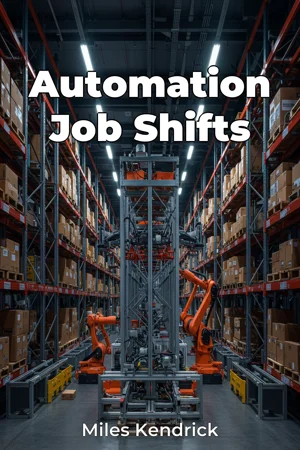
Will robots steal your job? *Automation Job Shifts* dives deep into how automation and robotics are reshaping labor markets, presenting a balanced analysis of the economic and technological forces at play. This book addresses the urgent need to understand the shifting landscape of work, particularly in manufacturing, logistics, and customer service – sectors experiencing rapid technological advancements. The central argument of *Automation Job Shifts* is that while automation inevitably displaces certain jobs, it simultaneously creates new opportunities, demanding a proactive approach to workforce adaptation and education. We must understand both the disruptive and creative aspects of automation to prepare for the future of work. The book aims to clarify the complex relationship between technology and employment, providing readers with the tools to navigate this evolving environment. This book begins by providing a historical context of automation, tracing its evolution from early industrial machinery to modern AI-driven systems. It explores the economic principles that govern labor demand and technological change, offering a foundation for understanding the subsequent analysis. This includes a review of relevant economic theories such as the skills-biased technological change and the task-based approach to labor markets. The core of *Automation Job Shifts* is structured around three key areas. First, it examines the impact of automation on manufacturing, detailing how robotic systems are transforming production processes and altering the skill requirements for workers. Second, it analyzes the logistics sector, focusing on the rise of automated warehouses, delivery drones, and self-driving vehicles. Third, it investigates the customer service industry, assessing the role of chatbots, AI assistants, and automated call centers. Each section provides concrete examples, case studies, and statistical data to illustrate the observed trends and future projections. The evidence presented in *Automation Job Shifts* draws from a wide range of sources, including academic research, industry reports, government statistics, and proprietary data on automation adoption rates. It also incorporates insights from interviews with industry experts, policymakers, and workers directly affected by these technological shifts. The research methodology combines quantitative analysis with qualitative assessments to provide a multifaceted perspective. This book also connects to several interdisciplinary fields. The discussion of technological advancements links to engineering and computer science; the analysis of labor market impacts connects to sociology and political science through discussions of inequality and policy responses; and the exploration of customer service automation intersects with psychology and marketing regarding consumer behavior and satisfaction. *Automation Job Shifts* distinguishes itself by offering a pragmatic, data-driven analysis of the challenges and opportunities presented by automation. It avoids both utopian and dystopian narratives, instead focusing on providing actionable insights for policymakers, business leaders, educators, and workers. The approach is analytical and objective, presenting a range of perspectives and acknowledging the complexities of the issue. Written in an accessible style that avoids excessive jargon, *Automation Job Shifts* is intended for a broad audience, including students, researchers, business professionals, and anyone interested in understanding the future of work. It offers valuable insights for those seeking to make informed decisions about education, career planning, and public policy. The scope of *Automation Job Shifts* encompasses the major trends and debates surrounding automation and its impact on employment. However, it intentionally limits its focus to the three aforementioned sectors—manufacturing, logistics, and customer service—to allow for a more in-depth analysis. While the book acknowledges the broader implications of automation across the economy, it prioritizes a detailed examination of these critical industries. The information presented in *Automation Job Shifts* has numerous real-world applications. Policymakers can use the book's findings to develop effective workforce development programs and address potential job displacement. Business leaders can leverage the insights to make strategic decisions about technology investments and workforce planning. Educators can utilize the content to prepare students for the changing demands of the labor market. One of the ongoing debates addressed in *Automation Job Shifts* is the extent to which automation will lead to widespread job losses versus job creation. The book explores different viewpoints on this issue, presenting evidence and arguments from various sources. It also examines the role of government policy in mitigating the negative impacts of automation and promoting inclusive growth.
Will robots steal your job? *Automation Job Shifts* dives deep into how automation and robotics are reshaping labor markets, presenting a balanced analysis of the economic and technological forces at play. This book addresses the urgent need to understand the shifting landscape of work, particularly in manufacturing, logistics, and customer service – sectors experiencing rapid technological advancements. The central argument of *Automation Job Shifts* is that while automation inevitably displaces certain jobs, it simultaneously creates new opportunities, demanding a proactive approach to workforce adaptation and education. We must understand both the disruptive and creative aspects of automation to prepare for the future of work. The book aims to clarify the complex relationship between technology and employment, providing readers with the tools to navigate this evolving environment. This book begins by providing a historical context of automation, tracing its evolution from early industrial machinery to modern AI-driven systems. It explores the economic principles that govern labor demand and technological change, offering a foundation for understanding the subsequent analysis. This includes a review of relevant economic theories such as the skills-biased technological change and the task-based approach to labor markets. The core of *Automation Job Shifts* is structured around three key areas. First, it examines the impact of automation on manufacturing, detailing how robotic systems are transforming production processes and altering the skill requirements for workers. Second, it analyzes the logistics sector, focusing on the rise of automated warehouses, delivery drones, and self-driving vehicles. Third, it investigates the customer service industry, assessing the role of chatbots, AI assistants, and automated call centers. Each section provides concrete examples, case studies, and statistical data to illustrate the observed trends and future projections. The evidence presented in *Automation Job Shifts* draws from a wide range of sources, including academic research, industry reports, government statistics, and proprietary data on automation adoption rates. It also incorporates insights from interviews with industry experts, policymakers, and workers directly affected by these technological shifts. The research methodology combines quantitative analysis with qualitative assessments to provide a multifaceted perspective. This book also connects to several interdisciplinary fields. The discussion of technological advancements links to engineering and computer science; the analysis of labor market impacts connects to sociology and political science through discussions of inequality and policy responses; and the exploration of customer service automation intersects with psychology and marketing regarding consumer behavior and satisfaction. *Automation Job Shifts* distinguishes itself by offering a pragmatic, data-driven analysis of the challenges and opportunities presented by automation. It avoids both utopian and dystopian narratives, instead focusing on providing actionable insights for policymakers, business leaders, educators, and workers. The approach is analytical and objective, presenting a range of perspectives and acknowledging the complexities of the issue. Written in an accessible style that avoids excessive jargon, *Automation Job Shifts* is intended for a broad audience, including students, researchers, business professionals, and anyone interested in understanding the future of work. It offers valuable insights for those seeking to make informed decisions about education, career planning, and public policy. The scope of *Automation Job Shifts* encompasses the major trends and debates surrounding automation and its impact on employment. However, it intentionally limits its focus to the three aforementioned sectors—manufacturing, logistics, and customer service—to allow for a more in-depth analysis. While the book acknowledges the broader implications of automation across the economy, it prioritizes a detailed examination of these critical industries. The information presented in *Automation Job Shifts* has numerous real-world applications. Policymakers can use the book's findings to develop effective workforce development programs and address potential job displacement. Business leaders can leverage the insights to make strategic decisions about technology investments and workforce planning. Educators can utilize the content to prepare students for the changing demands of the labor market. One of the ongoing debates addressed in *Automation Job Shifts* is the extent to which automation will lead to widespread job losses versus job creation. The book explores different viewpoints on this issue, presenting evidence and arguments from various sources. It also examines the role of government policy in mitigating the negative impacts of automation and promoting inclusive growth.
"Automation Job Shifts" offers a balanced exploration of how automation and robotics are transforming labor markets across sectors like manufacturing, logistics, and customer service. While automation can displace jobs, the book argues it simultaneously creates new opportunities, emphasizing the need for workforce adaptation. Notably, the book provides evidence suggesting that the integration of robotic systems in manufacturing is altering skill requirements for workers. The book progresses by first establishing a historical context of automation, then delving into the economic principles that govern labor demand and technological change. Analyzing specific industries, the book uses case studies and statistical data. For instance, the rise of automated warehouses and delivery drones in logistics is examined in detail. By focusing on these sectors, "Automation Job Shifts" delivers actionable insights for policymakers, business leaders, and educators navigating the future of work.
Book Details
ISBN
9788235279170
Publisher
Publifye AS
Your Licenses
You don't own any licenses for this book
Purchase a license below to unlock this book and download the EPUB.
Purchase License
Select a tier to unlock this book
Need bulk licensing?
Contact us for enterprise agreements.