
About This Book
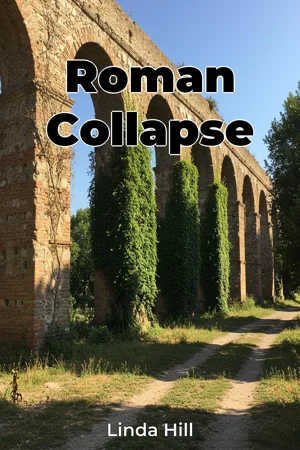
What really brought down the Roman Empire? Was it a sudden collapse or a slow, agonizing decline? This book, *Roman Collapse*, delves into the multifaceted reasons behind the fall of one of history's greatest empires, challenging conventional narratives and offering a nuanced understanding of this pivotal moment in world history. Our primary focus is on three interconnected elements: the economic struggles that plagued the later Roman Empire, the persistent barbarian invasions that stretched its resources to the breaking point, and the long-term consequences of these events on the subsequent development of European society and culture. Understanding these topics is crucial to grasping not just the history of Rome, but also the foundations of modern Europe. We examine how economic instability made the empire vulnerable, how migration and military pressure reshaped its borders, and how its collapse ultimately led to the fragmented political landscape of the medieval period. We begin by providing necessary background on the Roman Empire at its height, examining its political structures, social hierarchies, and economic systems. This context is necessary for understanding the strains that developed later. The book's central argument is that the fall of Rome was not a singular event caused by one factor, but rather a complex process resulting from the interplay of long-term systemic weaknesses and external pressures that gradually eroded the empire's foundations. The book is structured in four parts. First, we introduce the main concepts, outlining the traditional theories of Roman decline and identifying their shortcomings. Second, we explore the internal weaknesses that contributed to the empire's vulnerability, dedicating chapters to economic decline (including inflation, trade disruptions, and agricultural crises), and political instability (examining corruption, civil wars, and weak leadership). Third, we analyze the external pressures exerted by barbarian migrations and invasions, focusing on the military challenges faced by the Roman army and the impact of these migrations on Roman society. Finally, we assess the long-term consequences of the Roman collapse for the subsequent development of Europe, looking at the rise of new kingdoms, the transformation of social structures, and the legacy of Roman institutions and culture. Our analysis relies on a range of historical sources, including archaeological evidence, surviving legal codes, contemporary accounts from Roman and barbarian writers, and economic data that sheds light on the empire's financial situation. We also engage with modern scholarship on the topic, drawing on the work of historians, archaeologists, and economists to provide a comprehensive and up-to-date account. This book connects to several other fields, including economics (by examining the causes and consequences of economic decline), sociology (by exploring the social and cultural transformations that accompanied the empire's collapse), and political science (by analyzing the factors that contribute to state failure). These interdisciplinary connections enrich our understanding of the Roman collapse and its broader implications. *Roman Collapse* offers a unique perspective by emphasizing the interconnectedness of the different factors that contributed to the empire's demise. Rather than focusing on a single cause, we present a holistic picture that takes into account economic, political, social, and military factors. The writing style is academic yet accessible, aiming to engage both scholars and general readers with an interest in Roman history. The target audience includes students of history, enthusiasts of Roman history, and anyone interested in the rise and fall of civilizations. This book would be valuable to them by providing a comprehensive and nuanced understanding of the Roman collapse, challenging simplistic explanations, and offering insights into the complex dynamics that can lead to the decline of even the most powerful empires. This work adheres to the conventions of the 'History World', 'History', and 'World History' genres by providing a fact-based, scholarly account of historical events, drawing on primary and secondary sources, and engaging with existing scholarship on the topic. The scope of the book is limited to the Western Roman Empire, with only necessary references to the Eastern Roman Empire (Byzantium). The lessons of the Roman collapse have real-world applications for understanding contemporary challenges, such as economic instability, political polarization, and migration crises. By studying the past, we can gain insights into the present and better prepare for the future. We address ongoing debates about the relative importance of different factors in the Roman collapse, weighing the evidence for each and offering our own interpretation based on the available data.
What really brought down the Roman Empire? Was it a sudden collapse or a slow, agonizing decline? This book, *Roman Collapse*, delves into the multifaceted reasons behind the fall of one of history's greatest empires, challenging conventional narratives and offering a nuanced understanding of this pivotal moment in world history. Our primary focus is on three interconnected elements: the economic struggles that plagued the later Roman Empire, the persistent barbarian invasions that stretched its resources to the breaking point, and the long-term consequences of these events on the subsequent development of European society and culture. Understanding these topics is crucial to grasping not just the history of Rome, but also the foundations of modern Europe. We examine how economic instability made the empire vulnerable, how migration and military pressure reshaped its borders, and how its collapse ultimately led to the fragmented political landscape of the medieval period. We begin by providing necessary background on the Roman Empire at its height, examining its political structures, social hierarchies, and economic systems. This context is necessary for understanding the strains that developed later. The book's central argument is that the fall of Rome was not a singular event caused by one factor, but rather a complex process resulting from the interplay of long-term systemic weaknesses and external pressures that gradually eroded the empire's foundations. The book is structured in four parts. First, we introduce the main concepts, outlining the traditional theories of Roman decline and identifying their shortcomings. Second, we explore the internal weaknesses that contributed to the empire's vulnerability, dedicating chapters to economic decline (including inflation, trade disruptions, and agricultural crises), and political instability (examining corruption, civil wars, and weak leadership). Third, we analyze the external pressures exerted by barbarian migrations and invasions, focusing on the military challenges faced by the Roman army and the impact of these migrations on Roman society. Finally, we assess the long-term consequences of the Roman collapse for the subsequent development of Europe, looking at the rise of new kingdoms, the transformation of social structures, and the legacy of Roman institutions and culture. Our analysis relies on a range of historical sources, including archaeological evidence, surviving legal codes, contemporary accounts from Roman and barbarian writers, and economic data that sheds light on the empire's financial situation. We also engage with modern scholarship on the topic, drawing on the work of historians, archaeologists, and economists to provide a comprehensive and up-to-date account. This book connects to several other fields, including economics (by examining the causes and consequences of economic decline), sociology (by exploring the social and cultural transformations that accompanied the empire's collapse), and political science (by analyzing the factors that contribute to state failure). These interdisciplinary connections enrich our understanding of the Roman collapse and its broader implications. *Roman Collapse* offers a unique perspective by emphasizing the interconnectedness of the different factors that contributed to the empire's demise. Rather than focusing on a single cause, we present a holistic picture that takes into account economic, political, social, and military factors. The writing style is academic yet accessible, aiming to engage both scholars and general readers with an interest in Roman history. The target audience includes students of history, enthusiasts of Roman history, and anyone interested in the rise and fall of civilizations. This book would be valuable to them by providing a comprehensive and nuanced understanding of the Roman collapse, challenging simplistic explanations, and offering insights into the complex dynamics that can lead to the decline of even the most powerful empires. This work adheres to the conventions of the 'History World', 'History', and 'World History' genres by providing a fact-based, scholarly account of historical events, drawing on primary and secondary sources, and engaging with existing scholarship on the topic. The scope of the book is limited to the Western Roman Empire, with only necessary references to the Eastern Roman Empire (Byzantium). The lessons of the Roman collapse have real-world applications for understanding contemporary challenges, such as economic instability, political polarization, and migration crises. By studying the past, we can gain insights into the present and better prepare for the future. We address ongoing debates about the relative importance of different factors in the Roman collapse, weighing the evidence for each and offering our own interpretation based on the available data.
*Roman Collapse* explores the complex reasons behind the fall of the Roman Empire, moving beyond simple explanations to offer a nuanced view of this pivotal moment in World History. The book emphasizes the interconnectedness of economic struggles, barbarian invasions, and political instability as key factors in the Roman decline. For example, the empire's reliance on slave labor created vulnerabilities in its agricultural system, while constant migration strained resources and military capabilities. This book challenges traditional narratives by presenting a holistic picture of how these elements gradually eroded the empire's foundations, moving beyond the idea of a single cause. The book begins with a background on the Roman Empire at its height before delving into the internal weaknesses and external pressures that led to its demise. Examining economic decline, political turmoil, and barbarian migrations, the book uses archaeological evidence, legal codes, and contemporary accounts to provide a comprehensive analysis. The book concludes by assessing the long-term consequences of the Roman collapse on the development of Europe, highlighting the rise of new kingdoms and the transformation of social structures. By understanding the interplay of these forces, readers gain valuable insights into the dynamics that can cause even the most powerful empires to crumble.
Book Details
ISBN
9788235279019
Publisher
Publifye AS
Your Licenses
You don't own any licenses for this book
Purchase a license below to unlock this book and download the EPUB.
Purchase License
Select a tier to unlock this book
Need bulk licensing?
Contact us for enterprise agreements.