
About This Book
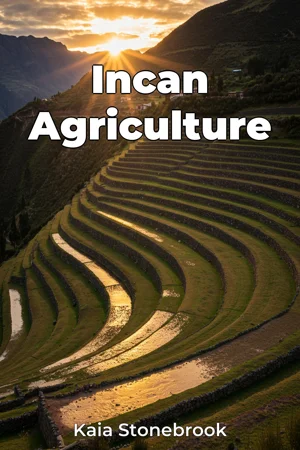
Could the agricultural practices of a civilization that thrived centuries ago hold the key to addressing modern food security challenges? In *Incan Agriculture*, we delve into the sophisticated and sustainable farming techniques developed by the Inca Empire, exploring how their ingenuity enabled them to feed a vast population in the challenging Andean environment. This book will illuminate the core principles of Incan agriculture and their enduring relevance for contemporary agricultural practices. This book focuses on three key themes: terracing, irrigation, and crop selection. Terracing, the creation of step-like platforms on steep slopes, maximized arable land and minimized soil erosion. Irrigation systems, engineered with a deep understanding of hydrology, efficiently distributed water across vast distances and varied terrains. Crucially, the Incas were adept at genetically selecting crops, prioritizing those best suited for survival and productivity at high altitudes. Understanding these cornerstones is essential to appreciate the full scope of their agricultural accomplishments and to highlight their potential adaptability to modern farming systems. To truly appreciate Incan agricultural achievements, it is important to understand the historical and environmental context in which they developed. The Inca Empire, flourishing between the 13th and 16th centuries, spanned a diverse range of ecosystems, from arid coastal deserts to high-altitude mountains and humid rainforests. Their agricultural success was not merely about applying simple techniques but about adapting and innovating within these varying conditions. No prior specialist knowledge is needed; we will be presenting information in an accessible manner. The core argument presented in *Incan Agriculture* is that the Incas developed a sophisticated understanding of ecological principles that allowed them to create a sustainable and highly productive agricultural system, using advanced farming operations. Studying this will offer valuable lessons for modern agricultural practices. It challenges the notion that advancements in agriculture are solely a product of modern science and technology, highlighting the critical role of indigenous knowledge and adaptation. Our exploration of Incan agriculture will proceed systematically. We begin by introducing the fundamental concepts of Andean agriculture, including the unique challenges and opportunities presented by the environment. We then dedicate chapters to terracing, irrigation, and crop selection, examining their design, implementation, and impact on agricultural productivity. Following this, we analyze the social and economic organization surrounding agricultural production, including labor systems, land tenure, and storage practices. The book culminates with a discussion of the lasting legacy of Incan agriculture and its potential for informing sustainable agricultural practices in the 21st century. The analyses and conclusions presented are based on a combination of archaeological evidence, historical accounts, ethnobotanical research, and modern scientific studies. We draw upon a wide range of sources, including reports from early Spanish chroniclers, analyses of ancient agricultural sites, and genetic studies of Andean crops. This interdisciplinary approach allows us to provide a holistic and nuanced understanding of Incan agriculture. This book exists at the intersection of history, science, and environmental studies. It connects to history by examining the agricultural practices of a specific civilization; to science through its analysis of soil science, hydrology, and genetics; and to environmental studies by exploring sustainable land management. These interdisciplinary connections enrich our understanding of Incan agriculture and its relevance to contemporary challenges. *Incan Agriculture* distinguishes itself through its focus on the holistic and integrated nature of Incan farming. Rather than simply cataloging agricultural techniques, the book emphasizes the interconnectedness of these practices and their relationship to the environment, social structures, and cultural beliefs. We emphasize the empirical basis of their innovations and techniques. This book is intended for a broad audience, including students, researchers, policymakers, and anyone interested in history, agriculture, sustainability, and indigenous knowledge. It will be specifically valuable to those seeking alternative solutions to modern agricultural challenges, particularly in the context of climate change and food security. As a work of non-fiction that falls into the genres of History and Science, it is committed to presenting factual information, supported by evidence and analysis. It avoids speculation and unsubstantiated claims, adhering to the standards of academic rigor. The scope of this book is limited to the Incan Empire and its agricultural practices. While it acknowledges the broader context of Andean agriculture, its primary focus is on the specific innovations and achievements of the Inca. It also avoids delving into other unrelated aspects of Inca civilization. The lessons learned from Incan agriculture can be applied to a wide range of real-world contexts, from designing sustainable farming systems to adapting crops to changing climate conditions. By understanding the principles that made Incan agriculture so successful, we can develop more resilient and sustainable food systems for the future. While there is widespread agreement on the ingenuity and effectiveness of Incan agricultural practices, there are ongoing debates about the precise methods used, the extent of state control over agricultural production, and the degree to which these practices can be successfully adapted to modern contexts. *Incan Agriculture* will address these controversies head-on, presenting different perspectives and offering reasoned arguments based on the available evidence.
Could the agricultural practices of a civilization that thrived centuries ago hold the key to addressing modern food security challenges? In *Incan Agriculture*, we delve into the sophisticated and sustainable farming techniques developed by the Inca Empire, exploring how their ingenuity enabled them to feed a vast population in the challenging Andean environment. This book will illuminate the core principles of Incan agriculture and their enduring relevance for contemporary agricultural practices. This book focuses on three key themes: terracing, irrigation, and crop selection. Terracing, the creation of step-like platforms on steep slopes, maximized arable land and minimized soil erosion. Irrigation systems, engineered with a deep understanding of hydrology, efficiently distributed water across vast distances and varied terrains. Crucially, the Incas were adept at genetically selecting crops, prioritizing those best suited for survival and productivity at high altitudes. Understanding these cornerstones is essential to appreciate the full scope of their agricultural accomplishments and to highlight their potential adaptability to modern farming systems. To truly appreciate Incan agricultural achievements, it is important to understand the historical and environmental context in which they developed. The Inca Empire, flourishing between the 13th and 16th centuries, spanned a diverse range of ecosystems, from arid coastal deserts to high-altitude mountains and humid rainforests. Their agricultural success was not merely about applying simple techniques but about adapting and innovating within these varying conditions. No prior specialist knowledge is needed; we will be presenting information in an accessible manner. The core argument presented in *Incan Agriculture* is that the Incas developed a sophisticated understanding of ecological principles that allowed them to create a sustainable and highly productive agricultural system, using advanced farming operations. Studying this will offer valuable lessons for modern agricultural practices. It challenges the notion that advancements in agriculture are solely a product of modern science and technology, highlighting the critical role of indigenous knowledge and adaptation. Our exploration of Incan agriculture will proceed systematically. We begin by introducing the fundamental concepts of Andean agriculture, including the unique challenges and opportunities presented by the environment. We then dedicate chapters to terracing, irrigation, and crop selection, examining their design, implementation, and impact on agricultural productivity. Following this, we analyze the social and economic organization surrounding agricultural production, including labor systems, land tenure, and storage practices. The book culminates with a discussion of the lasting legacy of Incan agriculture and its potential for informing sustainable agricultural practices in the 21st century. The analyses and conclusions presented are based on a combination of archaeological evidence, historical accounts, ethnobotanical research, and modern scientific studies. We draw upon a wide range of sources, including reports from early Spanish chroniclers, analyses of ancient agricultural sites, and genetic studies of Andean crops. This interdisciplinary approach allows us to provide a holistic and nuanced understanding of Incan agriculture. This book exists at the intersection of history, science, and environmental studies. It connects to history by examining the agricultural practices of a specific civilization; to science through its analysis of soil science, hydrology, and genetics; and to environmental studies by exploring sustainable land management. These interdisciplinary connections enrich our understanding of Incan agriculture and its relevance to contemporary challenges. *Incan Agriculture* distinguishes itself through its focus on the holistic and integrated nature of Incan farming. Rather than simply cataloging agricultural techniques, the book emphasizes the interconnectedness of these practices and their relationship to the environment, social structures, and cultural beliefs. We emphasize the empirical basis of their innovations and techniques. This book is intended for a broad audience, including students, researchers, policymakers, and anyone interested in history, agriculture, sustainability, and indigenous knowledge. It will be specifically valuable to those seeking alternative solutions to modern agricultural challenges, particularly in the context of climate change and food security. As a work of non-fiction that falls into the genres of History and Science, it is committed to presenting factual information, supported by evidence and analysis. It avoids speculation and unsubstantiated claims, adhering to the standards of academic rigor. The scope of this book is limited to the Incan Empire and its agricultural practices. While it acknowledges the broader context of Andean agriculture, its primary focus is on the specific innovations and achievements of the Inca. It also avoids delving into other unrelated aspects of Inca civilization. The lessons learned from Incan agriculture can be applied to a wide range of real-world contexts, from designing sustainable farming systems to adapting crops to changing climate conditions. By understanding the principles that made Incan agriculture so successful, we can develop more resilient and sustainable food systems for the future. While there is widespread agreement on the ingenuity and effectiveness of Incan agricultural practices, there are ongoing debates about the precise methods used, the extent of state control over agricultural production, and the degree to which these practices can be successfully adapted to modern contexts. *Incan Agriculture* will address these controversies head-on, presenting different perspectives and offering reasoned arguments based on the available evidence.
"Incan Agriculture" explores the sophisticated and sustainable farming techniques of the Inca Empire, revealing how they fed a vast population in the challenging Andean environment. The book focuses on key innovations like terracing, which maximized arable land on steep slopes, and advanced irrigation systems that efficiently distributed water. The Incas also excelled at crop selection, prioritizing varieties suited for high altitudes, ensuring food security. Understanding these agricultural practices, developed centuries ago, offers valuable insights for modern agricultural challenges. The book examines the historical and environmental context of Incan agriculture, highlighting its adaptability across diverse ecosystems. Through an interdisciplinary approach, drawing on archaeological evidence, historical accounts, and modern scientific studies, it demonstrates the interconnectedness of Incan farming practices with their environment, social structures, and cultural beliefs. It progresses systematically, beginning with the fundamentals of Andean agriculture, dedicating chapters to terracing, irrigation, and crop selection, then analyzing the social and economic aspects of agricultural production, and concluding with the lasting legacy of Incan agriculture.
Book Details
ISBN
9788235278197
Publisher
Publifye AS
Your Licenses
You don't own any licenses for this book
Purchase a license below to unlock this book and download the EPUB.
Purchase License
Select a tier to unlock this book
Need bulk licensing?
Contact us for enterprise agreements.