
About This Book
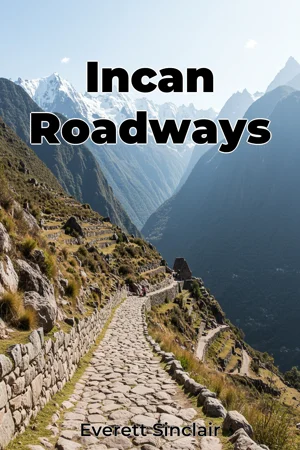
Imagine an empire stretching thousands of miles, its disparate regions connected not by harbors or rivers, but by a meticulously engineered network of roads scaling the heights of the Andes. "Incan Roadways" delves into the heart of this remarkable infrastructure, exploring not merely its construction, but its profound impact on the Inca Empire's political, economic, and social fabric. This book argues that the Incan road system, far from being simply a means of transportation, was a crucial tool for consolidating power, facilitating trade, and disseminating cultural influence throughout the vast and varied terrain of their domain. Its significance extends beyond the purely functional; it represents a sophisticated understanding of engineering, logistics, and social control. To understand the roads, one must first grasp the context in which they were built. The Inca Empire, or Tawantinsuyu, arose in the 15th century, rapidly expanding to encompass a diverse range of ecological zones and cultural groups. This expansion necessitated a reliable communication and transportation system, leading to the development of the Qhapaq Ñan, the Royal Road. The construction and maintenance of these roads were interwoven with concepts of reciprocal labor and state control, illustrating the complex relationship between the Inca rulers and their subjects. The book begins by detailing the engineering principles behind the roads, examining the various construction techniques employed to overcome geographical barriers. From suspension bridges spanning deep gorges to staircases carved into steep cliffs, the ingenuity of Inca engineers is evident. It then moves on to explore the administrative and logistical systems that sustained the road network, including the role of relay runners (chasquis) in delivering messages and the tambos (waystations) that provided lodging and supplies. A significant portion of the book is dedicated to analyzing the economic impact of the roads. By facilitating the movement of goods and resources, the roads enabled the Inca to exert control over trade and tribute. They also played a crucial role in the redistribution of surplus goods to regions affected by famine or natural disasters, underscoring the Inca state's commitment to social welfare. The book further examines the roads' impact on cultural diffusion. The roads facilitated the spread of Inca language, religion, and artistic styles, contributing to the homogenization of the empire. Simultaneously, they allowed for the transmission of local knowledge and practices to the imperial center, creating a dynamic interplay between the Inca rulers and the diverse populations they governed. The book draws upon archaeological evidence, ethnohistorical accounts, and recent scholarship to reconstruct the history and function of the Incan roadways. It analyzes primary sources such as the chronicles of Spanish conquistadors and the accounts of indigenous informants, as well as data obtained from archaeological surveys and excavations. "Incan Roadways" connects to several other fields of study, including archaeology, anthropology, and political science. By examining the material remains of the roads, archaeologists can gain insights into Inca engineering and construction techniques. Anthropological perspectives shed light on the social and cultural significance of the roads, while political science frameworks help to understand their role in state formation and control. This book offers a unique perspective by integrating these diverse fields of study to provide a holistic understanding of the Incan road system. It avoids romanticized portrayals of the Inca Empire, instead presenting a nuanced account of its achievements and limitations. The writing style is academic, yet accessible, aiming to engage both specialists and general readers with an interest in Inca history and culture. This book is ideally suited for students, researchers, and anyone interested in learning more about the history of engineering, the development of complex societies, and the legacy of the Inca Empire. While the book focuses primarily on the Qhapaq Ñan, it also acknowledges the existence of local and regional road networks that predated the Inca Empire. It does not attempt to provide a comprehensive account of all pre-Inca roads, but rather focuses on the Incan modifications, expansions, and management of these networks. The information presented in the book offers valuable insights for modern engineers and planners interested in sustainable infrastructure development. The lessons learned from the Incan road system can be applied to the design and construction of infrastructure in challenging environments around the world. While this book aims to present an objective and balanced account of the Incan road system, it acknowledges that there are ongoing debates among scholars regarding the exact dates of construction, the extent of Inca control over certain regions, and the interpretation of archaeological evidence.
Imagine an empire stretching thousands of miles, its disparate regions connected not by harbors or rivers, but by a meticulously engineered network of roads scaling the heights of the Andes. "Incan Roadways" delves into the heart of this remarkable infrastructure, exploring not merely its construction, but its profound impact on the Inca Empire's political, economic, and social fabric. This book argues that the Incan road system, far from being simply a means of transportation, was a crucial tool for consolidating power, facilitating trade, and disseminating cultural influence throughout the vast and varied terrain of their domain. Its significance extends beyond the purely functional; it represents a sophisticated understanding of engineering, logistics, and social control. To understand the roads, one must first grasp the context in which they were built. The Inca Empire, or Tawantinsuyu, arose in the 15th century, rapidly expanding to encompass a diverse range of ecological zones and cultural groups. This expansion necessitated a reliable communication and transportation system, leading to the development of the Qhapaq Ñan, the Royal Road. The construction and maintenance of these roads were interwoven with concepts of reciprocal labor and state control, illustrating the complex relationship between the Inca rulers and their subjects. The book begins by detailing the engineering principles behind the roads, examining the various construction techniques employed to overcome geographical barriers. From suspension bridges spanning deep gorges to staircases carved into steep cliffs, the ingenuity of Inca engineers is evident. It then moves on to explore the administrative and logistical systems that sustained the road network, including the role of relay runners (chasquis) in delivering messages and the tambos (waystations) that provided lodging and supplies. A significant portion of the book is dedicated to analyzing the economic impact of the roads. By facilitating the movement of goods and resources, the roads enabled the Inca to exert control over trade and tribute. They also played a crucial role in the redistribution of surplus goods to regions affected by famine or natural disasters, underscoring the Inca state's commitment to social welfare. The book further examines the roads' impact on cultural diffusion. The roads facilitated the spread of Inca language, religion, and artistic styles, contributing to the homogenization of the empire. Simultaneously, they allowed for the transmission of local knowledge and practices to the imperial center, creating a dynamic interplay between the Inca rulers and the diverse populations they governed. The book draws upon archaeological evidence, ethnohistorical accounts, and recent scholarship to reconstruct the history and function of the Incan roadways. It analyzes primary sources such as the chronicles of Spanish conquistadors and the accounts of indigenous informants, as well as data obtained from archaeological surveys and excavations. "Incan Roadways" connects to several other fields of study, including archaeology, anthropology, and political science. By examining the material remains of the roads, archaeologists can gain insights into Inca engineering and construction techniques. Anthropological perspectives shed light on the social and cultural significance of the roads, while political science frameworks help to understand their role in state formation and control. This book offers a unique perspective by integrating these diverse fields of study to provide a holistic understanding of the Incan road system. It avoids romanticized portrayals of the Inca Empire, instead presenting a nuanced account of its achievements and limitations. The writing style is academic, yet accessible, aiming to engage both specialists and general readers with an interest in Inca history and culture. This book is ideally suited for students, researchers, and anyone interested in learning more about the history of engineering, the development of complex societies, and the legacy of the Inca Empire. While the book focuses primarily on the Qhapaq Ñan, it also acknowledges the existence of local and regional road networks that predated the Inca Empire. It does not attempt to provide a comprehensive account of all pre-Inca roads, but rather focuses on the Incan modifications, expansions, and management of these networks. The information presented in the book offers valuable insights for modern engineers and planners interested in sustainable infrastructure development. The lessons learned from the Incan road system can be applied to the design and construction of infrastructure in challenging environments around the world. While this book aims to present an objective and balanced account of the Incan road system, it acknowledges that there are ongoing debates among scholars regarding the exact dates of construction, the extent of Inca control over certain regions, and the interpretation of archaeological evidence.
"Incan Roadways" explores the intricate road system of the Inca Empire and its critical role in the empire's success. More than just pathways, these roads facilitated political control, economic exchange, and cultural dissemination across the vast and diverse Andean landscape. The book highlights the sophisticated engineering of the Qhapaq Ñan, showcasing innovative solutions like suspension bridges and carved staircases that conquered formidable geographical barriers. Readers will discover how the roads were integral to the Inca's ability to manage resources, communicate efficiently through relay runners, and maintain social order. The book examines the Incan road system's impact on the empire's economy and culture, demonstrating how the roads enabled the movement of goods, the spread of Inca culture, and the integration of diverse populations. By drawing on archaeological evidence and historical accounts, the book reconstructs the history and function of these remarkable roadways, presenting a nuanced view of Inca achievements and limitations. The book progresses from detailing the engineering principles to exploring the administrative and logistical systems that sustained the road network, offering a comprehensive understanding of this ancient infrastructure.
Book Details
ISBN
9788235277992
Publisher
Publifye AS
Your Licenses
You don't own any licenses for this book
Purchase a license below to unlock this book and download the EPUB.
Purchase License
Select a tier to unlock this book
Need bulk licensing?
Contact us for enterprise agreements.