
About This Book
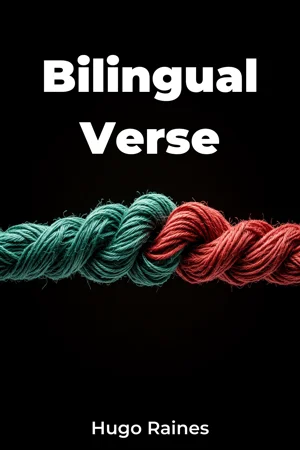
What happens when poetic expression transcends the boundaries of a single language, weaving together multiple linguistic threads into a cohesive and resonant whole? "Bilingual Verse" delves into this intricate realm, examining the rich tapestry of multilingual poetry and its significance in understanding identity, culture, and the art of poetic expression itself. This book explores how poets throughout history and across diverse cultures have strategically employed multiple languages within their work, creating unique aesthetic and thematic effects that are impossible to achieve in monolingual compositions. The central argument of "Bilingual Verse" is that multilingualism in poetry is not merely a decorative flourish, but a powerful tool for exploring complex themes of cultural hybridity, displacement, and the multifaceted nature of identity. It posits that the deliberate use of multiple languages allows poets to challenge linguistic norms, create nuanced meanings, and engage with diverse audiences in profound ways. This argument is vital because it shifts the perception of multilingual poetry from a niche phenomenon to a significant and innovative literary form with far-reaching implications. The book's structure begins with an introduction that defines bilingual verse, establishes its historical context, and outlines the theoretical framework for analysis. It then proceeds with detailed case studies, organized thematically. The first major section focuses on instances where bilingualism reflects migration, diaspora, and the negotiation of cultural identities, offering examples of poets using language to create a sense of belonging or express feelings of alienation. A second section investigates the deliberate use of code-switching and language mixing for stylistic effect, examining how poets manipulate linguistic contrasts to create humor, irony, or heightened emotional impact. This section will be supported by examples of a wide range of literary works. Finally, the book culminates in a discussion of the implications of bilingual verse for contemporary poetry and translation studies, exploring its potential to challenge traditional notions of linguistic purity and expand the possibilities of poetic expression. "Bilingual Verse" draws on a diverse range of evidence, including close readings of individual poems, analysis of critical essays on multilingual literature, and historical research into the social and cultural contexts in which these poems were created. It incorporates both well-known examples and lesser-studied works, providing a comprehensive overview of the field. The methodology involves a synthesis of literary analysis, linguistic theory, and cultural studies, offering a multifaceted perspective on the phenomenon of bilingual verse. This book connects to several interdisciplinary areas, including sociolinguistics, translation studies, and postcolonial literature. By examining the linguistic and cultural dynamics at play in multilingual poetry, it contributes to our understanding of language contact, cultural exchange, and the construction of identity in a globalized world. It adopts an academic approach, presenting information in a rigorous and well-supported manner, while remaining accessible to an informed readership, including students and scholars of literature, linguistics, and cultural studies, as well as poets and translators interested in exploring the possibilities of multilingual expression. The book's scope is intentionally broad, encompassing examples of bilingual verse from various languages and time periods. However, it acknowledges the limitations of a single volume and focuses primarily on works where the use of multiple languages is a central and deliberate feature of the poem. While controversies surrounding linguistic purity and cultural appropriation are acknowledged, the book aims to foster a deeper appreciation for the creative potential of multilingualism in poetry. Ultimately, "Bilingual Verse" offers a valuable resource for anyone seeking to understand the complex and fascinating world of poetry that transcends linguistic boundaries.
What happens when poetic expression transcends the boundaries of a single language, weaving together multiple linguistic threads into a cohesive and resonant whole? "Bilingual Verse" delves into this intricate realm, examining the rich tapestry of multilingual poetry and its significance in understanding identity, culture, and the art of poetic expression itself. This book explores how poets throughout history and across diverse cultures have strategically employed multiple languages within their work, creating unique aesthetic and thematic effects that are impossible to achieve in monolingual compositions. The central argument of "Bilingual Verse" is that multilingualism in poetry is not merely a decorative flourish, but a powerful tool for exploring complex themes of cultural hybridity, displacement, and the multifaceted nature of identity. It posits that the deliberate use of multiple languages allows poets to challenge linguistic norms, create nuanced meanings, and engage with diverse audiences in profound ways. This argument is vital because it shifts the perception of multilingual poetry from a niche phenomenon to a significant and innovative literary form with far-reaching implications. The book's structure begins with an introduction that defines bilingual verse, establishes its historical context, and outlines the theoretical framework for analysis. It then proceeds with detailed case studies, organized thematically. The first major section focuses on instances where bilingualism reflects migration, diaspora, and the negotiation of cultural identities, offering examples of poets using language to create a sense of belonging or express feelings of alienation. A second section investigates the deliberate use of code-switching and language mixing for stylistic effect, examining how poets manipulate linguistic contrasts to create humor, irony, or heightened emotional impact. This section will be supported by examples of a wide range of literary works. Finally, the book culminates in a discussion of the implications of bilingual verse for contemporary poetry and translation studies, exploring its potential to challenge traditional notions of linguistic purity and expand the possibilities of poetic expression. "Bilingual Verse" draws on a diverse range of evidence, including close readings of individual poems, analysis of critical essays on multilingual literature, and historical research into the social and cultural contexts in which these poems were created. It incorporates both well-known examples and lesser-studied works, providing a comprehensive overview of the field. The methodology involves a synthesis of literary analysis, linguistic theory, and cultural studies, offering a multifaceted perspective on the phenomenon of bilingual verse. This book connects to several interdisciplinary areas, including sociolinguistics, translation studies, and postcolonial literature. By examining the linguistic and cultural dynamics at play in multilingual poetry, it contributes to our understanding of language contact, cultural exchange, and the construction of identity in a globalized world. It adopts an academic approach, presenting information in a rigorous and well-supported manner, while remaining accessible to an informed readership, including students and scholars of literature, linguistics, and cultural studies, as well as poets and translators interested in exploring the possibilities of multilingual expression. The book's scope is intentionally broad, encompassing examples of bilingual verse from various languages and time periods. However, it acknowledges the limitations of a single volume and focuses primarily on works where the use of multiple languages is a central and deliberate feature of the poem. While controversies surrounding linguistic purity and cultural appropriation are acknowledged, the book aims to foster a deeper appreciation for the creative potential of multilingualism in poetry. Ultimately, "Bilingual Verse" offers a valuable resource for anyone seeking to understand the complex and fascinating world of poetry that transcends linguistic boundaries.
"Bilingual Verse" explores multilingual poetry as more than just a literary technique, revealing its power to express complex themes of cultural identity and displacement. It examines how poets strategically weave multiple languages, creating unique effects impossible to achieve in monolingual compositions. For example, poets often use language mixing to express feelings of alienation or to create a sense of belonging within a diaspora. Delving into the nuances of code-switching, the book reveals how poets manipulate linguistic contrasts to evoke humor, irony, or heightened emotional impact. This academic exploration begins by defining bilingual verse and establishing its historical context, then progresses through thematically organized case studies. One section focuses on migration and cultural identity, while another investigates stylistic effects. Drawing from literary analysis, linguistic theory, and cultural studies, the book provides a multifaceted perspective on multilingual poetry. Ultimately, it challenges traditional notions of linguistic purity and expands the possibilities of poetic expression, making it a valuable resource for students, scholars, and anyone interested in the intersection of poetry, linguistics, and cultural hybridity.
Book Details
ISBN
9788235277862
Publisher
Publifye AS
Your Licenses
You don't own any licenses for this book
Purchase a license below to unlock this book and download the EPUB.
Purchase License
Select a tier to unlock this book
Need bulk licensing?
Contact us for enterprise agreements.