
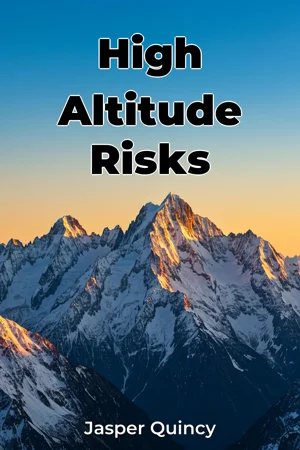
About This Book
How far would you push your body to reach a summit? 'High Altitude Risks' delves into the potentially deadly consequences of venturing into mountainous environments, equipping readers with the knowledge to understand, prevent, and respond to altitude-related illnesses and injuries. This book focuses on three critical areas: the physiological dangers of high altitude, including altitude sickness and oxygen deprivation; the threat of cold-related injuries like frostbite; and essential first aid strategies for survival in challenging mountainous terrains. The importance of understanding these risks cannot be overstated. As recreational and professional activities in mountainous regions become increasingly popular, the potential for life-threatening situations escalates. This book provides a comprehensive understanding of the human body's response to extreme environments, bridging the gap between theoretical knowledge and practical application. 'High Altitude Risks' begins by exploring the science behind altitude sickness, also known as Acute Mountain Sickness (AMS), High-Altitude Pulmonary Edema (HAPE), and High-Altitude Cerebral Edema (HACE). It details the physiological changes that occur as the body struggles to adapt to reduced oxygen levels, explaining how these changes can lead to severe and potentially fatal conditions. We trace the history of altitude research, from early observations by mountaineering pioneers to modern scientific studies conducted in high-altitude laboratories. The book's central argument posits that a thorough understanding of altitude physiology, coupled with proactive prevention strategies and effective first-aid techniques, is crucial for mitigating the risks associated with mountain environments. This premise is not just for experienced climbers; it's vital for hikers, trekkers, skiers, and anyone venturing above moderate altitudes. The book is structured in three parts. The first section introduces the physiological effects of altitude, detailing how reduced oxygen pressure impacts the respiratory and circulatory systems. It examines the causes and symptoms of various forms of altitude sickness, providing clear diagnostic criteria and emphasizing the importance of early recognition. The second part focuses on cold-related injuries, like frostbite and hypothermia, detailing the mechanisms by which these conditions develop and outlining preventive measures such as proper clothing and insulation. The third part synthesizes the knowledge, providing evidence-based first aid protocols. It covers topics such as oxygen administration, descent strategies, medication use, and evacuation procedures, emphasizing the critical role of rapid and appropriate intervention. The information presented is supported by a combination of medical research, case studies, and expert interviews. Drawing on data from high-altitude physiology studies and wilderness medicine journals, the book offers a blend of scientific rigor and practical insights. Furthermore, the book draws connections between physiology and environmental science, as changes in global climate impact conditions in mountain regions. It also links to the field of sports medicine, offering insights into optimizing physical performance at altitude. What sets 'High Altitude Risks' apart is its emphasis on practical application. It translates complex physiological concepts into actionable strategies that readers can use to protect themselves and others in mountainous environments. It adopts a clear and conversational tone, making the information accessible to a broad audience, from outdoor enthusiasts to medical professionals. The target audience includes hikers, climbers, skiers, search and rescue personnel, and healthcare providers working in wilderness settings. The book is designed to be a valuable resource for anyone seeking to understand and manage the risks associated with high-altitude environments. The scope of this book is limited to the acute risks associated with high-altitude exposure. It does not delve into long-term acclimatization strategies or the physiological adaptations of high-altitude natives. It acknowledges that ongoing debates exist regarding optimal treatment protocols for certain conditions, such as the use of specific medications for AMS and HAPE. The knowledge presented in 'High Altitude Risks' can be applied directly in real-world situations, from planning a safe trek to administering life-saving first aid. By empowering readers with the knowledge and skills to recognize, prevent, and respond to altitude-related illnesses and injuries, this book aims to promote safer and more enjoyable experiences in mountainous environments.
How far would you push your body to reach a summit? 'High Altitude Risks' delves into the potentially deadly consequences of venturing into mountainous environments, equipping readers with the knowledge to understand, prevent, and respond to altitude-related illnesses and injuries. This book focuses on three critical areas: the physiological dangers of high altitude, including altitude sickness and oxygen deprivation; the threat of cold-related injuries like frostbite; and essential first aid strategies for survival in challenging mountainous terrains. The importance of understanding these risks cannot be overstated. As recreational and professional activities in mountainous regions become increasingly popular, the potential for life-threatening situations escalates. This book provides a comprehensive understanding of the human body's response to extreme environments, bridging the gap between theoretical knowledge and practical application. 'High Altitude Risks' begins by exploring the science behind altitude sickness, also known as Acute Mountain Sickness (AMS), High-Altitude Pulmonary Edema (HAPE), and High-Altitude Cerebral Edema (HACE). It details the physiological changes that occur as the body struggles to adapt to reduced oxygen levels, explaining how these changes can lead to severe and potentially fatal conditions. We trace the history of altitude research, from early observations by mountaineering pioneers to modern scientific studies conducted in high-altitude laboratories. The book's central argument posits that a thorough understanding of altitude physiology, coupled with proactive prevention strategies and effective first-aid techniques, is crucial for mitigating the risks associated with mountain environments. This premise is not just for experienced climbers; it's vital for hikers, trekkers, skiers, and anyone venturing above moderate altitudes. The book is structured in three parts. The first section introduces the physiological effects of altitude, detailing how reduced oxygen pressure impacts the respiratory and circulatory systems. It examines the causes and symptoms of various forms of altitude sickness, providing clear diagnostic criteria and emphasizing the importance of early recognition. The second part focuses on cold-related injuries, like frostbite and hypothermia, detailing the mechanisms by which these conditions develop and outlining preventive measures such as proper clothing and insulation. The third part synthesizes the knowledge, providing evidence-based first aid protocols. It covers topics such as oxygen administration, descent strategies, medication use, and evacuation procedures, emphasizing the critical role of rapid and appropriate intervention. The information presented is supported by a combination of medical research, case studies, and expert interviews. Drawing on data from high-altitude physiology studies and wilderness medicine journals, the book offers a blend of scientific rigor and practical insights. Furthermore, the book draws connections between physiology and environmental science, as changes in global climate impact conditions in mountain regions. It also links to the field of sports medicine, offering insights into optimizing physical performance at altitude. What sets 'High Altitude Risks' apart is its emphasis on practical application. It translates complex physiological concepts into actionable strategies that readers can use to protect themselves and others in mountainous environments. It adopts a clear and conversational tone, making the information accessible to a broad audience, from outdoor enthusiasts to medical professionals. The target audience includes hikers, climbers, skiers, search and rescue personnel, and healthcare providers working in wilderness settings. The book is designed to be a valuable resource for anyone seeking to understand and manage the risks associated with high-altitude environments. The scope of this book is limited to the acute risks associated with high-altitude exposure. It does not delve into long-term acclimatization strategies or the physiological adaptations of high-altitude natives. It acknowledges that ongoing debates exist regarding optimal treatment protocols for certain conditions, such as the use of specific medications for AMS and HAPE. The knowledge presented in 'High Altitude Risks' can be applied directly in real-world situations, from planning a safe trek to administering life-saving first aid. By empowering readers with the knowledge and skills to recognize, prevent, and respond to altitude-related illnesses and injuries, this book aims to promote safer and more enjoyable experiences in mountainous environments.
"High Altitude Risks" explores the serious dangers of venturing into mountainous environments, offering crucial knowledge for understanding, preventing, and responding to altitude-related illnesses and injuries. The book highlights the physiological challenges of reduced oxygen levels, which can lead to Acute Mountain Sickness (AMS), High-Altitude Pulmonary Edema (HAPE), and High-Altitude Cerebral Edema (HACE). It also addresses cold-related injuries like frostbite and hypothermia, which pose significant threats in mountain environments, emphasizing that understanding these risks is vital for anyone venturing above moderate altitudes. The book’s approach is structured into three key sections: the physiological effects of altitude, cold-related injuries, and evidence-based first aid protocols. Readers gain insights into how reduced oxygen impacts the body, the mechanisms behind cold injuries, and essential intervention techniques such as oxygen administration and descent strategies. It emphasizes how proactive prevention strategies and effective first-aid techniques are crucial for mitigating risks and promoting safer experiences in challenging terrains.
Book Details
ISBN
9788235277534
Publisher
Publifye AS
Your Licenses
You don't own any licenses for this book
Purchase a license below to unlock this book and download the EPUB.
Purchase License
Select a tier to unlock this book
Need bulk licensing?
Contact us for enterprise agreements.