
About This Book
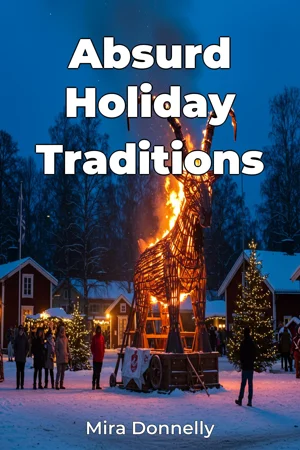
Ever wondered why some holidays involve throwing tomatoes, burning effigies of goats, or dressing up in terrifying costumes? "Absurd Holiday Traditions" delves into the origins and meanings behind some of the world's most unusual festive practices, offering a journey through diverse cultures and their unique ways of celebrating life. This book explores the surprising resilience of tradition, the role of cultural identity in shaping holiday rituals, and the often-unexpected ways societies express joy, fear, and community through these celebrations. Our investigation centers on three core themes: the persistence of ancient customs in modern society, the function of holidays as markers of cultural identity, and the psychological and sociological underpinnings of seemingly irrational festive behaviors. These topics are significant because they reveal fundamental aspects of human behavior, highlighting how societies maintain continuity with the past, reinforce group cohesion, and manage complex emotions through shared ritual. To understand these traditions, the book provides historical context, tracing the roots of these practices back to their points of origin. We examine the historical, anthropological, and sociological factors that have contributed to their survival. Some level of familiarity with basic world history and cultural anthropology will enhance the reader's appreciation of the material. "Absurd Holiday Traditions" argues that seemingly bizarre holiday customs are not simply remnants of a bygone era, but rather play vital roles in preserving cultural memory, reinforcing social bonds, and providing outlets for emotional expression. These traditions, however strange they may appear, offer a window into the values, beliefs, and anxieties of the societies that observe them. The book unfolds in a structured manner. First, we introduce the concept of "absurd traditions," clarifying what constitutes an unconventional holiday practice. Then, we explore the historical and cultural roots of several prominent case studies, dedicating chapters to specific categories like food-related festivities (e.g., La Tomatina in Spain), effigy-burning rituals (e.g., the Yule Goat in Sweden), and costume-based celebrations (e.g., Krampusnacht in Austria). Each case study examines the historical context, symbolic meaning, and contemporary significance of the tradition. Finally, we synthesize these observations, discussing the broader implications for understanding cultural behavior and the dynamics of social cohesion. "Absurd Holiday Traditions" draws upon a wide range of sources, including academic research in anthropology, sociology, and folklore studies. It includes historical accounts, ethnographic reports, and contemporary media coverage to provide a comprehensive picture of each tradition. The analysis incorporates quantitative data regarding participation rates and social attitudes, as well as qualitative data gathered from interviews and participant observations. The book intersects with several academic disciplines. It connects to psychology by examining the emotional release and catharsis that may be associated with certain holiday practices. It relates to sociology by investigating the role of holidays in reinforcing social norms and group identity. It also ties into political science by exploring how governments and institutions may support or suppress particular traditions to achieve specific social or political goals. A unique aspect of this book is its comparative approach, which bridges historical analysis with contemporary social science. By examining a diverse collection of traditions from different cultural contexts, it develops a nuanced understanding of the factors that contribute to the persistence and evolution of holiday practices. Written in a clear and accessible style, "Absurd Holiday Traditions" aims to engage a broad audience interested in history, culture, and human behavior. The target audience includes students, armchair travelers, and anyone curious about the world's diverse cultural traditions. The book is valuable because it provides a fresh perspective on familiar celebrations, revealing the hidden meanings and social functions of seemingly strange customs. As a work of non-fiction, "Absurd Holiday Traditions" adheres to the genre's emphasis on factual accuracy, evidence-based arguments, and transparent sourcing. While the book surveys a wide array of traditions, it acknowledges the limitations of its scope, recognizing that it cannot provide an exhaustive account of every unusual holiday practice worldwide. The selection of case studies is intended to be representative of the broader phenomenon of absurd traditions. The information in "Absurd Holiday Traditions" can be applied practically by readers seeking to better understand cultural differences, to critically evaluate their own cultural biases, or to gain insights into the dynamics of social behavior. While the book does not promote any particular viewpoint, it acknowledges that the interpretation of cultural traditions can be subject to debate, particularly when they involve sensitive topics such as religious beliefs or historical injustices.
Ever wondered why some holidays involve throwing tomatoes, burning effigies of goats, or dressing up in terrifying costumes? "Absurd Holiday Traditions" delves into the origins and meanings behind some of the world's most unusual festive practices, offering a journey through diverse cultures and their unique ways of celebrating life. This book explores the surprising resilience of tradition, the role of cultural identity in shaping holiday rituals, and the often-unexpected ways societies express joy, fear, and community through these celebrations. Our investigation centers on three core themes: the persistence of ancient customs in modern society, the function of holidays as markers of cultural identity, and the psychological and sociological underpinnings of seemingly irrational festive behaviors. These topics are significant because they reveal fundamental aspects of human behavior, highlighting how societies maintain continuity with the past, reinforce group cohesion, and manage complex emotions through shared ritual. To understand these traditions, the book provides historical context, tracing the roots of these practices back to their points of origin. We examine the historical, anthropological, and sociological factors that have contributed to their survival. Some level of familiarity with basic world history and cultural anthropology will enhance the reader's appreciation of the material. "Absurd Holiday Traditions" argues that seemingly bizarre holiday customs are not simply remnants of a bygone era, but rather play vital roles in preserving cultural memory, reinforcing social bonds, and providing outlets for emotional expression. These traditions, however strange they may appear, offer a window into the values, beliefs, and anxieties of the societies that observe them. The book unfolds in a structured manner. First, we introduce the concept of "absurd traditions," clarifying what constitutes an unconventional holiday practice. Then, we explore the historical and cultural roots of several prominent case studies, dedicating chapters to specific categories like food-related festivities (e.g., La Tomatina in Spain), effigy-burning rituals (e.g., the Yule Goat in Sweden), and costume-based celebrations (e.g., Krampusnacht in Austria). Each case study examines the historical context, symbolic meaning, and contemporary significance of the tradition. Finally, we synthesize these observations, discussing the broader implications for understanding cultural behavior and the dynamics of social cohesion. "Absurd Holiday Traditions" draws upon a wide range of sources, including academic research in anthropology, sociology, and folklore studies. It includes historical accounts, ethnographic reports, and contemporary media coverage to provide a comprehensive picture of each tradition. The analysis incorporates quantitative data regarding participation rates and social attitudes, as well as qualitative data gathered from interviews and participant observations. The book intersects with several academic disciplines. It connects to psychology by examining the emotional release and catharsis that may be associated with certain holiday practices. It relates to sociology by investigating the role of holidays in reinforcing social norms and group identity. It also ties into political science by exploring how governments and institutions may support or suppress particular traditions to achieve specific social or political goals. A unique aspect of this book is its comparative approach, which bridges historical analysis with contemporary social science. By examining a diverse collection of traditions from different cultural contexts, it develops a nuanced understanding of the factors that contribute to the persistence and evolution of holiday practices. Written in a clear and accessible style, "Absurd Holiday Traditions" aims to engage a broad audience interested in history, culture, and human behavior. The target audience includes students, armchair travelers, and anyone curious about the world's diverse cultural traditions. The book is valuable because it provides a fresh perspective on familiar celebrations, revealing the hidden meanings and social functions of seemingly strange customs. As a work of non-fiction, "Absurd Holiday Traditions" adheres to the genre's emphasis on factual accuracy, evidence-based arguments, and transparent sourcing. While the book surveys a wide array of traditions, it acknowledges the limitations of its scope, recognizing that it cannot provide an exhaustive account of every unusual holiday practice worldwide. The selection of case studies is intended to be representative of the broader phenomenon of absurd traditions. The information in "Absurd Holiday Traditions" can be applied practically by readers seeking to better understand cultural differences, to critically evaluate their own cultural biases, or to gain insights into the dynamics of social behavior. While the book does not promote any particular viewpoint, it acknowledges that the interpretation of cultural traditions can be subject to debate, particularly when they involve sensitive topics such as religious beliefs or historical injustices.
"Absurd Holiday Traditions" explores the fascinating world of unusual festive practices across different cultures. Delving into World History and Social Science, the book examines why certain holidays involve bizarre activities like throwing tomatoes or burning effigies, revealing how these customs persist and shape cultural identity. It highlights the surprising resilience of these traditions, demonstrating how they reinforce social cohesion and provide outlets for emotional expression. The book approaches its subject matter with a blend of historical context and contemporary social science, tracing the origins of these practices and examining their modern-day significance. For example, costume-based celebrations, sometimes seemingly terrifying, often serve as a way for societies to confront and manage collective fears. Unfolding in a structured manner, the book begins by defining "absurd traditions," then progresses through case studies categorized by type, such as food-related festivities and effigy-burning rituals, before synthesizing broader implications for understanding cultural behavior.
Book Details
ISBN
9788235276674
Publisher
Publifye AS
Your Licenses
You don't own any licenses for this book
Purchase a license below to unlock this book and download the EPUB.
Purchase License
Select a tier to unlock this book
Need bulk licensing?
Contact us for enterprise agreements.