
About This Book
What vanished civilization, flourishing millennia ago, continues to challenge our understanding of early urban life and societal collapse? "Indus Valley" unravels the mysteries surrounding one of the world's first great civilizations: the Indus Valley Civilization (IVC). This book delves into three crucial aspects of this ancient society: its remarkably advanced urban planning, its extensive and complex trade networks, and the factors contributing to its sudden and still debated decline. Understanding these elements is vital because the IVC offers invaluable insights into the origins of urbanism, the dynamics of early global trade, and the potential vulnerabilities of complex societies. This book provides essential historical and archaeological context, assuming only a general knowledge of ancient history on the part of the reader. It presents a comprehensive overview of the IVC, challenging the traditional narrative of linear societal progression. We argue that the IVC's sophisticated systems, while initially strengths, may have contained the seeds of its eventual downfall. This argument is critical because it compels us to rethink simplistic models of progress and consider the long-term consequences of societal choices. Our investigation proceeds in a structured manner. First, the book introduces the geographical setting and the timeline of the IVC's emergence, peak, and decline. Second, it explores the urban planning innovations of cities like Mohenjo-daro and Harappa, focusing on their grid-pattern layouts, advanced sanitation systems, and standardized brick construction. Third, it examines the IVC's trade networks, analyzing the evidence for exchange with Mesopotamia, Central Asia, and other regions. This section highlights the types of goods traded, the routes used, and the implications of this trade for the IVC's economy and culture. Finally, the book synthesizes current theories about the IVC's decline, considering factors such as climate change, environmental degradation, shifts in river courses, and potential social or political unrest. The evidence presented in this book draws upon a wide range of archaeological sources, including excavated city sites, analyzed artifacts, and paleoclimatological data. We also incorporate insights from textual evidence found in Mesopotamia that alludes to trade with a region thought to be the IVC. Our analysis benefits from innovative approaches to archaeological interpretation, including spatial analysis of settlement patterns and isotopic analysis of human and animal remains to reconstruct diet and migration. This book connects to several interdisciplinary fields, including archaeology, environmental science, and economics. Archaeological findings provide the primary data; environmental science helps us understand the effects of climate change on the IVC; and economic principles inform our analysis of its trade networks. The narrative provides a nuanced perspective by considering the interplay between human agency and environmental constraints, which in turn, allows for a greater understanding of urban development and societal resilience. "Indus Valley" is written in a professional and accessible style, aiming to engage both academic and general readers interested in ancient history and archaeology. It offers a valuable resource for students, researchers, and anyone curious about the rise and fall of civilizations. The scope of this book is limited to the core areas of the IVC and does not delve into speculative theories about its connections to later Indian history, focusing instead on presenting a balanced and evidence-based account of its known features and timelines. This book acknowledges the ongoing debates surrounding the IVC's undeciphered script and presents various interpretations without endorsing any single theory definitively and provides a balanced assessment of each perspective. The book demonstrates how understanding the IVC can inform contemporary urban planning and resource management. By studying the IVC's successes and failures, we can gain valuable insights into building more sustainable and resilient cities today.
What vanished civilization, flourishing millennia ago, continues to challenge our understanding of early urban life and societal collapse? "Indus Valley" unravels the mysteries surrounding one of the world's first great civilizations: the Indus Valley Civilization (IVC). This book delves into three crucial aspects of this ancient society: its remarkably advanced urban planning, its extensive and complex trade networks, and the factors contributing to its sudden and still debated decline. Understanding these elements is vital because the IVC offers invaluable insights into the origins of urbanism, the dynamics of early global trade, and the potential vulnerabilities of complex societies. This book provides essential historical and archaeological context, assuming only a general knowledge of ancient history on the part of the reader. It presents a comprehensive overview of the IVC, challenging the traditional narrative of linear societal progression. We argue that the IVC's sophisticated systems, while initially strengths, may have contained the seeds of its eventual downfall. This argument is critical because it compels us to rethink simplistic models of progress and consider the long-term consequences of societal choices. Our investigation proceeds in a structured manner. First, the book introduces the geographical setting and the timeline of the IVC's emergence, peak, and decline. Second, it explores the urban planning innovations of cities like Mohenjo-daro and Harappa, focusing on their grid-pattern layouts, advanced sanitation systems, and standardized brick construction. Third, it examines the IVC's trade networks, analyzing the evidence for exchange with Mesopotamia, Central Asia, and other regions. This section highlights the types of goods traded, the routes used, and the implications of this trade for the IVC's economy and culture. Finally, the book synthesizes current theories about the IVC's decline, considering factors such as climate change, environmental degradation, shifts in river courses, and potential social or political unrest. The evidence presented in this book draws upon a wide range of archaeological sources, including excavated city sites, analyzed artifacts, and paleoclimatological data. We also incorporate insights from textual evidence found in Mesopotamia that alludes to trade with a region thought to be the IVC. Our analysis benefits from innovative approaches to archaeological interpretation, including spatial analysis of settlement patterns and isotopic analysis of human and animal remains to reconstruct diet and migration. This book connects to several interdisciplinary fields, including archaeology, environmental science, and economics. Archaeological findings provide the primary data; environmental science helps us understand the effects of climate change on the IVC; and economic principles inform our analysis of its trade networks. The narrative provides a nuanced perspective by considering the interplay between human agency and environmental constraints, which in turn, allows for a greater understanding of urban development and societal resilience. "Indus Valley" is written in a professional and accessible style, aiming to engage both academic and general readers interested in ancient history and archaeology. It offers a valuable resource for students, researchers, and anyone curious about the rise and fall of civilizations. The scope of this book is limited to the core areas of the IVC and does not delve into speculative theories about its connections to later Indian history, focusing instead on presenting a balanced and evidence-based account of its known features and timelines. This book acknowledges the ongoing debates surrounding the IVC's undeciphered script and presents various interpretations without endorsing any single theory definitively and provides a balanced assessment of each perspective. The book demonstrates how understanding the IVC can inform contemporary urban planning and resource management. By studying the IVC's successes and failures, we can gain valuable insights into building more sustainable and resilient cities today.
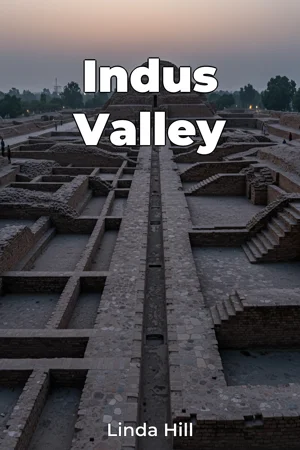
"Indus Valley" explores the fascinating story of the Indus Valley Civilization (IVC), one of history’s earliest urban societies. This book sheds light on the IVC's remarkable achievements in urban planning, evident in cities like Mohenjo-daro and Harappa, which featured grid-pattern layouts and advanced sanitation systems. It also investigates the civilization's extensive trade networks, revealing connections with Mesopotamia and Central Asia, highlighting the exchange of goods and cultural influences. A key focus is understanding the factors that led to the IVC's societal collapse, including environmental challenges and potential internal pressures. The book approaches the IVC by examining its geographical setting, urban innovations, and trade relations before delving into the theories surrounding its decline. It draws upon archaeological evidence, artifact analysis, and paleoclimatological data to provide a comprehensive picture. One intriguing aspect is how the IVC's sophisticated systems, initially strengths, may have contributed to its downfall, challenging simplistic views of progress. The book highlights the importance of considering the long-term consequences of societal choices, offering valuable lessons for contemporary urban planning and resource management. The narrative progresses systematically, beginning with an introduction to the civilization's timeline and geography, then exploring its urban planning and trade networks, and finally synthesizing theories about its decline. By focusing on evidence-based analysis and acknowledging ongoing scholarly debates, "Indus Valley" provides a balanced and nuanced perspective on this ancient civilization.
Book Details
ISBN
9788235276063
Publisher
Publifye AS
Your Licenses
You don't own any licenses for this book
Purchase a license below to unlock this book and download the EPUB.
Purchase License
Select a tier to unlock this book
Need bulk licensing?
Contact us for enterprise agreements.