
About This Book
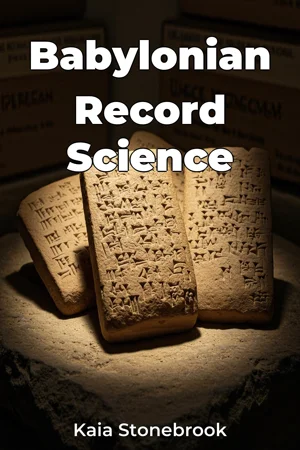
How did a civilization, millennia before modern computing, manage complex administrative and scientific endeavors? This book, *Babylonian Record Science*, delves into the meticulous record-keeping practices employed by the Babylonians, revealing how their innovative use of cuneiform tablets fostered administrative and scientific continuity across centuries. We will explore the diverse applications of these records, focusing on astronomy, agriculture, and economics, and demonstrate their integral role in shaping Babylonian society. This study is significant because it provides insight into the organizational capabilities of one of the earliest complex societies. Understanding Babylonian record-keeping offers a crucial perspective into the foundations of modern administrative and scientific thought. While a basic understanding of ancient history is helpful, no specialized prior knowledge is necessary to appreciate the book's content. *Babylonian Record Science* advances the argument that the Babylonians' sophisticated system of record-keeping, utilizing cuneiform script on clay tablets, served as a cornerstone for their societal stability and scientific advancements. This record-keeping was not merely a matter of bookkeeping, but a dynamic tool for analysis, prediction, and the transmission of knowledge across generations. The book is structured to guide the reader through a comprehensive understanding of Babylonian record-keeping. First, the introduction lays the groundwork by exploring the historical and cultural context of Babylonia, highlighting the development and use of cuneiform writing. Then we analyze the astronomical records to show how the Babylonians systematically observed and documented celestial events, identifying patterns critical for timekeeping and agriculture. The next section investigates agricultural records, examining how the Babylonians managed land, crops, and irrigation through detailed documentation, ensuring food security and economic stability. The book subsequently explores economic records, analyzing how the Babylonians tracked trade, taxes, and debts, creating a complex financial system supported by written documentation. Finally, the book synthesizes these findings to demonstrate the interconnectedness of Babylonian administration and science and emphasizes that their careful record-keeping underpinned their societal achievements. The analysis relies heavily on primary source materials, specifically translated cuneiform tablets from various archaeological sites. These tablets offer direct evidence of Babylonian practices and beliefs. We also incorporate secondary scholarship from Assyriology, archaeology, and the history of science to provide context and interpretation. This study connects to several other fields. Firstly, to mathematics, as the Babylonians employed a base-60 number system that influenced later mathematical developments. Secondly, to the history of science, as their astronomical observations laid the foundation for later advancements in astronomy and mathematics. Thirdly, to public administration, as their record-keeping practices offer insights into efficient governance. *Babylonian Record Science* offers a unique perspective by integrating archaeological evidence with historical and scientific analysis. It moves beyond a simple description of Babylonian records and instead examines their function within the broader context of Babylonian society, offering a holistic understanding of their importance. The book will be written in an academic yet accessible style, balancing scholarly rigor with readability to engage a broad audience. The target audience includes students and scholars of ancient history, archaeology, and the history of science and anyone interested in early civilizations and the development of administrative and scientific practices. The book will be of value to them because it provides a comprehensive and integrated analysis of Babylonian record-keeping, shedding light on a relatively understudied aspect of this influential civilization. As a work of non-fiction, specifically in the fields of history and science, *Babylonian Record Science* adheres to the standards of presenting verifiable facts, properly cited sources, and logical arguments supported by evidence. The scope of the book is limited to the study of record-keeping practices in Babylonia, primarily during the Old Babylonian and Neo-Babylonian periods. While connections to other Mesopotamian cultures are acknowledged, the focus remains on Babylonia due to the abundance of available textual evidence. The lessons from Babylonian record-keeping can be applied to modern-day data management and information governance. Understanding how the Babylonians used records to manage their society can inform contemporary strategies for data collection, analysis, and preservation. While the interpretation of cuneiform texts is generally well-established, ongoing debates surround the precise meaning and context of certain records. The book will address these debates and offer nuanced interpretations based on the available evidence.
How did a civilization, millennia before modern computing, manage complex administrative and scientific endeavors? This book, *Babylonian Record Science*, delves into the meticulous record-keeping practices employed by the Babylonians, revealing how their innovative use of cuneiform tablets fostered administrative and scientific continuity across centuries. We will explore the diverse applications of these records, focusing on astronomy, agriculture, and economics, and demonstrate their integral role in shaping Babylonian society. This study is significant because it provides insight into the organizational capabilities of one of the earliest complex societies. Understanding Babylonian record-keeping offers a crucial perspective into the foundations of modern administrative and scientific thought. While a basic understanding of ancient history is helpful, no specialized prior knowledge is necessary to appreciate the book's content. *Babylonian Record Science* advances the argument that the Babylonians' sophisticated system of record-keeping, utilizing cuneiform script on clay tablets, served as a cornerstone for their societal stability and scientific advancements. This record-keeping was not merely a matter of bookkeeping, but a dynamic tool for analysis, prediction, and the transmission of knowledge across generations. The book is structured to guide the reader through a comprehensive understanding of Babylonian record-keeping. First, the introduction lays the groundwork by exploring the historical and cultural context of Babylonia, highlighting the development and use of cuneiform writing. Then we analyze the astronomical records to show how the Babylonians systematically observed and documented celestial events, identifying patterns critical for timekeeping and agriculture. The next section investigates agricultural records, examining how the Babylonians managed land, crops, and irrigation through detailed documentation, ensuring food security and economic stability. The book subsequently explores economic records, analyzing how the Babylonians tracked trade, taxes, and debts, creating a complex financial system supported by written documentation. Finally, the book synthesizes these findings to demonstrate the interconnectedness of Babylonian administration and science and emphasizes that their careful record-keeping underpinned their societal achievements. The analysis relies heavily on primary source materials, specifically translated cuneiform tablets from various archaeological sites. These tablets offer direct evidence of Babylonian practices and beliefs. We also incorporate secondary scholarship from Assyriology, archaeology, and the history of science to provide context and interpretation. This study connects to several other fields. Firstly, to mathematics, as the Babylonians employed a base-60 number system that influenced later mathematical developments. Secondly, to the history of science, as their astronomical observations laid the foundation for later advancements in astronomy and mathematics. Thirdly, to public administration, as their record-keeping practices offer insights into efficient governance. *Babylonian Record Science* offers a unique perspective by integrating archaeological evidence with historical and scientific analysis. It moves beyond a simple description of Babylonian records and instead examines their function within the broader context of Babylonian society, offering a holistic understanding of their importance. The book will be written in an academic yet accessible style, balancing scholarly rigor with readability to engage a broad audience. The target audience includes students and scholars of ancient history, archaeology, and the history of science and anyone interested in early civilizations and the development of administrative and scientific practices. The book will be of value to them because it provides a comprehensive and integrated analysis of Babylonian record-keeping, shedding light on a relatively understudied aspect of this influential civilization. As a work of non-fiction, specifically in the fields of history and science, *Babylonian Record Science* adheres to the standards of presenting verifiable facts, properly cited sources, and logical arguments supported by evidence. The scope of the book is limited to the study of record-keeping practices in Babylonia, primarily during the Old Babylonian and Neo-Babylonian periods. While connections to other Mesopotamian cultures are acknowledged, the focus remains on Babylonia due to the abundance of available textual evidence. The lessons from Babylonian record-keeping can be applied to modern-day data management and information governance. Understanding how the Babylonians used records to manage their society can inform contemporary strategies for data collection, analysis, and preservation. While the interpretation of cuneiform texts is generally well-established, ongoing debates surround the precise meaning and context of certain records. The book will address these debates and offer nuanced interpretations based on the available evidence.
*Babylonian Record Science* explores how the Babylonians, without modern computing, used meticulous record-keeping on cuneiform tablets to manage their society and foster administrative and scientific continuity. The book reveals how these records, spanning areas like astronomy, agriculture, and economics, were integral to Babylonian society. Intriguingly, their base-60 number system influenced later mathematical developments, and their astronomical observations laid a foundation for future scientific advancements. The book argues that Babylonian record-keeping wasn't just about bookkeeping, but served as a dynamic tool for analysis and knowledge transmission. It examines their systematic observation of celestial events, their detailed management of land and crops, and their tracking of trade and taxes. By integrating archaeological evidence with historical and scientific analysis, the book offers a holistic view of how these practices underpinned their societal achievements. The book progresses by first exploring the historical and cultural context of Babylonia and the development of cuneiform writing. It then analyzes astronomical, agricultural, and economic records, culminating in a synthesis that demonstrates the interconnectedness of Babylonian administration and science. This approach makes the book valuable for anyone interested in ancient history, archaeology, or the history of science.
Book Details
ISBN
9788235275493
Publisher
Publifye AS
Your Licenses
You don't own any licenses for this book
Purchase a license below to unlock this book and download the EPUB.
Purchase License
Select a tier to unlock this book
Need bulk licensing?
Contact us for enterprise agreements.