
About This Book
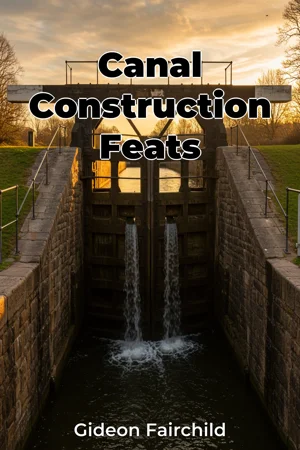
How have canals shaped the course of human history, impacting economies and geopolitical strategies across the globe? "Canal Construction Feats" explores the monumental engineering projects that have connected waterways, revolutionized trade, and influenced military campaigns, examining their lasting legacies on society. This book delves into two key topics: the economic transformations spurred by canal construction and the strategic importance of these waterways in shaping international relations. These topics are vital because canals have consistently served as catalysts for economic growth, facilitating the movement of goods and resources, while also acting as strategic assets, controlling vital trade routes and influencing military power projection. Understanding the historical context requires acknowledging the immense labor and complex engineering involved in building these canals, often characterized by significant social and environmental consequences. No prerequisite knowledge is needed to grasp the book's main concepts. The book argues that canal construction, while often portrayed as purely beneficial, entails a complex interplay of economic progress, strategic advantage, and social disruption, requiring a nuanced perspective to fully appreciate their impact. The book's structure unfolds in several stages. First, it introduces the fundamental principles of canal engineering and the economic theories underpinning their construction. Second, it examines case studies of significant canal projects, such as the Grand Canal of China, the Suez Canal, and the Panama Canal, detailing their construction, economic impact, and strategic significance. Third, it analyzes the social and environmental consequences of these projects, considering issues such as displacement, labor exploitation, and ecological damage. Finally, it culminates in a discussion of the future of canal construction in the context of globalization and climate change. Evidence presented throughout the book draws upon primary historical documents, engineering reports, economic data, and geographical analyses. Unique data sources include archival materials related to the planning and construction of the canals, as well as contemporary accounts from merchants, engineers, and laborers. "Canal Construction Feats" integrates insights from various disciplines, including history, economics, geography, and engineering. The link with economic history explores how canals affected trade routes and stimulated economic growth. The connection with geography examines how canals altered landscapes and influenced patterns of human settlement. These interdisciplinary connections enrich the book's argument by providing a holistic understanding of the complex impacts of canal construction. This book distinguishes itself by offering a balanced perspective on canal construction, acknowledging both the benefits and drawbacks of these projects. It avoids a purely celebratory narrative, critically examining the social and environmental costs often associated with these monumental undertakings. Written in a clear and accessible style, the book is aimed at a broad audience, including students of history, economics, and engineering, as well as general readers interested in the history of technology and infrastructure. It will appeal to those seeking a comprehensive and nuanced understanding of the lasting impact of canals on global society. As a work of non-fiction, the book adheres to the genre's conventions of accuracy, objectivity, and evidence-based argumentation. All claims are supported by verifiable sources, and different perspectives on the subject are considered. The book's scope encompasses major historical canal projects from around the world, with a focus on those that have had the most significant economic and strategic impacts. It acknowledges the limitations of focusing primarily on large-scale projects, recognizing that smaller canals have also played important roles in local and regional economies. The information presented in the book has practical applications for policymakers, urban planners, and engineers involved in infrastructure development. It provides valuable lessons about the economic, social, and environmental considerations that should be taken into account when planning and building new canals or modern infrastructure projects. The book addresses ongoing debates about the long-term sustainability of canal construction, particularly in the context of climate change and increasing water scarcity. It examines the potential for innovative engineering and management practices to mitigate the negative impacts of canals and ensure their continued relevance in the 21st century.
How have canals shaped the course of human history, impacting economies and geopolitical strategies across the globe? "Canal Construction Feats" explores the monumental engineering projects that have connected waterways, revolutionized trade, and influenced military campaigns, examining their lasting legacies on society. This book delves into two key topics: the economic transformations spurred by canal construction and the strategic importance of these waterways in shaping international relations. These topics are vital because canals have consistently served as catalysts for economic growth, facilitating the movement of goods and resources, while also acting as strategic assets, controlling vital trade routes and influencing military power projection. Understanding the historical context requires acknowledging the immense labor and complex engineering involved in building these canals, often characterized by significant social and environmental consequences. No prerequisite knowledge is needed to grasp the book's main concepts. The book argues that canal construction, while often portrayed as purely beneficial, entails a complex interplay of economic progress, strategic advantage, and social disruption, requiring a nuanced perspective to fully appreciate their impact. The book's structure unfolds in several stages. First, it introduces the fundamental principles of canal engineering and the economic theories underpinning their construction. Second, it examines case studies of significant canal projects, such as the Grand Canal of China, the Suez Canal, and the Panama Canal, detailing their construction, economic impact, and strategic significance. Third, it analyzes the social and environmental consequences of these projects, considering issues such as displacement, labor exploitation, and ecological damage. Finally, it culminates in a discussion of the future of canal construction in the context of globalization and climate change. Evidence presented throughout the book draws upon primary historical documents, engineering reports, economic data, and geographical analyses. Unique data sources include archival materials related to the planning and construction of the canals, as well as contemporary accounts from merchants, engineers, and laborers. "Canal Construction Feats" integrates insights from various disciplines, including history, economics, geography, and engineering. The link with economic history explores how canals affected trade routes and stimulated economic growth. The connection with geography examines how canals altered landscapes and influenced patterns of human settlement. These interdisciplinary connections enrich the book's argument by providing a holistic understanding of the complex impacts of canal construction. This book distinguishes itself by offering a balanced perspective on canal construction, acknowledging both the benefits and drawbacks of these projects. It avoids a purely celebratory narrative, critically examining the social and environmental costs often associated with these monumental undertakings. Written in a clear and accessible style, the book is aimed at a broad audience, including students of history, economics, and engineering, as well as general readers interested in the history of technology and infrastructure. It will appeal to those seeking a comprehensive and nuanced understanding of the lasting impact of canals on global society. As a work of non-fiction, the book adheres to the genre's conventions of accuracy, objectivity, and evidence-based argumentation. All claims are supported by verifiable sources, and different perspectives on the subject are considered. The book's scope encompasses major historical canal projects from around the world, with a focus on those that have had the most significant economic and strategic impacts. It acknowledges the limitations of focusing primarily on large-scale projects, recognizing that smaller canals have also played important roles in local and regional economies. The information presented in the book has practical applications for policymakers, urban planners, and engineers involved in infrastructure development. It provides valuable lessons about the economic, social, and environmental considerations that should be taken into account when planning and building new canals or modern infrastructure projects. The book addresses ongoing debates about the long-term sustainability of canal construction, particularly in the context of climate change and increasing water scarcity. It examines the potential for innovative engineering and management practices to mitigate the negative impacts of canals and ensure their continued relevance in the 21st century.
"Canal Construction Feats" examines the profound impact of canal construction on global economies and geopolitics. These strategic waterways have not only revolutionized trade routes but also played a pivotal role in shaping international relations. Consider, for example, how the Suez Canal dramatically shortened trade routes between Europe and Asia, or how the Panama Canal facilitated maritime transport between the Atlantic and Pacific Oceans, impacting global trade dynamics. The book highlights the economic transformations and strategic significance of these engineering feats throughout history. The book progresses chronologically, starting with the fundamental principles of canal engineering and economic theories, then delving into specific case studies like the Grand Canal of China, the Suez Canal, and the Panama Canal. It also critically analyzes the social and environmental consequences, offering a balanced perspective by acknowledging both the advantages and drawbacks of these monumental projects. By integrating insights from history, economics, geography, and engineering, the book provides a holistic understanding of how canal construction has shaped the world. Through its use of primary historical documents, engineering reports, and economic data, the book distinguishes itself by presenting a nuanced view of canal construction. It explores not only the economic benefits but also the social disruptions and ecological damage often associated with these projects. This approach provides valuable lessons for policymakers, urban planners, and engineers involved in modern infrastructure development, particularly in the context of globalization and climate change.
Book Details
ISBN
9788235275103
Publisher
Publifye AS
Your Licenses
You don't own any licenses for this book
Purchase a license below to unlock this book and download the EPUB.
Purchase License
Select a tier to unlock this book
Need bulk licensing?
Contact us for enterprise agreements.