
About This Book
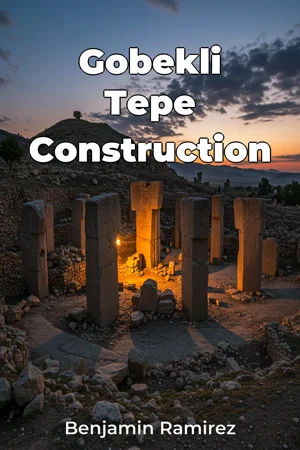
Imagine a site predating Stonehenge by six thousand years, a place where monumental architecture emerged seemingly out of nowhere. Gobekli Tepe, located in southeastern Turkey, challenges our understanding of the Neolithic Revolution. This book, 'Gobekli Tepe Construction,' delves into the mysteries surrounding this ancient temple complex, meticulously examining its construction, purpose, and the society that brought it into existence. We will explore the key questions: Who were the builders of Gobekli Tepe? What was the purpose of this elaborate structure? And how did they achieve such advanced construction techniques millennia before metal tools and widespread agriculture? This book establishes the central argument that Gobekli Tepe represents a pivotal moment in human history, signifying a shift towards organized religion and complex social structures far earlier than previously believed. Contrary to traditional narratives that link agriculture to the rise of settled societies and monumental construction, Gobekli Tepe suggests that religious and social imperatives may have preceded, or at least co-evolved with, agricultural practices. Understanding this paradigm shift is crucial for re-evaluating the trajectory of human civilization. The narrative unfolds in three major sections. We begin with an introduction to Gobekli Tepe, setting the archaeological and historical context. This includes a detailed description of the site's layout, the T-shaped pillars adorned with intricate animal carvings, and the various enclosures discovered through excavation. We then transition into an in-depth analysis of the construction techniques employed at Gobekli Tepe. This segment explores the quarrying, transportation, and erection of the massive pillars using only stone tools and human labor. Evidence from archaeological findings, geological surveys, and experimental archaeology are presented. The third section focuses on the purpose and meaning of Gobekli Tepe, exploring the potential rituals and beliefs that may have been practiced there. This involves analyzing the iconography of the carvings, considering the site's astronomical alignment, and drawing comparisons with other contemporary archaeological sites. Supporting our argument is an extensive review of archaeological data obtained from the ongoing excavations at Gobekli Tepe, combined with comparative analysis of other Neolithic sites in the Near East. We also draw upon geological studies to understand the sources of the stone used in construction and experimental archaeology to assess the feasibility of the construction methods proposed. This book connects to fields such as archaeology, anthropology, art history, and religious studies. It highlights the intersection of technological innovation and cultural evolution in early human societies. Our approach is to synthesize a broad range of evidence to provide a holistic reconstruction of Gobekli Tepe's creation and significance, moving beyond purely descriptive accounts to offer interpretive insights. Written in a clear and accessible style, this book is intended for anyone with an interest in archaeology, ancient history, or the origins of civilization. While maintaining academic rigor, the text avoids overly technical jargon, making it accessible to a general audience. The focus remains steadfastly on Gobekli Tepe and its immediate context, intentionally limiting the discussions of later periods or geographically distant cultures unless directly relevant to understanding the site. One of the ongoing debates explored in this book concerns the exact nature of the rituals performed at Gobekli Tepe and the specific role of the animal symbolism in these rituals. By presenting various interpretations and weighing the evidence for each, we aim to provide readers with a nuanced understanding of the complexities surrounding Gobekli Tepe. The real-world application of the knowledge presented lies in its potential to reshape our understanding of early human societies and to challenge conventional narratives about the origins of civilization. 'Gobekli Tepe Construction' offers readers a comprehensive exploration of this remarkable site helping to re-evaluate the history of human civilization.
Imagine a site predating Stonehenge by six thousand years, a place where monumental architecture emerged seemingly out of nowhere. Gobekli Tepe, located in southeastern Turkey, challenges our understanding of the Neolithic Revolution. This book, 'Gobekli Tepe Construction,' delves into the mysteries surrounding this ancient temple complex, meticulously examining its construction, purpose, and the society that brought it into existence. We will explore the key questions: Who were the builders of Gobekli Tepe? What was the purpose of this elaborate structure? And how did they achieve such advanced construction techniques millennia before metal tools and widespread agriculture? This book establishes the central argument that Gobekli Tepe represents a pivotal moment in human history, signifying a shift towards organized religion and complex social structures far earlier than previously believed. Contrary to traditional narratives that link agriculture to the rise of settled societies and monumental construction, Gobekli Tepe suggests that religious and social imperatives may have preceded, or at least co-evolved with, agricultural practices. Understanding this paradigm shift is crucial for re-evaluating the trajectory of human civilization. The narrative unfolds in three major sections. We begin with an introduction to Gobekli Tepe, setting the archaeological and historical context. This includes a detailed description of the site's layout, the T-shaped pillars adorned with intricate animal carvings, and the various enclosures discovered through excavation. We then transition into an in-depth analysis of the construction techniques employed at Gobekli Tepe. This segment explores the quarrying, transportation, and erection of the massive pillars using only stone tools and human labor. Evidence from archaeological findings, geological surveys, and experimental archaeology are presented. The third section focuses on the purpose and meaning of Gobekli Tepe, exploring the potential rituals and beliefs that may have been practiced there. This involves analyzing the iconography of the carvings, considering the site's astronomical alignment, and drawing comparisons with other contemporary archaeological sites. Supporting our argument is an extensive review of archaeological data obtained from the ongoing excavations at Gobekli Tepe, combined with comparative analysis of other Neolithic sites in the Near East. We also draw upon geological studies to understand the sources of the stone used in construction and experimental archaeology to assess the feasibility of the construction methods proposed. This book connects to fields such as archaeology, anthropology, art history, and religious studies. It highlights the intersection of technological innovation and cultural evolution in early human societies. Our approach is to synthesize a broad range of evidence to provide a holistic reconstruction of Gobekli Tepe's creation and significance, moving beyond purely descriptive accounts to offer interpretive insights. Written in a clear and accessible style, this book is intended for anyone with an interest in archaeology, ancient history, or the origins of civilization. While maintaining academic rigor, the text avoids overly technical jargon, making it accessible to a general audience. The focus remains steadfastly on Gobekli Tepe and its immediate context, intentionally limiting the discussions of later periods or geographically distant cultures unless directly relevant to understanding the site. One of the ongoing debates explored in this book concerns the exact nature of the rituals performed at Gobekli Tepe and the specific role of the animal symbolism in these rituals. By presenting various interpretations and weighing the evidence for each, we aim to provide readers with a nuanced understanding of the complexities surrounding Gobekli Tepe. The real-world application of the knowledge presented lies in its potential to reshape our understanding of early human societies and to challenge conventional narratives about the origins of civilization. 'Gobekli Tepe Construction' offers readers a comprehensive exploration of this remarkable site helping to re-evaluate the history of human civilization.
"Gobekli Tepe Construction" explores the groundbreaking archaeological site in Turkey that predates Stonehenge by millennia, challenging established timelines of the Neolithic Revolution. This ancient temple complex reveals sophisticated construction techniques and monumental architecture, suggesting that complex religious and social structures emerged far earlier than previously thought. One intriguing aspect is the presence of T-shaped pillars adorned with intricate animal carvings, raising questions about the rituals and beliefs of early human societies. The book argues that Gobekli Tepe marks a pivotal shift in human history, potentially indicating that religious imperatives spurred societal development before, or alongside, agricultural practices. The book begins by establishing the archaeological and historical context of Gobekli Tepe, detailing the site's layout and the unique features of its enclosures. It then transitions into an in-depth analysis of the construction methods used, examining how massive pillars were quarried, transported, and erected using only stone tools and human labor. Finally, the book explores the purpose and meaning of Gobekli Tepe, considering the iconography of the carvings and their potential astronomical alignments. By synthesizing archaeological findings and geological surveys, "Gobekli Tepe Construction" provides a holistic perspective on this remarkable site and its significance in reshaping our understanding of early human civilization.
Book Details
ISBN
9788235274694
Publisher
Publifye AS
Your Licenses
You don't own any licenses for this book
Purchase a license below to unlock this book and download the EPUB.
Purchase License
Select a tier to unlock this book
Need bulk licensing?
Contact us for enterprise agreements.