
About This Book
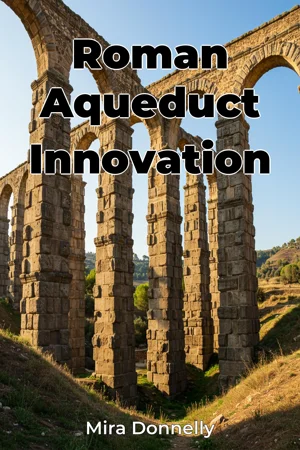
Did the Roman Empire's dominance across the Mediterranean hinge as much on its sophisticated water management as on its military might? "Roman Aqueduct Innovation" explores this very question, delving into the intricate engineering principles, comprehensive maintenance systems, and profound urban impact of Roman aqueducts throughout the Mediterranean world. This book examines how the Roman mastery of hydraulics not only sustained burgeoning cities but also shaped the social, economic, and political landscape of the Empire. The book focuses on three primary areas: the ingenious engineering that made these monumental structures possible, the highly organized maintenance systems that ensured their longevity, and the transformative impact these aqueducts had on urban development. These topics are crucial because they highlight the Romans' exceptional capacity for innovation and their understanding of the critical link between infrastructure and societal well-being. Without a reliable water supply, the growth and prosperity of Roman cities would have been severely limited, impacting everything from public health to industrial production. The historical, social, and scientific context surrounding Roman aqueducts is essential to understanding their significance. This book offers a foundational understanding of Roman engineering techniques, including surveying, materials science (particularly the use of Roman concrete), and hydraulic principles. No prior specialized knowledge is required; the book provides clear explanations of relevant technical concepts. The central argument of "Roman Aqueduct Innovation" is that the Roman aqueduct system represents a pinnacle of ancient engineering and a crucial element in the success and longevity of the Roman Empire. It argues that the aqueducts were not merely conduits for water but complex socio-technical systems that required substantial investment, skillful management, and a deep understanding of the natural environment. The book is structured to provide a comprehensive overview of the subject. It begins by introducing the fundamental principles of Roman hydraulics and construction techniques. The subsequent sections explore the development and evolution of aqueduct design, examining case studies from various regions of the Roman Empire, including those in Italy, Gaul, Spain, and North Africa. A dedicated section addresses the organizational structures and maintenance practices that ensured the continuous operation of these systems over centuries. Finally, the book analyzes the urban impact of aqueducts, considering their influence on population density, public health, sanitation, and the development of urban amenities like public baths and fountains. The book concludes by considering the legacy of Roman aqueducts and their influence on subsequent water management systems. The arguments presented are supported by a variety of evidence, including archaeological findings, surviving architectural remains, ancient texts (such as those by Vitruvius and Pliny the Elder), and epigraphic evidence (inscriptions that provide information about the construction and maintenance of aqueducts). The book will also incorporate recent scholarship and digital reconstructions to offer fresh insights into these remarkable structures. "Roman Aqueduct Innovation" connects to several other fields, including civil engineering, urban planning, environmental history, and social history. By examining the aqueducts from multiple perspectives, the book offers a richer and more nuanced understanding of their significance. The unique approach lies in its comprehensive analysis of the aqueducts as integrated systems, encompassing not only their physical construction but also their social, economic, and environmental dimensions. The tone of the book is academic yet accessible, aiming to engage both scholars and general readers with an interest in Roman history, engineering, or urban development. The book is intended for students, researchers, and anyone fascinated by the ingenuity and achievements of the Roman Empire. Its genre aligns with world history and architecture, conforming to the conventions of scholarly research and clear, well-supported analysis. The book's scope is limited to the design, construction, maintenance, and urban impact of Roman aqueducts throughout the Mediterranean region. It does not delve into other aspects of Roman water management, such as sewage systems or agricultural irrigation, except where they directly relate to the aqueducts. The knowledge presented in the book has real-world applications and can inform contemporary discussions about sustainable infrastructure development and water resource management, especially in regions facing similar challenges. While the book presents an objective overview, it will also acknowledge ongoing debates about the precise methods used in Roman aqueduct construction and the extent of their environmental impact.
Did the Roman Empire's dominance across the Mediterranean hinge as much on its sophisticated water management as on its military might? "Roman Aqueduct Innovation" explores this very question, delving into the intricate engineering principles, comprehensive maintenance systems, and profound urban impact of Roman aqueducts throughout the Mediterranean world. This book examines how the Roman mastery of hydraulics not only sustained burgeoning cities but also shaped the social, economic, and political landscape of the Empire. The book focuses on three primary areas: the ingenious engineering that made these monumental structures possible, the highly organized maintenance systems that ensured their longevity, and the transformative impact these aqueducts had on urban development. These topics are crucial because they highlight the Romans' exceptional capacity for innovation and their understanding of the critical link between infrastructure and societal well-being. Without a reliable water supply, the growth and prosperity of Roman cities would have been severely limited, impacting everything from public health to industrial production. The historical, social, and scientific context surrounding Roman aqueducts is essential to understanding their significance. This book offers a foundational understanding of Roman engineering techniques, including surveying, materials science (particularly the use of Roman concrete), and hydraulic principles. No prior specialized knowledge is required; the book provides clear explanations of relevant technical concepts. The central argument of "Roman Aqueduct Innovation" is that the Roman aqueduct system represents a pinnacle of ancient engineering and a crucial element in the success and longevity of the Roman Empire. It argues that the aqueducts were not merely conduits for water but complex socio-technical systems that required substantial investment, skillful management, and a deep understanding of the natural environment. The book is structured to provide a comprehensive overview of the subject. It begins by introducing the fundamental principles of Roman hydraulics and construction techniques. The subsequent sections explore the development and evolution of aqueduct design, examining case studies from various regions of the Roman Empire, including those in Italy, Gaul, Spain, and North Africa. A dedicated section addresses the organizational structures and maintenance practices that ensured the continuous operation of these systems over centuries. Finally, the book analyzes the urban impact of aqueducts, considering their influence on population density, public health, sanitation, and the development of urban amenities like public baths and fountains. The book concludes by considering the legacy of Roman aqueducts and their influence on subsequent water management systems. The arguments presented are supported by a variety of evidence, including archaeological findings, surviving architectural remains, ancient texts (such as those by Vitruvius and Pliny the Elder), and epigraphic evidence (inscriptions that provide information about the construction and maintenance of aqueducts). The book will also incorporate recent scholarship and digital reconstructions to offer fresh insights into these remarkable structures. "Roman Aqueduct Innovation" connects to several other fields, including civil engineering, urban planning, environmental history, and social history. By examining the aqueducts from multiple perspectives, the book offers a richer and more nuanced understanding of their significance. The unique approach lies in its comprehensive analysis of the aqueducts as integrated systems, encompassing not only their physical construction but also their social, economic, and environmental dimensions. The tone of the book is academic yet accessible, aiming to engage both scholars and general readers with an interest in Roman history, engineering, or urban development. The book is intended for students, researchers, and anyone fascinated by the ingenuity and achievements of the Roman Empire. Its genre aligns with world history and architecture, conforming to the conventions of scholarly research and clear, well-supported analysis. The book's scope is limited to the design, construction, maintenance, and urban impact of Roman aqueducts throughout the Mediterranean region. It does not delve into other aspects of Roman water management, such as sewage systems or agricultural irrigation, except where they directly relate to the aqueducts. The knowledge presented in the book has real-world applications and can inform contemporary discussions about sustainable infrastructure development and water resource management, especially in regions facing similar challenges. While the book presents an objective overview, it will also acknowledge ongoing debates about the precise methods used in Roman aqueduct construction and the extent of their environmental impact.
"Roman Aqueduct Innovation" explores the pivotal role of Roman aqueducts in shaping the Empire's dominance across the Mediterranean. It argues these structures were more than just conduits for water; they were complex systems integral to the Empire's socio-economic fabric. The book unveils how the Romans' mastery of hydraulics sustained growing cities and influenced public health, enabling advancements from sanitation to industrial production. The book highlights the innovative engineering and meticulous maintenance that ensured the longevity of these systems. The book uniquely examines aqueducts as integrated systems, encompassing their physical construction alongside their social and environmental impacts. It begins by outlining fundamental principles of Roman hydraulics and construction before delving into case studies from various regions, including Italy, Gaul, and North Africa. A dedicated section uncovers the organizational structures that maintained these systems for centuries. The book then analyzes the aqueducts' influence on urban life, considering factors like population density and the development of public amenities.
Book Details
ISBN
9788235274229
Publisher
Publifye AS
Your Licenses
You don't own any licenses for this book
Purchase a license below to unlock this book and download the EPUB.
Purchase License
Select a tier to unlock this book
Need bulk licensing?
Contact us for enterprise agreements.