
About This Book
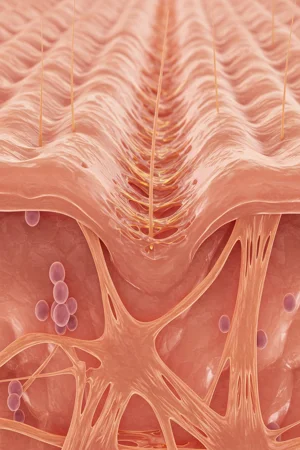
Have you ever wondered why skin seems to lose its youthful resilience over time, leading to the inevitable appearance of wrinkles? This book, "Wrinkle Formation," delves into the intricate science behind this universal phenomenon, exploring the biological, environmental, and lifestyle factors that contribute to the development of wrinkles. It is relevant because it provides a comprehensive understanding of the aging process at a cellular level, empowering readers to address concerns about skin aging with knowledge-based strategies. This book investigates how the skin's structural integrity weakens with age, primarily focusing on two key areas: the decline in collagen production and the loss of skin elasticity. Collagen, a fibrous protein, acts as the scaffolding of our skin, providing firmness and support. As we age, the body's natural ability to produce collagen diminishes, leading to a loss of skin volume and the formation of wrinkles. Simultaneously, the skin's elasticity, which allows it to stretch and bounce back, decreases due to changes in elastin fibers. This reduced elasticity contributes to the sagging and folding of the skin, further accentuating wrinkles. We also look at the significant role of hydration, diet, and proper skincare routines in either accelerating or slowing down wrinkle formation. Throughout "Wrinkle Formation," we present scientific evidence from various fields, including dermatology, biochemistry, and nutritional science, to support our arguments. We analyze the results of clinical trials, laboratory experiments, and population studies to provide a balanced and evidence-based perspective on the factors influencing wrinkle development. The book also draws upon historical perspectives on skin aging and societal views on beauty, providing context for the current focus on anti-aging strategies. The central argument of this book is that wrinkle formation is a complex process influenced by a combination of intrinsic aging factors and extrinsic environmental and lifestyle choices. Understanding this interplay is crucial for developing effective strategies to mitigate the visible signs of aging. We address this by exploring the following: An introduction to the anatomy and physiology of the skin, with a specific focus on the role of collagen and elastin. A detailed look at the aging process, including the genetic and hormonal factors that contribute to the decline in collagen production and skin elasticity. An examination of the environmental factors that accelerate wrinkle formation, such as sun exposure, pollution, and smoking. An analysis of the impact of diet and hydration on skin health, highlighting the importance of essential nutrients and antioxidants. A review of various skincare ingredients and treatments designed to combat wrinkle formation, evaluating their efficacy and potential side effects. The book culminates with a practical guide to developing personalized anti-aging strategies based on individual needs and risk factors. The book connects the fields of biology, nutrition, and environmental science to provide a holistic understanding of skin aging. It is written in a clear and accessible style, making complex scientific concepts understandable to a broad audience. The tone is informative and objective, presenting the latest research findings without sensationalism or unsubstantiated claims. The primary audience for "Wrinkle Formation" includes health-conscious individuals, skincare enthusiasts, and professionals in the beauty and wellness industries. It also provides useful information for students in relevant fields of study. The book offers valuable insights for anyone seeking to understand the science behind skin aging and make informed decisions about skincare and lifestyle choices. While "Wrinkle Formation" covers a wide range of topics related to wrinkle formation, it is important to note the limitations. The book focuses primarily on the biological and environmental factors that contribute to wrinkle development and does not delve deeply into surgical or cosmetic procedures. The information provided in this book is not intended as a substitute for professional medical advice. The information presented in this book has real-world applications for readers seeking to improve their skin health and reduce the appearance of wrinkles. By understanding the science behind wrinkle formation, readers can make informed decisions about their diet, skincare routine, and lifestyle choices to support healthy aging. The book addresses some controversies in the field, such as the effectiveness of certain anti-aging ingredients and the safety of various cosmetic procedures. By presenting the evidence from multiple perspectives, the book encourages readers to critically evaluate the information and make decisions that are right for them.
Have you ever wondered why skin seems to lose its youthful resilience over time, leading to the inevitable appearance of wrinkles? This book, "Wrinkle Formation," delves into the intricate science behind this universal phenomenon, exploring the biological, environmental, and lifestyle factors that contribute to the development of wrinkles. It is relevant because it provides a comprehensive understanding of the aging process at a cellular level, empowering readers to address concerns about skin aging with knowledge-based strategies. This book investigates how the skin's structural integrity weakens with age, primarily focusing on two key areas: the decline in collagen production and the loss of skin elasticity. Collagen, a fibrous protein, acts as the scaffolding of our skin, providing firmness and support. As we age, the body's natural ability to produce collagen diminishes, leading to a loss of skin volume and the formation of wrinkles. Simultaneously, the skin's elasticity, which allows it to stretch and bounce back, decreases due to changes in elastin fibers. This reduced elasticity contributes to the sagging and folding of the skin, further accentuating wrinkles. We also look at the significant role of hydration, diet, and proper skincare routines in either accelerating or slowing down wrinkle formation. Throughout "Wrinkle Formation," we present scientific evidence from various fields, including dermatology, biochemistry, and nutritional science, to support our arguments. We analyze the results of clinical trials, laboratory experiments, and population studies to provide a balanced and evidence-based perspective on the factors influencing wrinkle development. The book also draws upon historical perspectives on skin aging and societal views on beauty, providing context for the current focus on anti-aging strategies. The central argument of this book is that wrinkle formation is a complex process influenced by a combination of intrinsic aging factors and extrinsic environmental and lifestyle choices. Understanding this interplay is crucial for developing effective strategies to mitigate the visible signs of aging. We address this by exploring the following: An introduction to the anatomy and physiology of the skin, with a specific focus on the role of collagen and elastin. A detailed look at the aging process, including the genetic and hormonal factors that contribute to the decline in collagen production and skin elasticity. An examination of the environmental factors that accelerate wrinkle formation, such as sun exposure, pollution, and smoking. An analysis of the impact of diet and hydration on skin health, highlighting the importance of essential nutrients and antioxidants. A review of various skincare ingredients and treatments designed to combat wrinkle formation, evaluating their efficacy and potential side effects. The book culminates with a practical guide to developing personalized anti-aging strategies based on individual needs and risk factors. The book connects the fields of biology, nutrition, and environmental science to provide a holistic understanding of skin aging. It is written in a clear and accessible style, making complex scientific concepts understandable to a broad audience. The tone is informative and objective, presenting the latest research findings without sensationalism or unsubstantiated claims. The primary audience for "Wrinkle Formation" includes health-conscious individuals, skincare enthusiasts, and professionals in the beauty and wellness industries. It also provides useful information for students in relevant fields of study. The book offers valuable insights for anyone seeking to understand the science behind skin aging and make informed decisions about skincare and lifestyle choices. While "Wrinkle Formation" covers a wide range of topics related to wrinkle formation, it is important to note the limitations. The book focuses primarily on the biological and environmental factors that contribute to wrinkle development and does not delve deeply into surgical or cosmetic procedures. The information provided in this book is not intended as a substitute for professional medical advice. The information presented in this book has real-world applications for readers seeking to improve their skin health and reduce the appearance of wrinkles. By understanding the science behind wrinkle formation, readers can make informed decisions about their diet, skincare routine, and lifestyle choices to support healthy aging. The book addresses some controversies in the field, such as the effectiveness of certain anti-aging ingredients and the safety of various cosmetic procedures. By presenting the evidence from multiple perspectives, the book encourages readers to critically evaluate the information and make decisions that are right for them.
"Wrinkle Formation" explores the science behind skin aging, focusing on factors that contribute to wrinkles. The book explains how the decline in collagen production and loss of skin elasticity weaken the skin's structural integrity. Collagen acts as the skin's scaffolding, while elastin allows it to stretch; their deterioration leads to wrinkles and sagging. It examines how intrinsic aging factors combine with environmental and lifestyle choices, like sun exposure and diet, to impact skin health. The book analyzes evidence from dermatology, biochemistry, and nutrition to provide an evidence-based perspective of wrinkle development. For example, hydration, diet, and proper skincare routines significantly affect wrinkle formation. It progresses from the anatomy of the skin to environmental impacts and practical anti-aging strategies, offering readers a holistic view. Ultimately, "Wrinkle Formation" empowers readers with knowledge to make informed decisions about skincare and lifestyle choices. It connects biology, nutrition, and environmental science, presenting complex concepts in an accessible manner. This approach is invaluable for health-conscious individuals and skincare enthusiasts seeking to understand the science behind anti-aging strategies.
Book Details
ISBN
9788235274205
Publisher
Publifye AS
Your Licenses
You don't own any licenses for this book
Purchase a license below to unlock this book and download the EPUB.
Purchase License
Select a tier to unlock this book
Need bulk licensing?
Contact us for enterprise agreements.