
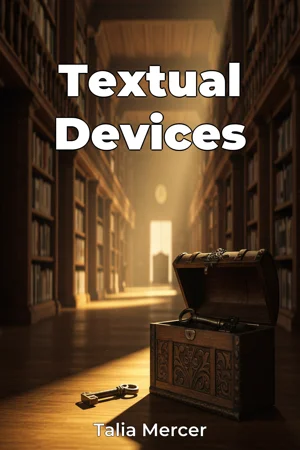
About This Book
Have you ever considered how much of a text’s power lies not only in *what* it says but *how* it says it? This book, *Textual Devices*, delves into the intricate world of literary techniques, offering a comprehensive guide to identifying, understanding, and appreciating the artful construction of written works. We will explore a diverse range of devices, with a particular focus on allegory, irony, and juxtaposition, and their pervasive influence across literary genres. These devices are not mere embellishments; they are fundamental building blocks that shape meaning, evoke emotion, and engage readers on multiple levels. Understanding them empowers us to move beyond a surface-level reading and to uncover the deeper layers of complexity and nuance that authors intentionally weave into their texts. This is particularly relevant in today's world, where media literacy and critical thinking are paramount. Our analysis begins with a foundational understanding of rhetoric and literary theory, tracing the evolution of these devices from classical origins to contemporary usage. We then move to an in-depth exploration of allegory, examining its role in conveying complex moral, political, or religious messages through symbolic narratives. Irony, in its various forms – dramatic, situational, and verbal – is dissected to reveal its capacity for satire, humor, and profound social commentary. Juxtaposition, the art of placing contrasting elements side-by-side, is examined for its ability to highlight thematic tensions, create startling effects, and challenge conventional perspectives. The book's central argument is that a conscious awareness of literary devices significantly enhances our comprehension of literature, enabling a more profound and enriching reading experience. Furthermore, it equips readers with the critical tools necessary to evaluate arguments, identify bias, and interpret complex narratives effectively. *Textual Devices* is structured to guide readers systematically through the subject matter. The introduction lays the groundwork by defining key terms and establishing a theoretical framework. Subsequent chapters are dedicated to individual devices or groups of related devices, each supported by detailed examples drawn from a wide range of literary works, including classic novels, poems, plays, and essays. The book culminates in a discussion of the practical applications of this knowledge, offering strategies for analyzing texts, crafting persuasive arguments, and appreciating the art of writing. Our analysis relies on close readings of primary texts, supported by secondary scholarship from leading literary critics and theorists. We also draw on historical and cultural contexts to illuminate the significance of specific devices within particular periods and societies. This book incorporates perspectives from linguistics, philosophy, and cultural studies to enrich the analysis of each device. For instance, we will consider the philosophical underpinnings of irony as explored by thinkers like Kierkegaard, as well as the linguistic mechanics through which irony is conveyed. This book aims to be directly relevant to students of literature, language arts, and rhetoric, as well as educators seeking to enhance their teaching methods. It will also appeal to general readers interested in deepening their understanding and appreciation of literature. The scope encompasses a broad range of literary devices but focuses primarily on allegory, irony, and juxtaposition due to their prevalence and complexity. While we acknowledge the importance of other devices, a comprehensive treatment of every possible technique falls outside the scope of this work. Ultimately, *Textual Devices* seeks to empower readers to become more discerning and engaged consumers of literature, equipping them with the tools necessary to unlock the hidden depths and appreciate the artistry of the written word.
Have you ever considered how much of a text’s power lies not only in *what* it says but *how* it says it? This book, *Textual Devices*, delves into the intricate world of literary techniques, offering a comprehensive guide to identifying, understanding, and appreciating the artful construction of written works. We will explore a diverse range of devices, with a particular focus on allegory, irony, and juxtaposition, and their pervasive influence across literary genres. These devices are not mere embellishments; they are fundamental building blocks that shape meaning, evoke emotion, and engage readers on multiple levels. Understanding them empowers us to move beyond a surface-level reading and to uncover the deeper layers of complexity and nuance that authors intentionally weave into their texts. This is particularly relevant in today's world, where media literacy and critical thinking are paramount. Our analysis begins with a foundational understanding of rhetoric and literary theory, tracing the evolution of these devices from classical origins to contemporary usage. We then move to an in-depth exploration of allegory, examining its role in conveying complex moral, political, or religious messages through symbolic narratives. Irony, in its various forms – dramatic, situational, and verbal – is dissected to reveal its capacity for satire, humor, and profound social commentary. Juxtaposition, the art of placing contrasting elements side-by-side, is examined for its ability to highlight thematic tensions, create startling effects, and challenge conventional perspectives. The book's central argument is that a conscious awareness of literary devices significantly enhances our comprehension of literature, enabling a more profound and enriching reading experience. Furthermore, it equips readers with the critical tools necessary to evaluate arguments, identify bias, and interpret complex narratives effectively. *Textual Devices* is structured to guide readers systematically through the subject matter. The introduction lays the groundwork by defining key terms and establishing a theoretical framework. Subsequent chapters are dedicated to individual devices or groups of related devices, each supported by detailed examples drawn from a wide range of literary works, including classic novels, poems, plays, and essays. The book culminates in a discussion of the practical applications of this knowledge, offering strategies for analyzing texts, crafting persuasive arguments, and appreciating the art of writing. Our analysis relies on close readings of primary texts, supported by secondary scholarship from leading literary critics and theorists. We also draw on historical and cultural contexts to illuminate the significance of specific devices within particular periods and societies. This book incorporates perspectives from linguistics, philosophy, and cultural studies to enrich the analysis of each device. For instance, we will consider the philosophical underpinnings of irony as explored by thinkers like Kierkegaard, as well as the linguistic mechanics through which irony is conveyed. This book aims to be directly relevant to students of literature, language arts, and rhetoric, as well as educators seeking to enhance their teaching methods. It will also appeal to general readers interested in deepening their understanding and appreciation of literature. The scope encompasses a broad range of literary devices but focuses primarily on allegory, irony, and juxtaposition due to their prevalence and complexity. While we acknowledge the importance of other devices, a comprehensive treatment of every possible technique falls outside the scope of this work. Ultimately, *Textual Devices* seeks to empower readers to become more discerning and engaged consumers of literature, equipping them with the tools necessary to unlock the hidden depths and appreciate the artistry of the written word.
"Textual Devices" explores the power of literary techniques, focusing on how they shape meaning and engage readers. Understanding these devices allows us to move beyond surface-level reading, uncovering the deeper layers of complexity within written works. For example, irony, a key focus, can be used for satire, humor, or social commentary, highlighting its versatility as a textual device. The book emphasizes the importance of critical thinking and media literacy in today's world, providing tools for analyzing texts and identifying bias. The book begins with a foundational understanding of rhetoric and literary theory before diving into specific devices like allegory, irony, and juxtaposition. Allegory, for instance, conveys complex messages through symbolic narratives. Each device is supported by examples from classic novels, poems, plays, and essays. This approach provides a systematic guide to understanding and appreciating the artful construction of written works. This academic approach is structured to guide readers through the subject matter, with chapters dedicated to individual or related devices. It aims to enhance the comprehension of literature, enabling a more profound and enriching reading experience. By exploring these literary techniques, readers will gain a deeper appreciation for the artistry of writing and the power of language.
Book Details
ISBN
9788235273772
Publisher
Publifye AS
Your Licenses
You don't own any licenses for this book
Purchase a license below to unlock this book and download the EPUB.
Purchase License
Select a tier to unlock this book
Need bulk licensing?
Contact us for enterprise agreements.