
About This Book
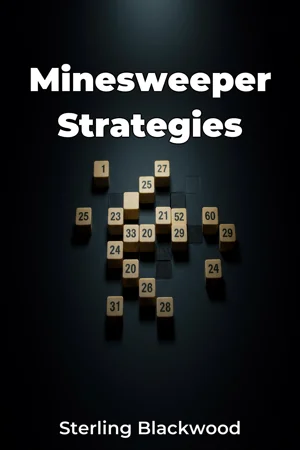
Have you ever wondered if there's more to Minesweeper than just random clicking and luck? "Minesweeper Strategies" unveils the sophisticated mathematical and logical framework hidden beneath the seemingly simple tile-clearing game. This book delves into the core principles of probability, combinatorics, and pattern recognition that are crucial for mastering Minesweeper, transforming it from a game of chance to a test of intellect. The significance lies in demonstrating how these abstract mathematical concepts can be practically applied to solve real-world problems involving risk assessment and strategic decision-making. This book provides a comprehensive exploration of Minesweeper, beginning with a historical overview of its origins and evolution within the landscape of computer games. While no prior advanced mathematical knowledge is strictly required, a basic understanding of probability and logical reasoning will enhance the reader's appreciation of the concepts presented. The central argument is that Minesweeper, far from being a trivial pastime, serves as an accessible model for understanding and applying complex problem-solving strategies. By dissecting the game's mechanics, we expose the power of logical deduction and probabilistic analysis in navigating uncertain environments. The book is structured to progressively build upon foundational concepts. Initially, it introduces the fundamental rules of Minesweeper and the basic logic required to identify safe tiles and potential mine locations. Next, it develops the core ideas of probability and combinatorics as they apply to complex board configurations, including advanced techniques like pattern recognition and edge-case analysis. A significant portion of the book is dedicated to illustrating these strategies with detailed examples and visual aids, allowing readers to grasp the underlying principles effectively. The culmination of these ideas leads to the development and presentation of advanced solving algorithms often employed by top Minesweeper players. Finally, the book explores the practical applications of these skills in various fields, such as data analysis, risk management, and artificial intelligence. The evidence presented throughout the book is derived from a combination of mathematical theory, experimental analysis, and empirical observation. We utilize game simulations and statistical analysis to validate the effectiveness of different strategies under various conditions. Unique data sources include extensive game logs from human players and AI algorithms, allowing for a comparative assessment of performance and strategy adoption. "Minesweeper Strategies" draws interdisciplinary connections to several fields. Firstly, it links directly to the field of artificial intelligence, exploring how AI algorithms can be designed to solve Minesweeper and learn optimal strategies. Secondly, it connects to cognitive science by examining the human decision-making processes involved in playing the game and the biases that can influence performance. Thirdly, it relates to risk management, demonstrating how the probabilistic analysis used in Minesweeper can be applied to assess and mitigate risks in various real-world scenarios. This book adopts a unique approach by focusing specifically on the mathematical underpinnings of Minesweeper strategies. It presents logical deduction and probabilistic analysis techniques in a straightforward, easy to understand manner. The tone of the book is both informative and engaging, using clear explanations and real-world examples to make complex concepts accessible to a broad audience. The target audience includes puzzle enthusiasts, students of mathematics and computer science, and anyone interested in improving their problem-solving skills. This book will be valuable to them because it offers a novel and engaging way to learn and apply mathematical concepts. As a work of non-fiction in the genres of Computers and Science, "Minesweeper Strategies" adheres to the convention of providing accurate and verifiable information supported by evidence and logical reasoning. The scope of the book is intentionally limited to the logical and mathematical strategies applicable to standard Minesweeper variations. It does not delve into the psychological aspects of gameplay or the social dynamics of Minesweeper communities. The practical applications described can be applied to any situation involving uncertainty and requiring reasoned decision-making. While Minesweeper itself is not subject to significant controversies, the book addresses the ongoing debate about the role of luck versus skill in determining outcomes. It argues that while luck plays a factor, strategic thinking and probabilistic reasoning can significantly improve a player's chances of success, effectively minimizing the impact of randomness.
Have you ever wondered if there's more to Minesweeper than just random clicking and luck? "Minesweeper Strategies" unveils the sophisticated mathematical and logical framework hidden beneath the seemingly simple tile-clearing game. This book delves into the core principles of probability, combinatorics, and pattern recognition that are crucial for mastering Minesweeper, transforming it from a game of chance to a test of intellect. The significance lies in demonstrating how these abstract mathematical concepts can be practically applied to solve real-world problems involving risk assessment and strategic decision-making. This book provides a comprehensive exploration of Minesweeper, beginning with a historical overview of its origins and evolution within the landscape of computer games. While no prior advanced mathematical knowledge is strictly required, a basic understanding of probability and logical reasoning will enhance the reader's appreciation of the concepts presented. The central argument is that Minesweeper, far from being a trivial pastime, serves as an accessible model for understanding and applying complex problem-solving strategies. By dissecting the game's mechanics, we expose the power of logical deduction and probabilistic analysis in navigating uncertain environments. The book is structured to progressively build upon foundational concepts. Initially, it introduces the fundamental rules of Minesweeper and the basic logic required to identify safe tiles and potential mine locations. Next, it develops the core ideas of probability and combinatorics as they apply to complex board configurations, including advanced techniques like pattern recognition and edge-case analysis. A significant portion of the book is dedicated to illustrating these strategies with detailed examples and visual aids, allowing readers to grasp the underlying principles effectively. The culmination of these ideas leads to the development and presentation of advanced solving algorithms often employed by top Minesweeper players. Finally, the book explores the practical applications of these skills in various fields, such as data analysis, risk management, and artificial intelligence. The evidence presented throughout the book is derived from a combination of mathematical theory, experimental analysis, and empirical observation. We utilize game simulations and statistical analysis to validate the effectiveness of different strategies under various conditions. Unique data sources include extensive game logs from human players and AI algorithms, allowing for a comparative assessment of performance and strategy adoption. "Minesweeper Strategies" draws interdisciplinary connections to several fields. Firstly, it links directly to the field of artificial intelligence, exploring how AI algorithms can be designed to solve Minesweeper and learn optimal strategies. Secondly, it connects to cognitive science by examining the human decision-making processes involved in playing the game and the biases that can influence performance. Thirdly, it relates to risk management, demonstrating how the probabilistic analysis used in Minesweeper can be applied to assess and mitigate risks in various real-world scenarios. This book adopts a unique approach by focusing specifically on the mathematical underpinnings of Minesweeper strategies. It presents logical deduction and probabilistic analysis techniques in a straightforward, easy to understand manner. The tone of the book is both informative and engaging, using clear explanations and real-world examples to make complex concepts accessible to a broad audience. The target audience includes puzzle enthusiasts, students of mathematics and computer science, and anyone interested in improving their problem-solving skills. This book will be valuable to them because it offers a novel and engaging way to learn and apply mathematical concepts. As a work of non-fiction in the genres of Computers and Science, "Minesweeper Strategies" adheres to the convention of providing accurate and verifiable information supported by evidence and logical reasoning. The scope of the book is intentionally limited to the logical and mathematical strategies applicable to standard Minesweeper variations. It does not delve into the psychological aspects of gameplay or the social dynamics of Minesweeper communities. The practical applications described can be applied to any situation involving uncertainty and requiring reasoned decision-making. While Minesweeper itself is not subject to significant controversies, the book addresses the ongoing debate about the role of luck versus skill in determining outcomes. It argues that while luck plays a factor, strategic thinking and probabilistic reasoning can significantly improve a player's chances of success, effectively minimizing the impact of randomness.
"Minesweeper Strategies" reveals the hidden mathematical and logical depths of a seemingly simple computer game. It transforms Minesweeper from a game of chance into a fascinating exploration of problem-solving, demonstrating how probability, combinatorics, and pattern recognition can be applied to master the game. Did you know that Minesweeper can be used as a model for understanding risk assessment and strategic decision-making in real-world scenarios? The book emphasizes how logical deduction and probabilistic analysis can significantly improve your chances of success. The book progresses from basic game rules to advanced solving algorithms, illustrating strategies with detailed examples and visual aids. It uniquely focuses on the mathematical underpinnings of Minesweeper, presenting these concepts in an accessible manner. By analyzing game logs from human players and AI algorithms, the book provides a comparative assessment of performance and strategy adoption. It connects Minesweeper strategies to fields like artificial intelligence, cognitive science, and risk management, making it valuable for puzzle enthusiasts and those interested in improving their problem-solving skills.
Book Details
ISBN
9788235273680
Publisher
Publifye AS
Your Licenses
You don't own any licenses for this book
Purchase a license below to unlock this book and download the EPUB.
Purchase License
Select a tier to unlock this book
Need bulk licensing?
Contact us for enterprise agreements.