
About This Book
How did the Songhai Empire, a political entity arising from relative obscurity, come to dominate West Africa for over a century? This book, "Songhai Military Strategy," delves into the intricate framework of the Songhai military and logistical systems, exploring how these structures enabled the empire’s rise and sustained its power. Understanding these systems is crucial for appreciating the complexities of West African history and the sophisticated organizational capabilities of pre-colonial African empires, a subject often overlooked in broader historical narratives. This book situates the Songhai Empire within the context of 15th and 16th-century West Africa, examining its social, economic, and political environment. Readers will gain insight into the predecessor empires, such as Mali, and the dynamics of trans-Saharan trade that fueled Songhai's growth. The book assumes a basic familiarity with African geography and a general understanding of pre-modern warfare, though key concepts will be clarified as needed. The central argument of "Songhai Military Strategy" is that the Songhai Empire’s dominance was not merely the result of charismatic leadership or chance, but rather the product of a deliberately engineered and effectively managed military and logistical infrastructure. This infrastructure allowed the Songhai to project power across vast distances, maintain control over diverse populations, and adapt to evolving military challenges. This study challenges simplistic narratives of African history by highlighting the empire's detailed organization and strategic thinking. The book is structured logically to support this argument. First, it introduces the historical context of the Songhai Empire, detailing its origins and the factors that contributed to its initial expansion. It then moves into a detailed examination of the Songhai military organization, covering topics such as army composition, command structure, and weaponry. A chapter dedicated to logistical support analyzes supply lines, transportation networks, and resource management. Finally, it explores the empire’s strategic doctrines and tactical adaptations through various key battles and campaigns, concluding with an analysis of the factors contributing to the empire’s eventual decline. The evidence presented in this book draws from a variety of sources, including primary accounts from Arabic chronicles, oral traditions collected by historians, and archaeological findings. Furthermore, it incorporates quantitative data regarding troop sizes, distances, and resource allocation, where available, to give a comprehensive picture of Songhai military capabilities. Special attention is given to cross-referencing and corroborating information from different sources to address potential biases. The study of Songhai military strategy connects to several other fields. Political science benefits from an examination of the administrative structures necessary to support a large military. Economic history provides insights into the resource mobilization and trade networks that sustained the Songhai armies. Anthropology contributes an understanding of the cultural factors influencing military organization and warrior ethos. These interdisciplinary connections enrich the book's analysis and broaden its relevance. This book offers a unique perspective by focusing specifically on the operational and logistical aspects of the Songhai military. Much of the existing literature emphasizes political history or broad cultural trends. By drilling down into the specifics of military organization and support, "Songhai Military Strategy" provides a more granular and insightful understanding of the empire’s power. Written in a formal but accessible style, the book aims to reach a broad audience, including students of African history, military history enthusiasts, and anyone interested in pre-colonial empires and their organizational systems. Its value lies in providing a detailed, evidence-based analysis of a major African empire, countering Eurocentric narratives and highlighting the sophistication of African societies. As a work of military history, "Songhai Military Strategy" adheres to the conventions of rigorous scholarship, including clear source citations, detailed maps, and a comprehensive bibliography. While aiming to provide a holistic view of the Songhai war machine, its scope is limited to the period of the empire’s greatest strength, roughly from the mid-15th to the late 16th centuries. This focus allows for a more in-depth analysis, even if it means excluding a detailed account of the empire's formative and decline phases. The lessons learned from studying the Songhai military have real-world applications. Modern military planners and strategists can draw insights from the Songhai example about the importance of logistics, communication, and adaptation in diverse operational environments. Furthermore, understanding the Songhai's system of governance provides valuable comparative data for political scientists studying state-building and empire management. While the Songhai Empire’s success is well-documented, the degree to which its military innovations were indigenous developments versus adaptations of existing strategies continues to be debated among scholars. This book engages with these debates by carefully weighing the available evidence and offering a nuanced perspective on the empire’s military achievements.
How did the Songhai Empire, a political entity arising from relative obscurity, come to dominate West Africa for over a century? This book, "Songhai Military Strategy," delves into the intricate framework of the Songhai military and logistical systems, exploring how these structures enabled the empire’s rise and sustained its power. Understanding these systems is crucial for appreciating the complexities of West African history and the sophisticated organizational capabilities of pre-colonial African empires, a subject often overlooked in broader historical narratives. This book situates the Songhai Empire within the context of 15th and 16th-century West Africa, examining its social, economic, and political environment. Readers will gain insight into the predecessor empires, such as Mali, and the dynamics of trans-Saharan trade that fueled Songhai's growth. The book assumes a basic familiarity with African geography and a general understanding of pre-modern warfare, though key concepts will be clarified as needed. The central argument of "Songhai Military Strategy" is that the Songhai Empire’s dominance was not merely the result of charismatic leadership or chance, but rather the product of a deliberately engineered and effectively managed military and logistical infrastructure. This infrastructure allowed the Songhai to project power across vast distances, maintain control over diverse populations, and adapt to evolving military challenges. This study challenges simplistic narratives of African history by highlighting the empire's detailed organization and strategic thinking. The book is structured logically to support this argument. First, it introduces the historical context of the Songhai Empire, detailing its origins and the factors that contributed to its initial expansion. It then moves into a detailed examination of the Songhai military organization, covering topics such as army composition, command structure, and weaponry. A chapter dedicated to logistical support analyzes supply lines, transportation networks, and resource management. Finally, it explores the empire’s strategic doctrines and tactical adaptations through various key battles and campaigns, concluding with an analysis of the factors contributing to the empire’s eventual decline. The evidence presented in this book draws from a variety of sources, including primary accounts from Arabic chronicles, oral traditions collected by historians, and archaeological findings. Furthermore, it incorporates quantitative data regarding troop sizes, distances, and resource allocation, where available, to give a comprehensive picture of Songhai military capabilities. Special attention is given to cross-referencing and corroborating information from different sources to address potential biases. The study of Songhai military strategy connects to several other fields. Political science benefits from an examination of the administrative structures necessary to support a large military. Economic history provides insights into the resource mobilization and trade networks that sustained the Songhai armies. Anthropology contributes an understanding of the cultural factors influencing military organization and warrior ethos. These interdisciplinary connections enrich the book's analysis and broaden its relevance. This book offers a unique perspective by focusing specifically on the operational and logistical aspects of the Songhai military. Much of the existing literature emphasizes political history or broad cultural trends. By drilling down into the specifics of military organization and support, "Songhai Military Strategy" provides a more granular and insightful understanding of the empire’s power. Written in a formal but accessible style, the book aims to reach a broad audience, including students of African history, military history enthusiasts, and anyone interested in pre-colonial empires and their organizational systems. Its value lies in providing a detailed, evidence-based analysis of a major African empire, countering Eurocentric narratives and highlighting the sophistication of African societies. As a work of military history, "Songhai Military Strategy" adheres to the conventions of rigorous scholarship, including clear source citations, detailed maps, and a comprehensive bibliography. While aiming to provide a holistic view of the Songhai war machine, its scope is limited to the period of the empire’s greatest strength, roughly from the mid-15th to the late 16th centuries. This focus allows for a more in-depth analysis, even if it means excluding a detailed account of the empire's formative and decline phases. The lessons learned from studying the Songhai military have real-world applications. Modern military planners and strategists can draw insights from the Songhai example about the importance of logistics, communication, and adaptation in diverse operational environments. Furthermore, understanding the Songhai's system of governance provides valuable comparative data for political scientists studying state-building and empire management. While the Songhai Empire’s success is well-documented, the degree to which its military innovations were indigenous developments versus adaptations of existing strategies continues to be debated among scholars. This book engages with these debates by carefully weighing the available evidence and offering a nuanced perspective on the empire’s military achievements.
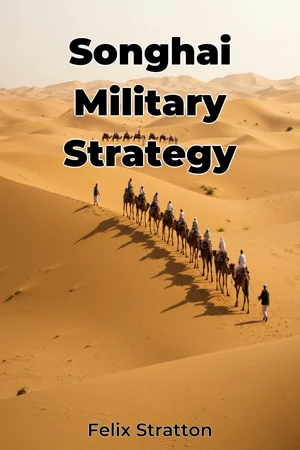
"Songhai Military Strategy" explores the rise and dominance of the Songhai Empire in 15th and 16th-century West Africa. It investigates how the empire's sophisticated military and logistical systems, often overlooked in traditional histories, were crucial to its success. The book argues that Songhai's power stemmed not just from leadership, but from a deliberately engineered military infrastructure, enabling them to control vast territories and adapt to evolving challenges. Intriguingly, the Songhai managed to project power across immense distances through effective resource management and strategic doctrines. The book examines the historical context, including predecessor empires and trans-Saharan trade dynamics, before delving into the Songhai military organization. It covers army composition, command structure, weaponry, and logistical support, analyzing supply lines and resource management. It then explores strategic doctrines and tactical adaptations through key battles and campaigns. By focusing on the operational and logistical aspects, the book provides a unique, granular understanding of the Songhai Empire's war machine. The book progresses logically, first introducing the empire's origins and expansion factors. Then, it examines military organization and logistical support. Finally, it analyzes strategic doctrines through key battles and the empire's eventual decline. Drawing from Arabic chronicles, oral traditions, and archaeological findings, the book offers a detailed, evidence-based analysis, making it valuable for students of African history, military history enthusiasts, and those interested in pre-colonial empires.
Book Details
ISBN
9788235273352
Publisher
Publifye AS
Your Licenses
You don't own any licenses for this book
Purchase a license below to unlock this book and download the EPUB.
Purchase License
Select a tier to unlock this book
Need bulk licensing?
Contact us for enterprise agreements.