
About This Book
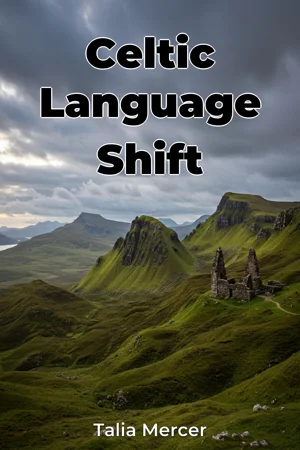
How do languages transform when confronted with persistent political and cultural dominance? "Celtic Language Shift" investigates this critical question by examining the dynamic evolution of Gaelic and Brythonic languages across Ireland, Scotland, and Wales. This book is essential for anyone interested in language evolution, Celtic history, or the sociopolitical forces shaping linguistic landscapes. This study focuses on two primary areas: the structural adaptations within Gaelic and Brythonic languages under external pressures, and the sociolinguistic factors driving language shift and maintenance. Understanding these topics is crucial because they illuminate broader patterns of language contact, endangerment, and revitalization worldwide. The book provides a historical, political, and social context, highlighting key events such as the Norman and English conquests, the Highland Clearances, and contemporary language revival movements. No prior knowledge of Celtic languages is required, as linguistic concepts are clearly explained. The central argument posits that the evolution of Gaelic and Brythonic languages has been profoundly shaped by sustained political and cultural pressures, resulting in both structural changes within the languages themselves and shifts in their usage across different communities. This argument is significant because it challenges simplistic notions of language decline as a purely natural phenomenon, emphasizing the role of power dynamics in shaping linguistic trajectories. The book is structured in four major sections. Part 1 introduces the Celtic language family, detailing its historical spread and the emergence of distinct Gaelic and Brythonic branches. It also establishes the theoretical framework for analyzing language contact and shift. Part 2 examines Ireland, focusing on the decline of the Irish language and the impact of English colonization on its grammar, vocabulary, and usage. Part 3 addresses Scotland and Wales, comparing and contrasting the experiences of Scottish Gaelic and Welsh under similar, yet distinct, pressures. This section highlights the varying degrees of language maintenance and revitalization in each region. Part 4 synthesizes the findings, drawing broader conclusions about language shift in minority language communities and exploring strategies for language preservation. The evidence presented in this book draws from a variety of sources, including historical documents, linguistic corpora, sociolinguistic surveys, and oral histories. A key methodological aspect is the comparative analysis of linguistic data across the three regions, revealing common patterns and unique adaptations. This book connects to several interdisciplinary fields, including history, sociology, and political science. By examining the historical context of language shift, the sociological factors influencing language attitudes, and the political policies affecting language use, the book provides a holistic understanding of the complex forces at play. "Celtic Language Shift" offers a unique perspective by comparing the experiences of three distinct Celtic-speaking regions, revealing both shared challenges and divergent paths. The book adopts an academic yet accessible tone, making it suitable for both specialists and general readers. The target audience includes students and scholars of linguistics, history, and Celtic studies, as well as anyone interested in language endangerment and revitalization. This exploration aligns with the conventions of language learning and history genres, focusing on factual analysis and evidence-based arguments. The scope is limited to the Gaelic and Brythonic languages of Ireland, Scotland, and Wales, acknowledging that other Celtic languages (e.g., Breton, Cornish) have also experienced significant shifts. The information in this book can be applied practically by policymakers and language activists seeking to develop effective strategies for language preservation and promotion. The book addresses ongoing debates about the causes and consequences of language shift, offering a nuanced perspective that considers both internal linguistic factors and external sociopolitical forces.
How do languages transform when confronted with persistent political and cultural dominance? "Celtic Language Shift" investigates this critical question by examining the dynamic evolution of Gaelic and Brythonic languages across Ireland, Scotland, and Wales. This book is essential for anyone interested in language evolution, Celtic history, or the sociopolitical forces shaping linguistic landscapes. This study focuses on two primary areas: the structural adaptations within Gaelic and Brythonic languages under external pressures, and the sociolinguistic factors driving language shift and maintenance. Understanding these topics is crucial because they illuminate broader patterns of language contact, endangerment, and revitalization worldwide. The book provides a historical, political, and social context, highlighting key events such as the Norman and English conquests, the Highland Clearances, and contemporary language revival movements. No prior knowledge of Celtic languages is required, as linguistic concepts are clearly explained. The central argument posits that the evolution of Gaelic and Brythonic languages has been profoundly shaped by sustained political and cultural pressures, resulting in both structural changes within the languages themselves and shifts in their usage across different communities. This argument is significant because it challenges simplistic notions of language decline as a purely natural phenomenon, emphasizing the role of power dynamics in shaping linguistic trajectories. The book is structured in four major sections. Part 1 introduces the Celtic language family, detailing its historical spread and the emergence of distinct Gaelic and Brythonic branches. It also establishes the theoretical framework for analyzing language contact and shift. Part 2 examines Ireland, focusing on the decline of the Irish language and the impact of English colonization on its grammar, vocabulary, and usage. Part 3 addresses Scotland and Wales, comparing and contrasting the experiences of Scottish Gaelic and Welsh under similar, yet distinct, pressures. This section highlights the varying degrees of language maintenance and revitalization in each region. Part 4 synthesizes the findings, drawing broader conclusions about language shift in minority language communities and exploring strategies for language preservation. The evidence presented in this book draws from a variety of sources, including historical documents, linguistic corpora, sociolinguistic surveys, and oral histories. A key methodological aspect is the comparative analysis of linguistic data across the three regions, revealing common patterns and unique adaptations. This book connects to several interdisciplinary fields, including history, sociology, and political science. By examining the historical context of language shift, the sociological factors influencing language attitudes, and the political policies affecting language use, the book provides a holistic understanding of the complex forces at play. "Celtic Language Shift" offers a unique perspective by comparing the experiences of three distinct Celtic-speaking regions, revealing both shared challenges and divergent paths. The book adopts an academic yet accessible tone, making it suitable for both specialists and general readers. The target audience includes students and scholars of linguistics, history, and Celtic studies, as well as anyone interested in language endangerment and revitalization. This exploration aligns with the conventions of language learning and history genres, focusing on factual analysis and evidence-based arguments. The scope is limited to the Gaelic and Brythonic languages of Ireland, Scotland, and Wales, acknowledging that other Celtic languages (e.g., Breton, Cornish) have also experienced significant shifts. The information in this book can be applied practically by policymakers and language activists seeking to develop effective strategies for language preservation and promotion. The book addresses ongoing debates about the causes and consequences of language shift, offering a nuanced perspective that considers both internal linguistic factors and external sociopolitical forces.
"Celtic Language Shift" explores how Gaelic and Brythonic languages in Ireland, Scotland, and Wales have transformed under persistent political and cultural dominance. This study investigates the structural adaptations within these languages and the sociolinguistic factors driving language shift and maintenance. The book highlights the impact of historical events like the Norman and English conquests and the Highland Clearances, providing a comprehensive view of language evolution in the face of external pressures. The book presents a historical, political, and social context to understand the complex forces at play. Examining the decline of the Irish language due to English colonization and comparing the experiences of Scottish Gaelic and Welsh, it reveals both shared challenges and unique adaptations in language maintenance. This comparative analysis offers insights into broader patterns of language contact, endangerment, and revitalization worldwide, challenging simplistic notions of language decline. Structured in four parts, the book introduces the Celtic language family, examines the situation in Ireland, then Scotland and Wales, and synthesizes the findings to draw broader conclusions about language shift. Using historical documents, linguistic corpora, and sociolinguistic surveys, "Celtic Language Shift" provides a nuanced perspective suitable for specialists and general readers interested in linguistics, Celtic history, and language preservation.
Book Details
ISBN
9788235271396
Publisher
Publifye AS
Your Licenses
You don't own any licenses for this book
Purchase a license below to unlock this book and download the EPUB.
Purchase License
Select a tier to unlock this book
Need bulk licensing?
Contact us for enterprise agreements.