
About This Book
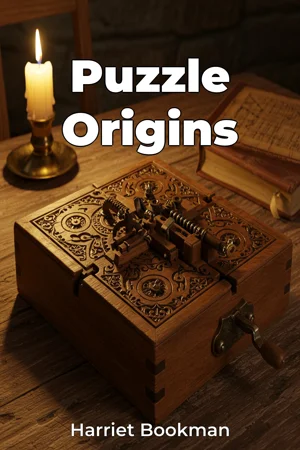
Have you ever wondered about the origins of that satisfying "aha!" moment when you finally solve a challenging puzzle? "Puzzle Origins" embarks on a journey to uncover the captivating history of puzzles, from their ancient roots to their modern manifestations, revealing their profound impact on human intellect and culture. This book explores the development of puzzles as more than mere diversions; they are tools that shape critical thinking, foster creativity, and reflect the evolving human experience. This book delves into three key areas: the emergence of riddles and wordplay in ancient civilizations, the ingenuity behind mechanical puzzles that sparked the Industrial Revolution, and the rise of logic and mathematical brain teasers that continue to challenge us today. Each of these topics offers a unique lens through which to understand the human fascination with problem-solving. Understanding how cultures across different eras have engaged with puzzles provides valuable insights into their cognitive development and societal values. To fully appreciate the evolution of puzzles, we will explore the corresponding historical and social contexts. From the oral traditions of ancient Greece, where riddles served as both entertainment and intellectual sparring, to the Victorian era, which saw a surge in mechanical puzzle design driven by technological advancements, the book provides a backdrop to the puzzle's trajectory. No specialized knowledge is required; the book is crafted to be accessible to anyone with a general interest in history and intellectual curiosities. The central argument of "Puzzle Origins" is that the history of puzzles mirrors the history of human ingenuity. Puzzles are not just trivial pastimes; they are concrete indicators of our cognitive abilities, our technological progress, and our capacity for creative problem-solving. By tracing the development of various puzzle forms, this book showcases the enduring human drive to understand and manipulate the world around us. The book begins by introducing the fundamental concepts of puzzles and their classification. From there, it explores the ancient world, examining riddles and word puzzles from cultures such as Egypt, Greece, and China, analyzing their role in education, entertainment, and spiritual practices. The book then transitions to mechanical puzzles, highlighting key inventors, designs, and the impact of industrialization on puzzle production. The final section focuses on logic and mathematical puzzles, including their connections to the development of mathematics, computer science, and artificial intelligence. Each section will culminate in an analysis of the broader implications of that puzzle type on human cognition and problem-solving strategies. The arguments presented are supported by extensive research drawn from historical texts, museum collections, and scholarly articles on puzzle history, mathematics, and cognitive science. Where possible, the book will include visual representations of puzzles, historical diagrams, and analyses of original puzzle manuals. "Puzzle Origins" also connects to diverse fields such as mathematics (exploring number theory and combinatorics in puzzle design), psychology (investigating the cognitive processes involved in problem-solving), and engineering (examining the mechanics and design principles of physical puzzles). These interdisciplinary connections serve to deepen the reader's understanding of the multifaceted nature of puzzles. This book presents a novel perspective by providing a comprehensive historical survey of puzzles, integrating perspectives from history, mathematics, and cognitive science. It approaches the subject matter in a narrative non-fiction style, blending historical accounts with insightful analysis, making it engaging and accessible to a broad audience. The target audience includes puzzle enthusiasts, history buffs, students of mathematics and computer science, and anyone interested in the history of human ingenuity. This book will be valuable to them because it offers a comprehensive and engaging overview of a topic that has been largely overlooked in mainstream historical literature. As a work of history and reference, this book adheres to the standards of accuracy, clarity, and comprehensive coverage. It provides properly cited sources and avoids subjective interpretations. The scope of the book is deliberately broad, encompassing a wide range of puzzle types and historical periods. The principles of problem-solving explored throughout the book can be applied to various real-world scenarios, from improving logical thinking skills to fostering innovation in design and engineering. By understanding how puzzles have challenged and stimulated human intellect throughout history, readers can gain insights into their own problem-solving capabilities. While the history of puzzles is largely uncontroversial, the book acknowledges ongoing debates regarding the precise origins of particular puzzle designs and the relative importance of different puzzle types in shaping cognitive skills.
Have you ever wondered about the origins of that satisfying "aha!" moment when you finally solve a challenging puzzle? "Puzzle Origins" embarks on a journey to uncover the captivating history of puzzles, from their ancient roots to their modern manifestations, revealing their profound impact on human intellect and culture. This book explores the development of puzzles as more than mere diversions; they are tools that shape critical thinking, foster creativity, and reflect the evolving human experience. This book delves into three key areas: the emergence of riddles and wordplay in ancient civilizations, the ingenuity behind mechanical puzzles that sparked the Industrial Revolution, and the rise of logic and mathematical brain teasers that continue to challenge us today. Each of these topics offers a unique lens through which to understand the human fascination with problem-solving. Understanding how cultures across different eras have engaged with puzzles provides valuable insights into their cognitive development and societal values. To fully appreciate the evolution of puzzles, we will explore the corresponding historical and social contexts. From the oral traditions of ancient Greece, where riddles served as both entertainment and intellectual sparring, to the Victorian era, which saw a surge in mechanical puzzle design driven by technological advancements, the book provides a backdrop to the puzzle's trajectory. No specialized knowledge is required; the book is crafted to be accessible to anyone with a general interest in history and intellectual curiosities. The central argument of "Puzzle Origins" is that the history of puzzles mirrors the history of human ingenuity. Puzzles are not just trivial pastimes; they are concrete indicators of our cognitive abilities, our technological progress, and our capacity for creative problem-solving. By tracing the development of various puzzle forms, this book showcases the enduring human drive to understand and manipulate the world around us. The book begins by introducing the fundamental concepts of puzzles and their classification. From there, it explores the ancient world, examining riddles and word puzzles from cultures such as Egypt, Greece, and China, analyzing their role in education, entertainment, and spiritual practices. The book then transitions to mechanical puzzles, highlighting key inventors, designs, and the impact of industrialization on puzzle production. The final section focuses on logic and mathematical puzzles, including their connections to the development of mathematics, computer science, and artificial intelligence. Each section will culminate in an analysis of the broader implications of that puzzle type on human cognition and problem-solving strategies. The arguments presented are supported by extensive research drawn from historical texts, museum collections, and scholarly articles on puzzle history, mathematics, and cognitive science. Where possible, the book will include visual representations of puzzles, historical diagrams, and analyses of original puzzle manuals. "Puzzle Origins" also connects to diverse fields such as mathematics (exploring number theory and combinatorics in puzzle design), psychology (investigating the cognitive processes involved in problem-solving), and engineering (examining the mechanics and design principles of physical puzzles). These interdisciplinary connections serve to deepen the reader's understanding of the multifaceted nature of puzzles. This book presents a novel perspective by providing a comprehensive historical survey of puzzles, integrating perspectives from history, mathematics, and cognitive science. It approaches the subject matter in a narrative non-fiction style, blending historical accounts with insightful analysis, making it engaging and accessible to a broad audience. The target audience includes puzzle enthusiasts, history buffs, students of mathematics and computer science, and anyone interested in the history of human ingenuity. This book will be valuable to them because it offers a comprehensive and engaging overview of a topic that has been largely overlooked in mainstream historical literature. As a work of history and reference, this book adheres to the standards of accuracy, clarity, and comprehensive coverage. It provides properly cited sources and avoids subjective interpretations. The scope of the book is deliberately broad, encompassing a wide range of puzzle types and historical periods. The principles of problem-solving explored throughout the book can be applied to various real-world scenarios, from improving logical thinking skills to fostering innovation in design and engineering. By understanding how puzzles have challenged and stimulated human intellect throughout history, readers can gain insights into their own problem-solving capabilities. While the history of puzzles is largely uncontroversial, the book acknowledges ongoing debates regarding the precise origins of particular puzzle designs and the relative importance of different puzzle types in shaping cognitive skills.
"Puzzle Origins" explores the rich history of puzzles, revealing how they've shaped human intellect and culture. From ancient riddles to modern brain teasers, the book showcases puzzles not just as diversions, but as tools for critical thinking and creativity. Did you know that ancient civilizations used riddles for both entertainment and intellectual sparring? Or that the Victorian era saw a boom in mechanical puzzles due to industrial advancements? The book journeys through time, beginning with ancient riddles in Egypt, Greece, and China, then moves to mechanical puzzles influenced by the Industrial Revolution. Finally, it examines logic and mathematical puzzles, connecting them to mathematics, computer science, and AI. The book argues that the history of puzzles mirrors human ingenuity, demonstrating our cognitive abilities and problem-solving skills. Each section analyzes the broader impact of puzzle types on human cognition. This reference work offers a comprehensive survey of puzzles, integrating perspectives from history, mathematics, and cognitive science. It presents a narrative non-fiction style, blending historical accounts with insightful analysis, making it accessible to a broad audience.
Book Details
ISBN
9788235270696
Publisher
Publifye AS
Your Licenses
You don't own any licenses for this book
Purchase a license below to unlock this book and download the EPUB.
Purchase License
Select a tier to unlock this book
Need bulk licensing?
Contact us for enterprise agreements.