
About This Book
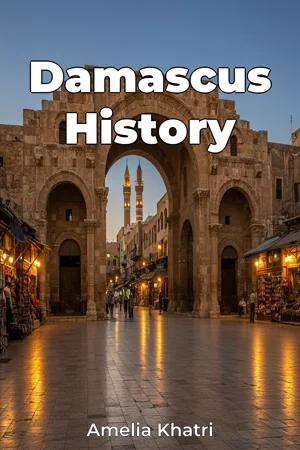
How has one city managed to thrive for millennia, witnessing the rise and fall of empires, the ebb and flow of countless cultures, and the constant reshaping of the world around it? This book, 'Damascus History,' delves into the remarkable story of Damascus, one of the oldest continuously inhabited cities on Earth, exploring its extensive history, its pivotal role in international trade, and its enduring cultural legacy. We will explore the multifaceted history of Damascus, focusing on its strategic geographic location which made it a coveted prize for various empires, including the Arameans, Romans, Byzantines, and Islamic caliphates. The book will address how its location also facilitated its emergence as a vital hub for trade routes connecting East and West, fostering economic prosperity and cultural exchange. Finally, we will examine the profound cultural impact of Damascus, tracing its influence on art, architecture, literature, and science throughout history. Understanding the history of Damascus requires a grasp of ancient Near Eastern history, the rise of Islam, and the dynamics of global trade networks. This book presents a comprehensive narrative, drawing on archaeological evidence, historical texts, and scholarly research to paint a vivid picture of Damascus through the ages. The central argument is that Damascus's enduring existence and historical significance stem from its unique combination of strategic location, economic adaptability, and cultural resilience. This argument challenges simplistic views of historical determinism, highlighting the complex interplay of factors that have shaped the city's destiny. The book is structured into three major sections. The first section introduces the ancient origins of Damascus, tracing its development from a small settlement to a prominent urban center. The second section explores the city's golden age under Islamic rule, focusing on its contributions to science, philosophy, and the arts. The third section examines the challenges and changes faced by Damascus in the modern era, including periods of Ottoman rule, French mandate, and contemporary conflicts. Then, the final chapter brings the book to a culmination, offering insights into the lessons that Damascus's history can teach us about urban resilience, cultural preservation, and the interconnectedness of human civilization. To support its arguments, this book relies on a diverse range of evidence, including archaeological excavations, ancient inscriptions, historical chronicles, and travel accounts. Primary source materials are analyzed alongside existing scholarly interpretations to provide a balanced and nuanced perspective. 'Damascus History' also connects to fields such as archaeology, religious studies, and Near Eastern studies. By integrating insights from these disciplines, the book offers a holistic understanding of Damascus's historical significance. This book stands out by offering a comprehensive and interdisciplinary examination of Damascus. It moves beyond a mere chronicle of events to explore the underlying factors that have shaped the city's identity and its role in world history. The book is written in an accessible style, aiming for a broad audience with an interest in world history, urban studies, and the Middle East. It will be valuable to students, researchers, and general readers alike. As a work of non-fiction history, this book adheres to the principles of accuracy, objectivity, and evidence-based analysis. It acknowledges areas of uncertainty or scholarly debate, presenting multiple perspectives on contested issues. The scope of the book extends from the earliest archaeological evidence of settlement in Damascus to the present day, with a focus on periods of significant historical change and cultural transformation. Limitations include the availability of primary source materials for certain periods and the ongoing challenges of conducting research in the region. The lessons from Damascus's history have real-world applications for urban planners, policymakers, and anyone interested in building sustainable and resilient communities. The book offers insights into managing cultural heritage, promoting economic development, and fostering intercultural dialogue in diverse urban environments. This book also addresses some of the ongoing debates surrounding the legacy of colonialism in the Middle East and the challenges of preserving cultural heritage in conflict zones. By engaging with these controversies, it aims to promote informed discussion and critical thinking about the region's complex past and present.
How has one city managed to thrive for millennia, witnessing the rise and fall of empires, the ebb and flow of countless cultures, and the constant reshaping of the world around it? This book, 'Damascus History,' delves into the remarkable story of Damascus, one of the oldest continuously inhabited cities on Earth, exploring its extensive history, its pivotal role in international trade, and its enduring cultural legacy. We will explore the multifaceted history of Damascus, focusing on its strategic geographic location which made it a coveted prize for various empires, including the Arameans, Romans, Byzantines, and Islamic caliphates. The book will address how its location also facilitated its emergence as a vital hub for trade routes connecting East and West, fostering economic prosperity and cultural exchange. Finally, we will examine the profound cultural impact of Damascus, tracing its influence on art, architecture, literature, and science throughout history. Understanding the history of Damascus requires a grasp of ancient Near Eastern history, the rise of Islam, and the dynamics of global trade networks. This book presents a comprehensive narrative, drawing on archaeological evidence, historical texts, and scholarly research to paint a vivid picture of Damascus through the ages. The central argument is that Damascus's enduring existence and historical significance stem from its unique combination of strategic location, economic adaptability, and cultural resilience. This argument challenges simplistic views of historical determinism, highlighting the complex interplay of factors that have shaped the city's destiny. The book is structured into three major sections. The first section introduces the ancient origins of Damascus, tracing its development from a small settlement to a prominent urban center. The second section explores the city's golden age under Islamic rule, focusing on its contributions to science, philosophy, and the arts. The third section examines the challenges and changes faced by Damascus in the modern era, including periods of Ottoman rule, French mandate, and contemporary conflicts. Then, the final chapter brings the book to a culmination, offering insights into the lessons that Damascus's history can teach us about urban resilience, cultural preservation, and the interconnectedness of human civilization. To support its arguments, this book relies on a diverse range of evidence, including archaeological excavations, ancient inscriptions, historical chronicles, and travel accounts. Primary source materials are analyzed alongside existing scholarly interpretations to provide a balanced and nuanced perspective. 'Damascus History' also connects to fields such as archaeology, religious studies, and Near Eastern studies. By integrating insights from these disciplines, the book offers a holistic understanding of Damascus's historical significance. This book stands out by offering a comprehensive and interdisciplinary examination of Damascus. It moves beyond a mere chronicle of events to explore the underlying factors that have shaped the city's identity and its role in world history. The book is written in an accessible style, aiming for a broad audience with an interest in world history, urban studies, and the Middle East. It will be valuable to students, researchers, and general readers alike. As a work of non-fiction history, this book adheres to the principles of accuracy, objectivity, and evidence-based analysis. It acknowledges areas of uncertainty or scholarly debate, presenting multiple perspectives on contested issues. The scope of the book extends from the earliest archaeological evidence of settlement in Damascus to the present day, with a focus on periods of significant historical change and cultural transformation. Limitations include the availability of primary source materials for certain periods and the ongoing challenges of conducting research in the region. The lessons from Damascus's history have real-world applications for urban planners, policymakers, and anyone interested in building sustainable and resilient communities. The book offers insights into managing cultural heritage, promoting economic development, and fostering intercultural dialogue in diverse urban environments. This book also addresses some of the ongoing debates surrounding the legacy of colonialism in the Middle East and the challenges of preserving cultural heritage in conflict zones. By engaging with these controversies, it aims to promote informed discussion and critical thinking about the region's complex past and present.
Damascus, one of the world's oldest continuously inhabited cities, is the central focus of *Damascus History*. This book explores the city's remarkable journey through millennia, revealing its pivotal role in trade, cultural exchange, and the rise and fall of empires. Intriguingly, Damascus's strategic geographic location made it a coveted prize, attracting powers from the Arameans to Islamic caliphates. Furthermore, its location fostered its emergence as a vital hub connecting East and West, driving economic prosperity and cultural exchange. *Damascus History* presents a comprehensive and interdisciplinary examination of the city. The book draws upon archaeological evidence, historical texts, and scholarly research to illuminate Damascus's story. Organized into three major sections, the book begins with the city's ancient origins, explores its golden age under Islamic rule, and examines the challenges it faced in the modern era, including periods of Ottoman rule, French mandate, and contemporary conflicts. The final chapter offers insights into the lessons that Damascus's history can teach us about urban resilience, cultural preservation, and the interconnectedness of human civilization.
Book Details
ISBN
9788235269379
Publisher
Publifye AS
Your Licenses
You don't own any licenses for this book
Purchase a license below to unlock this book and download the EPUB.
Purchase License
Select a tier to unlock this book
Need bulk licensing?
Contact us for enterprise agreements.