
About This Book
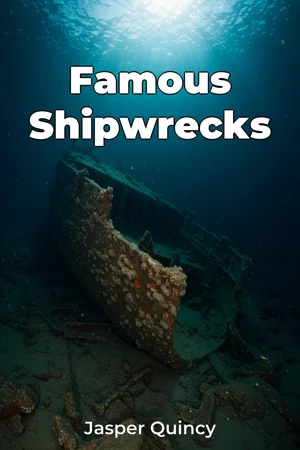
What secrets lie beneath the waves, entombed within the skeletal remains of history's lost vessels? "Famous Shipwrecks" delves into the captivating and often tragic stories of maritime disasters, exploring not only the events that led to their sinking but also the enduring legacies they left behind. This book examines well-known tragedies like the Titanic, mysteries surrounding lost pirate ships, and the technological advancements enabling deep-sea recovery missions. These topics are significant because shipwrecks offer unique insights into past societies, technological limitations, and the enduring human struggle against the power of the sea. Understanding shipwrecks requires a grasp of maritime history, naval architecture, and the environmental conditions that contribute to their preservation or decay. We'll explore the historical context of each featured vessel, examining the social and economic factors that influenced its design, construction, and operation. Basic knowledge of ocean currents, weather patterns, and diving technology will enrich the reader's understanding. The central argument of this book is that shipwrecks are more than just historical accidents; they are time capsules that offer tangible connections to the past, revealing crucial details about trade, warfare, exploration, and the human experience. The importance of this argument lies in its ability to transform our perception of maritime disasters, encouraging us to view them as valuable sources of historical and archaeological information. "Famous Shipwrecks" begins by introducing key concepts in maritime archaeology and wreck diving. The book then develops its central argument through several thematic sections. First, we investigate the most famous disasters, such as the Titanic, Lusitania, and the Vasa, analyzing the causes of their sinking and the immediate aftermath. Second, we explore the shadowy world of pirate ships, examining archaeological evidence to uncover details about their operations, weaponry, and the lives of the pirates themselves. Finally, the book explores the cutting-edge technology and ethical considerations involved in modern deep-sea recovery missions, showcasing the challenges and rewards of bringing these sunken treasures to light. The culmination of the argument will demonstrate how the study of shipwrecks contributes to a deeper understanding of human history and technological innovation. The evidence presented in "Famous Shipwrecks" draws from a variety of sources, including historical documents, survivor accounts, nautical charts, and archaeological surveys. High-resolution photographs and detailed illustrations will provide a visual record of the wrecks and the artifacts recovered from them. We feature unique data from recent expeditions. This book connects to several interdisciplinary fields, including history, archaeology, and oceanography. The historical lens provides context for the events leading to the shipwrecks, while the archaeological perspective focuses on the material remains and their interpretation. Oceanography helps us understand the environmental factors that influenced the wrecks' preservation and discovery. This interdisciplinary approach enhances the book's argument by providing a more holistic and nuanced understanding of maritime disasters. "Famous Shipwrecks" offers a unique perspective by combining historical narrative with archaeological analysis and insights into the latest deep-sea exploration techniques. The tone of the book will be informative and engaging, blending factual accuracy with compelling storytelling. The writing style aims to be accessible to a broad audience, avoiding overly technical jargon while maintaining scholarly rigor. The target audience includes history enthusiasts, maritime buffs, archaeology aficionados, and anyone interested in adventure and exploration. This book will be valuable because it offers a comprehensive and engaging overview of famous shipwrecks, providing insights into the past and the present. As a work of narrative non-fiction, the book strives to present historical facts in an accessible and engaging manner. The scope of "Famous Shipwrecks" encompasses a wide range of maritime disasters from antiquity to the present day, with a focus on the most well-known and historically significant wrecks. The book intentionally limits its scope by focusing on individual shipwrecks rather than broader trends in maritime history. The information presented in "Famous Shipwrecks" has practical applications for those interested in maritime archaeology, wreck diving, and historical preservation. The book will address ongoing debates surrounding the ethics of deep-sea recovery, the ownership of salvaged artifacts, and the preservation of underwater cultural heritage. These controversies add depth and complexity to the narrative, encouraging readers to consider the ethical dimensions of exploring and interacting with shipwrecks.
What secrets lie beneath the waves, entombed within the skeletal remains of history's lost vessels? "Famous Shipwrecks" delves into the captivating and often tragic stories of maritime disasters, exploring not only the events that led to their sinking but also the enduring legacies they left behind. This book examines well-known tragedies like the Titanic, mysteries surrounding lost pirate ships, and the technological advancements enabling deep-sea recovery missions. These topics are significant because shipwrecks offer unique insights into past societies, technological limitations, and the enduring human struggle against the power of the sea. Understanding shipwrecks requires a grasp of maritime history, naval architecture, and the environmental conditions that contribute to their preservation or decay. We'll explore the historical context of each featured vessel, examining the social and economic factors that influenced its design, construction, and operation. Basic knowledge of ocean currents, weather patterns, and diving technology will enrich the reader's understanding. The central argument of this book is that shipwrecks are more than just historical accidents; they are time capsules that offer tangible connections to the past, revealing crucial details about trade, warfare, exploration, and the human experience. The importance of this argument lies in its ability to transform our perception of maritime disasters, encouraging us to view them as valuable sources of historical and archaeological information. "Famous Shipwrecks" begins by introducing key concepts in maritime archaeology and wreck diving. The book then develops its central argument through several thematic sections. First, we investigate the most famous disasters, such as the Titanic, Lusitania, and the Vasa, analyzing the causes of their sinking and the immediate aftermath. Second, we explore the shadowy world of pirate ships, examining archaeological evidence to uncover details about their operations, weaponry, and the lives of the pirates themselves. Finally, the book explores the cutting-edge technology and ethical considerations involved in modern deep-sea recovery missions, showcasing the challenges and rewards of bringing these sunken treasures to light. The culmination of the argument will demonstrate how the study of shipwrecks contributes to a deeper understanding of human history and technological innovation. The evidence presented in "Famous Shipwrecks" draws from a variety of sources, including historical documents, survivor accounts, nautical charts, and archaeological surveys. High-resolution photographs and detailed illustrations will provide a visual record of the wrecks and the artifacts recovered from them. We feature unique data from recent expeditions. This book connects to several interdisciplinary fields, including history, archaeology, and oceanography. The historical lens provides context for the events leading to the shipwrecks, while the archaeological perspective focuses on the material remains and their interpretation. Oceanography helps us understand the environmental factors that influenced the wrecks' preservation and discovery. This interdisciplinary approach enhances the book's argument by providing a more holistic and nuanced understanding of maritime disasters. "Famous Shipwrecks" offers a unique perspective by combining historical narrative with archaeological analysis and insights into the latest deep-sea exploration techniques. The tone of the book will be informative and engaging, blending factual accuracy with compelling storytelling. The writing style aims to be accessible to a broad audience, avoiding overly technical jargon while maintaining scholarly rigor. The target audience includes history enthusiasts, maritime buffs, archaeology aficionados, and anyone interested in adventure and exploration. This book will be valuable because it offers a comprehensive and engaging overview of famous shipwrecks, providing insights into the past and the present. As a work of narrative non-fiction, the book strives to present historical facts in an accessible and engaging manner. The scope of "Famous Shipwrecks" encompasses a wide range of maritime disasters from antiquity to the present day, with a focus on the most well-known and historically significant wrecks. The book intentionally limits its scope by focusing on individual shipwrecks rather than broader trends in maritime history. The information presented in "Famous Shipwrecks" has practical applications for those interested in maritime archaeology, wreck diving, and historical preservation. The book will address ongoing debates surrounding the ethics of deep-sea recovery, the ownership of salvaged artifacts, and the preservation of underwater cultural heritage. These controversies add depth and complexity to the narrative, encouraging readers to consider the ethical dimensions of exploring and interacting with shipwrecks.
"Famous Shipwrecks" explores the captivating world of maritime disasters, presenting shipwrecks not just as accidents, but as time capsules holding invaluable historical information. These underwater sites reveal crucial details about past societies, technological limitations, and humanity's relationship with the sea. For instance, the book delves into famous tragedies like the Titanic, analyzing the causes of its sinking and the enduring legacy it left behind, while also examining the mysteries surrounding lost pirate ships, uncovering details about their operations, weaponry, and the lives of the pirates themselves. The book uniquely combines historical narrative with archaeological analysis, incorporating insights into cutting-edge deep-sea exploration techniques. It progresses from introducing key concepts in maritime archaeology to exploring the most famous disasters and pirate ships, culminating in a discussion of modern deep-sea recovery missions and their ethical considerations. By drawing from historical documents, survivor accounts, nautical charts, and archaeological surveys, "Famous Shipwrecks" offers a comprehensive and engaging overview, making it valuable for history enthusiasts, maritime buffs, and anyone interested in adventure and exploration.
Book Details
ISBN
9788235267795
Publisher
Publifye AS
Your Licenses
You don't own any licenses for this book
Purchase a license below to unlock this book and download the EPUB.
Purchase License
Select a tier to unlock this book
Need bulk licensing?
Contact us for enterprise agreements.