
About This Book
Ever wondered how societies functioned financially before the advent of modern banking systems? "Money Before Banks" unveils the fascinating evolution of economic exchange, exploring the ingenuity and adaptability of ancient civilizations in creating systems of value and trade. This book delves into the historical depths of economics, focusing on bartering practices and the diverse forms of early currency that shaped pre-bank financial landscapes. This book is important because it illuminates the foundational economic principles that underpin modern finance, providing a crucial understanding of how societies organized their economies without the institutions we take for granted today. We explore two key themes: the mechanics of barter systems and the emergence of proto-currencies. Barter sheds light on the challenges of direct exchange and the need for standardized value, while early currencies demonstrate the human drive to create universally accepted mediums of exchange. To fully appreciate these concepts, we begin by establishing a historical context, examining the social and technological conditions that fostered the development of trade networks. Readers will benefit from a basic understanding of ancient history and rudimentary economic principles, but no specialized knowledge is required. The central argument of "Money Before Banks" asserts that the innovations in pre-banking financial systems were not merely primitive precursors to modern banking but rather sophisticated solutions to the challenges of economic coordination in their respective times. Understanding these systems reveals the core principles of money and value that persist even today, offering insights into the fundamental nature of economic exchange. This book is structured to guide readers through a chronological exploration, from the earliest forms of bartering to the development of commodity and representative currencies. a) Part 1 introduces the inherent problems of barter economies, such as the need for a "double coincidence of wants," and examines how early societies overcame these challenges through social structures and informal agreements. b) Part 2 investigates the emergence of commodity currencies, focusing on specific examples like salt, livestock, and precious metals, and analyzes their role in facilitating trade and storing wealth. c) Part 3 explores the development of representative currencies, such as tally sticks and early forms of coinage, and discusses their impact on economic complexity and specialization. Finally, we culminate with an overview of the lasting legacy of these early systems and their influence on the subsequent rise of formal banking institutions. The evidence presented in "Money Before Banks" draws upon archaeological findings, historical texts, and anthropological studies. We examine trade routes, analyze coin hoards, and interpret ancient economic records to reconstruct the financial practices of past civilizations. Unique data sources, such as cuneiform tablets detailing Mesopotamian trade transactions and anthropological studies of modern-day barter economies, provide rich empirical support for our arguments. "Money Before Banks" also connects to fields such as anthropology, sociology, and political science. By examining the social and political contexts in which these early financial systems operated, we gain a deeper understanding of their impact on societal development and power structures. Moreover, the book touches upon the psychology of money, exploring how perceptions of value and trust influenced the acceptance and use of different forms of currency. This book offers a fresh perspective by challenging the traditional view of pre-banking economies as unsophisticated or inefficient. It demonstrates the creativity and adaptability of ancient societies in devising financial solutions that met their specific needs and circumstances. Written in a clear and accessible style, "Money Before Banks" aims to engage a broad audience, including history enthusiasts, economics students, and anyone curious about the origins of money and banking. The book avoids technical jargon and complex mathematical models, making it accessible to readers with no prior knowledge of economics or finance. This book broadly covers ancient Mesopotamia, Egypt, Greece, and Rome and intentionally limits its scope to pre-banking systems, setting the stage for potential future examination of the history of banking itself. The insights offered in "Money Before Banks" have practical applications for understanding contemporary economic challenges, particularly in the context of cryptocurrencies and alternative payment systems. By examining the historical evolution of money, we can gain a deeper understanding of the principles that govern its acceptance and value, providing a valuable framework for evaluating new financial technologies. While there is general agreement on the historical progression of monetary systems, debates persist regarding the relative importance of different factors, such as social norms, technological innovation, and political power, in shaping their development. "Money Before Banks" addresses these debates by presenting a balanced and nuanced perspective, acknowledging the complexity and multifaceted nature of economic history.
Ever wondered how societies functioned financially before the advent of modern banking systems? "Money Before Banks" unveils the fascinating evolution of economic exchange, exploring the ingenuity and adaptability of ancient civilizations in creating systems of value and trade. This book delves into the historical depths of economics, focusing on bartering practices and the diverse forms of early currency that shaped pre-bank financial landscapes. This book is important because it illuminates the foundational economic principles that underpin modern finance, providing a crucial understanding of how societies organized their economies without the institutions we take for granted today. We explore two key themes: the mechanics of barter systems and the emergence of proto-currencies. Barter sheds light on the challenges of direct exchange and the need for standardized value, while early currencies demonstrate the human drive to create universally accepted mediums of exchange. To fully appreciate these concepts, we begin by establishing a historical context, examining the social and technological conditions that fostered the development of trade networks. Readers will benefit from a basic understanding of ancient history and rudimentary economic principles, but no specialized knowledge is required. The central argument of "Money Before Banks" asserts that the innovations in pre-banking financial systems were not merely primitive precursors to modern banking but rather sophisticated solutions to the challenges of economic coordination in their respective times. Understanding these systems reveals the core principles of money and value that persist even today, offering insights into the fundamental nature of economic exchange. This book is structured to guide readers through a chronological exploration, from the earliest forms of bartering to the development of commodity and representative currencies. a) Part 1 introduces the inherent problems of barter economies, such as the need for a "double coincidence of wants," and examines how early societies overcame these challenges through social structures and informal agreements. b) Part 2 investigates the emergence of commodity currencies, focusing on specific examples like salt, livestock, and precious metals, and analyzes their role in facilitating trade and storing wealth. c) Part 3 explores the development of representative currencies, such as tally sticks and early forms of coinage, and discusses their impact on economic complexity and specialization. Finally, we culminate with an overview of the lasting legacy of these early systems and their influence on the subsequent rise of formal banking institutions. The evidence presented in "Money Before Banks" draws upon archaeological findings, historical texts, and anthropological studies. We examine trade routes, analyze coin hoards, and interpret ancient economic records to reconstruct the financial practices of past civilizations. Unique data sources, such as cuneiform tablets detailing Mesopotamian trade transactions and anthropological studies of modern-day barter economies, provide rich empirical support for our arguments. "Money Before Banks" also connects to fields such as anthropology, sociology, and political science. By examining the social and political contexts in which these early financial systems operated, we gain a deeper understanding of their impact on societal development and power structures. Moreover, the book touches upon the psychology of money, exploring how perceptions of value and trust influenced the acceptance and use of different forms of currency. This book offers a fresh perspective by challenging the traditional view of pre-banking economies as unsophisticated or inefficient. It demonstrates the creativity and adaptability of ancient societies in devising financial solutions that met their specific needs and circumstances. Written in a clear and accessible style, "Money Before Banks" aims to engage a broad audience, including history enthusiasts, economics students, and anyone curious about the origins of money and banking. The book avoids technical jargon and complex mathematical models, making it accessible to readers with no prior knowledge of economics or finance. This book broadly covers ancient Mesopotamia, Egypt, Greece, and Rome and intentionally limits its scope to pre-banking systems, setting the stage for potential future examination of the history of banking itself. The insights offered in "Money Before Banks" have practical applications for understanding contemporary economic challenges, particularly in the context of cryptocurrencies and alternative payment systems. By examining the historical evolution of money, we can gain a deeper understanding of the principles that govern its acceptance and value, providing a valuable framework for evaluating new financial technologies. While there is general agreement on the historical progression of monetary systems, debates persist regarding the relative importance of different factors, such as social norms, technological innovation, and political power, in shaping their development. "Money Before Banks" addresses these debates by presenting a balanced and nuanced perspective, acknowledging the complexity and multifaceted nature of economic history.
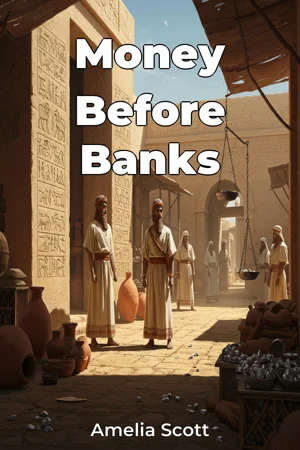
"Money Before Banks" explores the fascinating world of pre-banking economies, revealing how ancient societies managed trade and value exchange. It delves into early currency forms and barter systems, highlighting the ingenuity employed before modern financial institutions existed. The book emphasizes that these systems weren't just primitive precursors but sophisticated solutions tailored to their times. Discover how the challenges of barter, like the "double coincidence of wants," were overcome through social structures. The book progresses chronologically, starting with barter economies and moving through the development of commodity and representative currencies. Examples range from using salt and livestock as early currencies to the emergence of tally sticks and coinage. By examining archaeological findings and historical texts, the book provides a fresh perspective, demonstrating the creativity of ancient civilizations in devising financial solutions. This approach offers practical insights for understanding modern economic challenges, including the rise of cryptocurrencies.
Book Details
ISBN
9788235267436
Publisher
Publifye AS
Your Licenses
You don't own any licenses for this book
Purchase a license below to unlock this book and download the EPUB.
Purchase License
Select a tier to unlock this book
Need bulk licensing?
Contact us for enterprise agreements.