
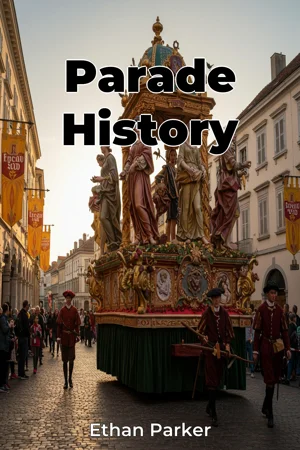
About This Book
Have you ever wondered about the origins of the seemingly ubiquitous parades that fill streets worldwide, from the grand spectacles featuring enormous balloons and intricate floats to the vibrant cultural displays of marching bands and traditional performances? "Parade History" delves into the rich and often unexpected stories behind these public celebrations, exploring their evolution from ancient rituals to modern-day expressions of identity and commemoration. This book examines parades through two primary lenses: their historical development and their role as a form of performing art. Understanding the historical context is crucial because parades often reflect significant social, political, and cultural shifts. Analyzing them as performance art reveals the deliberate construction of meaning through visual spectacle, music, and choreography. These two perspectives allow for a comprehensive understanding of the parade phenomenon. The book is structured chronologically and thematically. It begins by exploring the ancient roots of parades in religious processions and triumphal entries, tracing their development through the medieval period and the Renaissance, where civic and royal parades became more elaborate. The narrative then shifts to the rise of modern parades in the 19th and 20th centuries, focusing on the influence of industrialization, urbanization, and mass media on their form and function. Key examples, such as the Mardi Gras in New Orleans, the Macy's Thanksgiving Day Parade, and various St. Patrick's Day parades, are examined in detail to illustrate broader trends. The central argument of "Parade History" is that parades are not merely festive displays but powerful cultural texts that reflect and shape societal values, beliefs, and historical narratives. By understanding their history and artistic construction, we can gain a deeper appreciation of their significance in shaping collective identity and public memory. The evidence presented in this book draws from a variety of sources, including historical documents, newspaper accounts, photographs, parade route maps, and analyses of parade performances. The research also incorporates interdisciplinary perspectives from history, performance studies, art history, and sociology to provide a comprehensive understanding of the parade phenomenon. "Parade History" connects to several other fields of study, including sociology, which examines the social dynamics of parades; political science, which analyzes their use as tools of political expression; and art history, which explores their aesthetic dimensions. These connections enhance the book's argument by demonstrating the multifaceted nature of parades and their relevance to a wide range of academic disciplines. This book offers a unique perspective by analyzing parades as both historical events and carefully constructed performances. This approach allows for a deeper understanding of their cultural significance and their role in shaping collective identity. The writing style is accessible and engaging, aiming to appeal to a broad audience. The intended audience includes students and scholars of history, performing arts, and cultural studies, as well as general readers interested in the history and cultural significance of parades. This book would be valuable to them because it provides a comprehensive and interdisciplinary analysis of a ubiquitous yet often overlooked cultural phenomenon. As a work residing in the genres of 'Performing Arts' and 'History,' the book adheres to the conventions of rigorous historical research while also embracing the analytical tools of performance studies. The scope of the book is broad, covering parades from antiquity to the present day, but it also acknowledges certain limitations, such as the focus on parades in Western cultures due to the availability of sources. The information presented in "Parade History" can be applied practically by readers interested in organizing or analyzing parades. By understanding the history and artistic construction of parades, they can create more meaningful and impactful events or gain a deeper appreciation of the parades they attend. While this book strives for objectivity, it acknowledges that the interpretation of parades can be subject to debate, particularly regarding their representation of certain groups or historical events. By presenting a range of perspectives, the book aims to foster a more nuanced understanding of the complex cultural dynamics at play in parades.
Have you ever wondered about the origins of the seemingly ubiquitous parades that fill streets worldwide, from the grand spectacles featuring enormous balloons and intricate floats to the vibrant cultural displays of marching bands and traditional performances? "Parade History" delves into the rich and often unexpected stories behind these public celebrations, exploring their evolution from ancient rituals to modern-day expressions of identity and commemoration. This book examines parades through two primary lenses: their historical development and their role as a form of performing art. Understanding the historical context is crucial because parades often reflect significant social, political, and cultural shifts. Analyzing them as performance art reveals the deliberate construction of meaning through visual spectacle, music, and choreography. These two perspectives allow for a comprehensive understanding of the parade phenomenon. The book is structured chronologically and thematically. It begins by exploring the ancient roots of parades in religious processions and triumphal entries, tracing their development through the medieval period and the Renaissance, where civic and royal parades became more elaborate. The narrative then shifts to the rise of modern parades in the 19th and 20th centuries, focusing on the influence of industrialization, urbanization, and mass media on their form and function. Key examples, such as the Mardi Gras in New Orleans, the Macy's Thanksgiving Day Parade, and various St. Patrick's Day parades, are examined in detail to illustrate broader trends. The central argument of "Parade History" is that parades are not merely festive displays but powerful cultural texts that reflect and shape societal values, beliefs, and historical narratives. By understanding their history and artistic construction, we can gain a deeper appreciation of their significance in shaping collective identity and public memory. The evidence presented in this book draws from a variety of sources, including historical documents, newspaper accounts, photographs, parade route maps, and analyses of parade performances. The research also incorporates interdisciplinary perspectives from history, performance studies, art history, and sociology to provide a comprehensive understanding of the parade phenomenon. "Parade History" connects to several other fields of study, including sociology, which examines the social dynamics of parades; political science, which analyzes their use as tools of political expression; and art history, which explores their aesthetic dimensions. These connections enhance the book's argument by demonstrating the multifaceted nature of parades and their relevance to a wide range of academic disciplines. This book offers a unique perspective by analyzing parades as both historical events and carefully constructed performances. This approach allows for a deeper understanding of their cultural significance and their role in shaping collective identity. The writing style is accessible and engaging, aiming to appeal to a broad audience. The intended audience includes students and scholars of history, performing arts, and cultural studies, as well as general readers interested in the history and cultural significance of parades. This book would be valuable to them because it provides a comprehensive and interdisciplinary analysis of a ubiquitous yet often overlooked cultural phenomenon. As a work residing in the genres of 'Performing Arts' and 'History,' the book adheres to the conventions of rigorous historical research while also embracing the analytical tools of performance studies. The scope of the book is broad, covering parades from antiquity to the present day, but it also acknowledges certain limitations, such as the focus on parades in Western cultures due to the availability of sources. The information presented in "Parade History" can be applied practically by readers interested in organizing or analyzing parades. By understanding the history and artistic construction of parades, they can create more meaningful and impactful events or gain a deeper appreciation of the parades they attend. While this book strives for objectivity, it acknowledges that the interpretation of parades can be subject to debate, particularly regarding their representation of certain groups or historical events. By presenting a range of perspectives, the book aims to foster a more nuanced understanding of the complex cultural dynamics at play in parades.
"Parade History" explores the captivating story of parades, revealing them as more than just festive displays. These public celebrations, ubiquitous across the globe, are examined through the dual lenses of historical development and performing arts. The book traces their evolution from ancient rituals to expressions of cultural identity, highlighting how parades reflect social, political, and cultural shifts. For instance, the elaborate civic and royal parades of the Renaissance demonstrate how power and artistry intertwined in public spectacle. The book progresses chronologically, moving from the ancient world through the medieval period to the rise of modern parades, exemplified by events like Mardi Gras and the Macy's Thanksgiving Day Parade. These key examples illustrate broader trends influenced by industrialization and mass media. By analyzing parades' visual spectacle, music, and choreography, the book reveals how these events shape societal values, beliefs, and historical narratives. This unique approach, combining historical analysis with performance studies, offers readers a deeper understanding of the cultural significance of parades.
Book Details
ISBN
9788235267306
Publisher
Publifye AS
Your Licenses
You don't own any licenses for this book
Purchase a license below to unlock this book and download the EPUB.
Purchase License
Select a tier to unlock this book
Need bulk licensing?
Contact us for enterprise agreements.