
About This Book
Have you ever wondered why, across vastly different cultures, people celebrate the summer solstice with such fervor and strikingly similar rituals? "Midsummer Festivals" explores this fascinating global phenomenon, delving into the history, significance, and enduring appeal of midsummer celebrations around the world. This book examines the interconnectedness of human experience through the lens of seasonal festivities, offering a rich tapestry of cultural traditions and their underlying meanings. Our investigation centers on three key topics: the historical roots of midsummer festivals, the common symbolic elements found across cultures, and the contemporary relevance of these ancient practices. Understanding these areas sheds light on humanity's enduring connection to the natural world and the ways in which societies mark time, celebrate fertility, and reinforce community bonds. These topics are important because they reveal deep-seated patterns in human behavior and belief systems, offering insights into our shared past and present. The book provides historical context by tracing the origins of midsummer celebrations to pre-Christian pagan traditions, examining their evolution through various historical periods, and analyzing their adaptation into modern society. Social context is explored by examining how these festivals function to reinforce social structures, provide outlets for community expression, and transmit cultural values across generations. Knowledge of basic world history and cultural anthropology will enhance the reader's understanding. The central argument is that midsummer festivals, despite their diverse forms, share fundamental symbolic and social functions that reflect humanity's universal relationship with nature and the cyclical rhythms of life. This argument is significant because it challenges assumptions about cultural isolation and highlights the interconnectedness of human experience across geographical boundaries. It demonstrates how similar needs and experiences give rise to analogous cultural practices. "Midsummer Festivals" is structured to provide a comprehensive understanding of the subject. The introduction establishes the topic's relevance and outlines the book's scope. The subsequent chapters explore specific festivals in different regions, such as the Scandinavian Sankt Hans, the Slavic Kupala Night, and various indigenous celebrations in the Americas. These chapters delve into the unique customs, rituals, and folklore associated with each festival. The book culminates with a broader analysis of the common themes and symbolic meanings that connect these diverse traditions, followed by a discussion of the festivals’ continuing significance in the 21st century. The book draws upon a wide range of historical sources, including accounts of early travelers and missionaries, archaeological findings, and folklore collections. Contemporary ethnographic studies and interviews with festival participants provide insights into the lived experience of these celebrations. Unique data sources include comparative analyses of festival iconography and music, revealing subtle connections between seemingly disparate traditions. "Midsummer Festivals" connects to several other fields of study. Firstly, anthropology provides the theoretical framework for understanding cultural practices and their social functions. Secondly, religious studies offers insights into the pagan roots of many midsummer customs and their relationship to later religious traditions. Thirdly, folklore studies contribute to understanding the myths, legends, and beliefs associated with these festivals. What sets this book apart is its comparative approach, which highlights the commonalities and differences between midsummer celebrations across cultures. Instead of simply describing individual festivals, it seeks to identify the underlying patterns and symbolic meanings that connect them. The tone is informative and engaging, aiming to present complex ideas in an accessible manner. The writing style blends scholarly rigor with narrative flair, aiming to capture the vibrancy and richness of the festivals themselves. The book is aimed at anyone interested in world history, cultural studies, or folklore. It will appeal to readers curious about the origins of cultural traditions and the ways in which people celebrate the natural world. As a work of world history and social science, this book adheres to scholarly standards of accuracy, objectivity, and evidence-based reasoning. It avoids generalizations and provides nuanced interpretations of cultural practices. The scope of the book is global, covering a wide range of midsummer festivals from different regions and historical periods. However, it is not exhaustive; it focuses on select examples that illustrate key themes and patterns. The information in "Midsummer Festivals" can be applied to a better understanding of cultural diversity, promoting cross-cultural dialogue, and appreciating the shared heritage of humanity. It encourages reflection on our relationship with nature and the importance of community in a rapidly changing world.
Have you ever wondered why, across vastly different cultures, people celebrate the summer solstice with such fervor and strikingly similar rituals? "Midsummer Festivals" explores this fascinating global phenomenon, delving into the history, significance, and enduring appeal of midsummer celebrations around the world. This book examines the interconnectedness of human experience through the lens of seasonal festivities, offering a rich tapestry of cultural traditions and their underlying meanings. Our investigation centers on three key topics: the historical roots of midsummer festivals, the common symbolic elements found across cultures, and the contemporary relevance of these ancient practices. Understanding these areas sheds light on humanity's enduring connection to the natural world and the ways in which societies mark time, celebrate fertility, and reinforce community bonds. These topics are important because they reveal deep-seated patterns in human behavior and belief systems, offering insights into our shared past and present. The book provides historical context by tracing the origins of midsummer celebrations to pre-Christian pagan traditions, examining their evolution through various historical periods, and analyzing their adaptation into modern society. Social context is explored by examining how these festivals function to reinforce social structures, provide outlets for community expression, and transmit cultural values across generations. Knowledge of basic world history and cultural anthropology will enhance the reader's understanding. The central argument is that midsummer festivals, despite their diverse forms, share fundamental symbolic and social functions that reflect humanity's universal relationship with nature and the cyclical rhythms of life. This argument is significant because it challenges assumptions about cultural isolation and highlights the interconnectedness of human experience across geographical boundaries. It demonstrates how similar needs and experiences give rise to analogous cultural practices. "Midsummer Festivals" is structured to provide a comprehensive understanding of the subject. The introduction establishes the topic's relevance and outlines the book's scope. The subsequent chapters explore specific festivals in different regions, such as the Scandinavian Sankt Hans, the Slavic Kupala Night, and various indigenous celebrations in the Americas. These chapters delve into the unique customs, rituals, and folklore associated with each festival. The book culminates with a broader analysis of the common themes and symbolic meanings that connect these diverse traditions, followed by a discussion of the festivals’ continuing significance in the 21st century. The book draws upon a wide range of historical sources, including accounts of early travelers and missionaries, archaeological findings, and folklore collections. Contemporary ethnographic studies and interviews with festival participants provide insights into the lived experience of these celebrations. Unique data sources include comparative analyses of festival iconography and music, revealing subtle connections between seemingly disparate traditions. "Midsummer Festivals" connects to several other fields of study. Firstly, anthropology provides the theoretical framework for understanding cultural practices and their social functions. Secondly, religious studies offers insights into the pagan roots of many midsummer customs and their relationship to later religious traditions. Thirdly, folklore studies contribute to understanding the myths, legends, and beliefs associated with these festivals. What sets this book apart is its comparative approach, which highlights the commonalities and differences between midsummer celebrations across cultures. Instead of simply describing individual festivals, it seeks to identify the underlying patterns and symbolic meanings that connect them. The tone is informative and engaging, aiming to present complex ideas in an accessible manner. The writing style blends scholarly rigor with narrative flair, aiming to capture the vibrancy and richness of the festivals themselves. The book is aimed at anyone interested in world history, cultural studies, or folklore. It will appeal to readers curious about the origins of cultural traditions and the ways in which people celebrate the natural world. As a work of world history and social science, this book adheres to scholarly standards of accuracy, objectivity, and evidence-based reasoning. It avoids generalizations and provides nuanced interpretations of cultural practices. The scope of the book is global, covering a wide range of midsummer festivals from different regions and historical periods. However, it is not exhaustive; it focuses on select examples that illustrate key themes and patterns. The information in "Midsummer Festivals" can be applied to a better understanding of cultural diversity, promoting cross-cultural dialogue, and appreciating the shared heritage of humanity. It encourages reflection on our relationship with nature and the importance of community in a rapidly changing world.
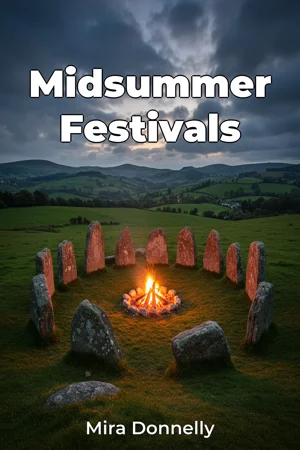
"Midsummer Festivals" explores the captivating world of summer solstice celebrations across diverse cultures, revealing humanity's enduring connection to nature. From ancient pagan traditions to modern-day festivities, the book examines how societies mark time, celebrate fertility, and reinforce community bonds through rituals like bonfires, dances, and symbolic feasts. The study delves into the historical roots of these celebrations, highlighting common symbolic elements such as the use of fire to represent the sun's power and the importance of water in cleansing and renewal. The book investigates specific festivals, including the Scandinavian Sankt Hans and the Slavic Kupala Night, uncovering unique customs and folklore while also revealing shared themes. By tracing the evolution of these midsummer festivals, the book demonstrates how they have adapted through various historical periods, maintaining their cultural relevance into the 21st century. This approach emphasizes the interconnectedness of human experience and challenges assumptions about cultural isolation, making it a valuable resource for those interested in world history, social science, and cultural studies.
Book Details
ISBN
9788235266934
Publisher
Publifye AS
Your Licenses
You don't own any licenses for this book
Purchase a license below to unlock this book and download the EPUB.
Purchase License
Select a tier to unlock this book
Need bulk licensing?
Contact us for enterprise agreements.