
About This Book
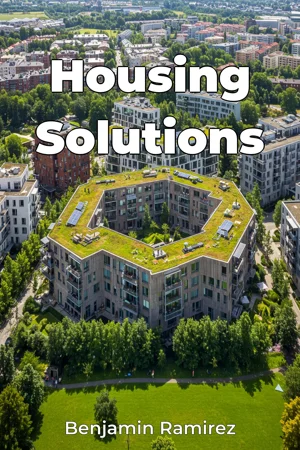
How can we ensure access to safe, affordable, and sustainable housing in rapidly growing urban centers? "Housing Solutions" addresses this critical question by exploring innovative and practical strategies for creating livable communities in the face of escalating housing costs and environmental concerns. The book delves into three key areas: policy reforms that promote equitable housing development, technological advancements that enable sustainable construction, and community-led initiatives that foster social inclusion and resilience. These topics are vital because they directly impact the well-being of individuals, the economic stability of cities, and the long-term health of the planet. Contemporary housing challenges are rooted in a complex interplay of factors, including historical zoning practices, economic inequality, and climate change. Understanding these underlying conditions is crucial for developing effective solutions. Readers will gain insights into the evolution of urban planning, the impact of globalization on housing markets, and the environmental consequences of conventional construction methods. No prior expertise is required, as the book provides a comprehensive overview of relevant concepts and terminology. The central argument of "Housing Solutions" is that a multi-faceted approach, combining policy innovation, technological advancement, and community engagement, is essential for achieving truly affordable and sustainable housing. This argument challenges the conventional focus on market-based solutions and emphasizes the need for collaborative action across sectors. The book is structured to systematically explore the problem and offer viable solutions. It begins by outlining the current state of the global housing crisis, examining the social, economic, and environmental implications. The subsequent sections delve into specific strategies, including: a) analyzing zoning policies to increase density and promote mixed-income communities; b) evaluating innovative construction technologies, such as modular building and green building materials, to reduce costs and environmental impact; and c) exploring community land trusts and cooperative housing models that empower residents and ensure long-term affordability. The book culminates in a synthesis of these strategies, outlining a roadmap for creating more equitable and sustainable urban environments. The analysis presented in "Housing Solutions" is supported by a range of evidence, including case studies of successful housing initiatives from around the world, statistical data on housing affordability and availability, and research findings from urban planning, architecture, and environmental science. Data sources include government reports, academic journals, and non-profit organizations dedicated to housing advocacy. The book also draws connections to several other fields, including economics, sociology, and public health. The economic impact of housing policies, the social consequences of segregation, and the health benefits of access to safe and affordable housing are all explored in detail. These interdisciplinary connections enrich the argument and demonstrate the far-reaching implications of housing policy. "Housing Solutions" distinguishes itself through its integrated approach, combining policy analysis, technological innovation, and community engagement. It offers a holistic perspective on the housing crisis, moving beyond simplistic solutions and embracing the complexity of the challenge. The book is written in a clear and accessible style, making it suitable for a broad audience, including policymakers, urban planners, architects, developers, community organizers, and concerned citizens. It will appeal to anyone interested in creating more just and sustainable cities. As a work within the genres of Environment, Architecture, and Architecture General, it adheres to the conventions of scholarly rigor while remaining practical and solution-oriented. The scope of "Housing Solutions" is global, but it focuses primarily on urban areas in developed countries. While the challenges and solutions may vary in developing countries, the underlying principles of affordability, sustainability, and equity remain relevant. The information presented can be applied practically by readers in a variety of ways. Policymakers can use the book to inform housing policy reforms, developers can explore innovative construction technologies, and community organizers can learn about successful models for community-led housing initiatives. The book addresses ongoing debates in the field, such as the role of government regulation in housing markets, the effectiveness of different affordability strategies, and the environmental impact of urban development. By presenting a balanced and evidence-based analysis, "Housing Solutions" aims to contribute to a more informed and productive discussion about the future of housing.
How can we ensure access to safe, affordable, and sustainable housing in rapidly growing urban centers? "Housing Solutions" addresses this critical question by exploring innovative and practical strategies for creating livable communities in the face of escalating housing costs and environmental concerns. The book delves into three key areas: policy reforms that promote equitable housing development, technological advancements that enable sustainable construction, and community-led initiatives that foster social inclusion and resilience. These topics are vital because they directly impact the well-being of individuals, the economic stability of cities, and the long-term health of the planet. Contemporary housing challenges are rooted in a complex interplay of factors, including historical zoning practices, economic inequality, and climate change. Understanding these underlying conditions is crucial for developing effective solutions. Readers will gain insights into the evolution of urban planning, the impact of globalization on housing markets, and the environmental consequences of conventional construction methods. No prior expertise is required, as the book provides a comprehensive overview of relevant concepts and terminology. The central argument of "Housing Solutions" is that a multi-faceted approach, combining policy innovation, technological advancement, and community engagement, is essential for achieving truly affordable and sustainable housing. This argument challenges the conventional focus on market-based solutions and emphasizes the need for collaborative action across sectors. The book is structured to systematically explore the problem and offer viable solutions. It begins by outlining the current state of the global housing crisis, examining the social, economic, and environmental implications. The subsequent sections delve into specific strategies, including: a) analyzing zoning policies to increase density and promote mixed-income communities; b) evaluating innovative construction technologies, such as modular building and green building materials, to reduce costs and environmental impact; and c) exploring community land trusts and cooperative housing models that empower residents and ensure long-term affordability. The book culminates in a synthesis of these strategies, outlining a roadmap for creating more equitable and sustainable urban environments. The analysis presented in "Housing Solutions" is supported by a range of evidence, including case studies of successful housing initiatives from around the world, statistical data on housing affordability and availability, and research findings from urban planning, architecture, and environmental science. Data sources include government reports, academic journals, and non-profit organizations dedicated to housing advocacy. The book also draws connections to several other fields, including economics, sociology, and public health. The economic impact of housing policies, the social consequences of segregation, and the health benefits of access to safe and affordable housing are all explored in detail. These interdisciplinary connections enrich the argument and demonstrate the far-reaching implications of housing policy. "Housing Solutions" distinguishes itself through its integrated approach, combining policy analysis, technological innovation, and community engagement. It offers a holistic perspective on the housing crisis, moving beyond simplistic solutions and embracing the complexity of the challenge. The book is written in a clear and accessible style, making it suitable for a broad audience, including policymakers, urban planners, architects, developers, community organizers, and concerned citizens. It will appeal to anyone interested in creating more just and sustainable cities. As a work within the genres of Environment, Architecture, and Architecture General, it adheres to the conventions of scholarly rigor while remaining practical and solution-oriented. The scope of "Housing Solutions" is global, but it focuses primarily on urban areas in developed countries. While the challenges and solutions may vary in developing countries, the underlying principles of affordability, sustainability, and equity remain relevant. The information presented can be applied practically by readers in a variety of ways. Policymakers can use the book to inform housing policy reforms, developers can explore innovative construction technologies, and community organizers can learn about successful models for community-led housing initiatives. The book addresses ongoing debates in the field, such as the role of government regulation in housing markets, the effectiveness of different affordability strategies, and the environmental impact of urban development. By presenting a balanced and evidence-based analysis, "Housing Solutions" aims to contribute to a more informed and productive discussion about the future of housing.
"Housing Solutions" tackles the pressing issue of ensuring access to safe, affordable, and sustainable housing in rapidly expanding urban areas. The book uniquely combines policy reforms, technological advancements, and community-led initiatives to foster inclusive and resilient communities. Readers will gain insights into how historical zoning practices and economic inequality influence contemporary housing challenges, with the book highlighting how conventional construction methods impact the environment. The book argues that a multi-faceted approach is essential for affordable and sustainable housing, challenging market-based solutions and emphasizing collaboration. Beginning with an overview of the global housing crisis and its implications, "Housing Solutions" progresses through analyzing zoning policies, evaluating innovative construction technologies like modular building, and exploring community land trusts. This approach provides a roadmap for creating more equitable and sustainable environments.
Book Details
ISBN
9788235266415
Publisher
Publifye AS
Your Licenses
You don't own any licenses for this book
Purchase a license below to unlock this book and download the EPUB.
Purchase License
Select a tier to unlock this book
Need bulk licensing?
Contact us for enterprise agreements.