
About This Book
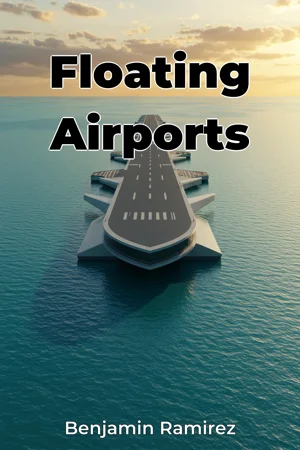
Imagine a world where airport congestion is a relic of the past, and major cities gain valuable land without displacing communities. *Floating Airports* explores the innovative concept of constructing airport runways on water, offering a potential solution to the growing challenges of urban air travel and land scarcity. This book delves into the architectural, technological, and logistical aspects of these ambitious projects, presenting a comprehensive overview of their feasibility and impact. The book examines the core challenges driving the need for floating airports: increasing air traffic, limited land availability in densely populated urban areas, and the environmental impact of traditional airport construction. We will explore how floating runways can alleviate these pressure points by providing additional capacity without requiring extensive land acquisition, potentially reducing noise pollution for communities, and presenting novel approaches to environmental management. We begin by establishing the historical context of airport development and the increasing demand for air travel. This includes an examination of the limitations of existing airport infrastructure and the environmental consequences of land-based airport expansion. The book then introduces the central argument: that floating airport technology, while complex, represents a viable and sustainable solution for future airport infrastructure, particularly in coastal cities facing significant land constraints. The book is structured into three major sections. First, we will discuss the fundamental engineering principles involved in constructing stable and safe floating platforms. This section will analyze different design options, including concrete pontoons and artificial islands, assessing their advantages and disadvantages in varying environmental conditions. The second section focuses on the technological innovations required for floating airports, such as advanced navigation systems, wave dampening technologies, and sustainable power generation. Case studies of existing floating structures, like offshore platforms and artificial islands, will be analyzed to provide a practical understanding of the engineering challenges and solutions. The final section addresses the environmental and socio-economic impacts of floating airports, including potential effects on marine ecosystems, noise pollution mitigation strategies, and the economic benefits of increased airport capacity and reduced land use. The arguments presented are substantiated by a range of evidence, including engineering studies, environmental impact assessments, economic analyses, and case studies of existing floating structures. We will examine research data on wave behavior, structural integrity, and the impact of underwater construction on marine life. Unique data sources, such as proprietary engineering reports and simulations will be utilized to provide in-depth insights. *Floating Airports* connects to several interdisciplinary fields, including coastal engineering, marine biology, and urban planning. The book explores the relationship between engineering design and environmental sustainability, assessing how floating airports can be integrated into urban development plans while minimizing their environmental footprint. Connections will also be made to economics, analyzing the cost-benefit of floating airports compared to land-based alternatives. This book differentiates itself by providing a thorough and objective analysis of floating airport technology, moving beyond conceptual discussions to address the practical challenges and opportunities involved in their implementation. It avoids overly optimistic projections and instead offers a realistic assessment of the potential benefits and risks, taking into account the complexities of environmental regulations, economic feasibility, and public acceptance. The tone is professional and informative, using clear and concise language to make complex technical concepts accessible to a broad audience. The book targets airport planners, architects, engineers, policymakers, and anyone interested in the future of aviation and sustainable urban development. It will be especially valuable within architecture, offering insights into the intersection of innovative design and practical infrastructure solutions. The scope is limited to the feasibility and impact of floating runways, without delving into aspects of airport management or aviation regulations that are not directly relevant to the core argument. The book addresses ongoing debates about the environmental sustainability of aviation and the need for innovative solutions to address the challenges of urban growth and infrastructure development.
Imagine a world where airport congestion is a relic of the past, and major cities gain valuable land without displacing communities. *Floating Airports* explores the innovative concept of constructing airport runways on water, offering a potential solution to the growing challenges of urban air travel and land scarcity. This book delves into the architectural, technological, and logistical aspects of these ambitious projects, presenting a comprehensive overview of their feasibility and impact. The book examines the core challenges driving the need for floating airports: increasing air traffic, limited land availability in densely populated urban areas, and the environmental impact of traditional airport construction. We will explore how floating runways can alleviate these pressure points by providing additional capacity without requiring extensive land acquisition, potentially reducing noise pollution for communities, and presenting novel approaches to environmental management. We begin by establishing the historical context of airport development and the increasing demand for air travel. This includes an examination of the limitations of existing airport infrastructure and the environmental consequences of land-based airport expansion. The book then introduces the central argument: that floating airport technology, while complex, represents a viable and sustainable solution for future airport infrastructure, particularly in coastal cities facing significant land constraints. The book is structured into three major sections. First, we will discuss the fundamental engineering principles involved in constructing stable and safe floating platforms. This section will analyze different design options, including concrete pontoons and artificial islands, assessing their advantages and disadvantages in varying environmental conditions. The second section focuses on the technological innovations required for floating airports, such as advanced navigation systems, wave dampening technologies, and sustainable power generation. Case studies of existing floating structures, like offshore platforms and artificial islands, will be analyzed to provide a practical understanding of the engineering challenges and solutions. The final section addresses the environmental and socio-economic impacts of floating airports, including potential effects on marine ecosystems, noise pollution mitigation strategies, and the economic benefits of increased airport capacity and reduced land use. The arguments presented are substantiated by a range of evidence, including engineering studies, environmental impact assessments, economic analyses, and case studies of existing floating structures. We will examine research data on wave behavior, structural integrity, and the impact of underwater construction on marine life. Unique data sources, such as proprietary engineering reports and simulations will be utilized to provide in-depth insights. *Floating Airports* connects to several interdisciplinary fields, including coastal engineering, marine biology, and urban planning. The book explores the relationship between engineering design and environmental sustainability, assessing how floating airports can be integrated into urban development plans while minimizing their environmental footprint. Connections will also be made to economics, analyzing the cost-benefit of floating airports compared to land-based alternatives. This book differentiates itself by providing a thorough and objective analysis of floating airport technology, moving beyond conceptual discussions to address the practical challenges and opportunities involved in their implementation. It avoids overly optimistic projections and instead offers a realistic assessment of the potential benefits and risks, taking into account the complexities of environmental regulations, economic feasibility, and public acceptance. The tone is professional and informative, using clear and concise language to make complex technical concepts accessible to a broad audience. The book targets airport planners, architects, engineers, policymakers, and anyone interested in the future of aviation and sustainable urban development. It will be especially valuable within architecture, offering insights into the intersection of innovative design and practical infrastructure solutions. The scope is limited to the feasibility and impact of floating runways, without delving into aspects of airport management or aviation regulations that are not directly relevant to the core argument. The book addresses ongoing debates about the environmental sustainability of aviation and the need for innovative solutions to address the challenges of urban growth and infrastructure development.
*Floating Airports* explores a cutting-edge solution to airport congestion and land scarcity: constructing airport runways on water. This approach offers relief for densely populated urban areas, potentially reducing noise pollution and minimizing land acquisition. The book examines the architectural and technological innovations required to make floating airports a reality. For example, the book analyzes how concrete pontoons and artificial islands can serve as stable platforms, while wave dampening technologies can increase safety and stability. The book progresses through engineering principles, technological innovations, and environmental impacts. It assesses the viability of floating airports by analyzing case studies of existing floating structures like offshore platforms. This approach provides a practical understanding of the challenges and solutions involved. The book also delves into the potential effects on marine ecosystems and the economic benefits of increased airport capacity, making it a valuable resource for airport planners, architects, and policymakers interested in sustainable development.
Book Details
ISBN
9788235265944
Publisher
Publifye AS
Your Licenses
You don't own any licenses for this book
Purchase a license below to unlock this book and download the EPUB.
Purchase License
Select a tier to unlock this book
Need bulk licensing?
Contact us for enterprise agreements.