
About This Book
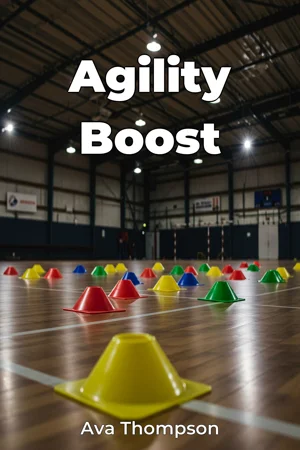
Are you ready to unlock your athletic potential and move with unparalleled precision and power? "Agility Boost" provides a comprehensive guide to enhancing reaction time, coordination, and speed through targeted agility training drills and exercises. This book delves into the science-backed methods for improving your physical capabilities, regardless of your current fitness level or sport. This book focuses on three key topics: neuromuscular efficiency, biomechanical optimization, and cognitive integration. Neuromuscular efficiency examines how the brain and muscles communicate to coordinate movements. Effective neuromuscular communication is the foundation of agility. Biomechanical optimization focuses on refining movement patterns to maximize power transfer and minimize energy expenditure. Cognitive integration explores the mental aspects of agility, such as anticipation, decision-making, and focus under pressure. These topics are important because they address all facets of agility, leading to well-rounded performance gains. Agility training evolved from basic conditioning exercises to sophisticated programs incorporating neurological and biomechanical principles. Historically, early approaches to agility were largely based on trial and error. Modern techniques leverage advances in sports science, biomechanics, and cognitive psychology to create targeted and effective training protocols. A basic understanding of anatomy, physiology, and fundamental movement principles will be beneficial, but not strictly necessary, for maximizing the book's insights. The central argument of "Agility Boost" is that agility is not merely an innate ability but a skill that can be systematically developed through understanding and applying scientific principles and targeted training techniques. Improving agility translates to enhanced performance, reduced injury risk, and increased confidence in various physical activities. The book begins by defining agility and debunking common misconceptions. It then explores the underlying scientific principles of agility, including neuromuscular adaptations, biomechanics, and cognitive processing. Subsequent chapters detail specific training drills and exercises designed to enhance each aspect of agility, presented with clear instructions, visual aids, and modifications for different skill levels. It also includes methods for assessing agility to monitor progress and adjust training programs accordingly. A final section focuses on integrating agility training into broader fitness and sports-specific training regimens, providing practical guidance for athletes and coaches. The book supports its arguments with research findings from peer-reviewed studies in sports science, biomechanics, and cognitive psychology. It also incorporates case studies of athletes who have successfully utilized agility training to improve their performance. "Agility Boost" also draws from data collected through motion capture analysis and force plate measurements to illustrate biomechanical principles in action. "Agility Boost" connects to the fields of physical therapy by providing rehabilitation strategies for joint stability and injury prevention. It also connects to cognitive psychology by examining the role of anticipation and decision-making in agile movements. Nutrition is also touched upon, briefly explaining the link between optimal energy levels and agile performance. These connections provide a holistic perspective on agility improvement. This book offers a unique perspective by integrating the latest scientific research with practical training techniques. It provides customized training programs based on individual assessment, rather than a one-size-fits-all approach. "Agility Boost" adopts a clear and accessible writing style, avoiding technical jargon where possible and providing definitions for unfamiliar terms. The tone is informative and encouraging, motivating readers to actively engage with the material and apply the techniques in their own training. The primary target audience includes athletes of all levels, coaches, personal trainers, and fitness enthusiasts seeking to improve their speed, coordination, and reaction time. This book offers the science-backed methods and actionable strategies necessary to make measurable improvements. As a health and fitness book, "Agility Boost" provides instructions and information related to exercise and physical training. The book focuses primarily on physical agility and does not delve into tactical agility (decision-making in team sports) or other unrelated areas. It sets out to explain how to become more agile in your movements and body control. The information in "Agility Boost" can be applied to various real-world settings, from improving athletic performance to preventing falls in older adults. The drills and exercises can be incorporated into daily routines, sports training programs, or rehabilitation protocols. While the benefits of agility training are widely recognized, there are ongoing debates regarding the optimal training methods and the relative importance of different agility components. "Agility Boost" addresses these debates by presenting a balanced perspective and highlighting the evidence supporting different approaches.
Are you ready to unlock your athletic potential and move with unparalleled precision and power? "Agility Boost" provides a comprehensive guide to enhancing reaction time, coordination, and speed through targeted agility training drills and exercises. This book delves into the science-backed methods for improving your physical capabilities, regardless of your current fitness level or sport. This book focuses on three key topics: neuromuscular efficiency, biomechanical optimization, and cognitive integration. Neuromuscular efficiency examines how the brain and muscles communicate to coordinate movements. Effective neuromuscular communication is the foundation of agility. Biomechanical optimization focuses on refining movement patterns to maximize power transfer and minimize energy expenditure. Cognitive integration explores the mental aspects of agility, such as anticipation, decision-making, and focus under pressure. These topics are important because they address all facets of agility, leading to well-rounded performance gains. Agility training evolved from basic conditioning exercises to sophisticated programs incorporating neurological and biomechanical principles. Historically, early approaches to agility were largely based on trial and error. Modern techniques leverage advances in sports science, biomechanics, and cognitive psychology to create targeted and effective training protocols. A basic understanding of anatomy, physiology, and fundamental movement principles will be beneficial, but not strictly necessary, for maximizing the book's insights. The central argument of "Agility Boost" is that agility is not merely an innate ability but a skill that can be systematically developed through understanding and applying scientific principles and targeted training techniques. Improving agility translates to enhanced performance, reduced injury risk, and increased confidence in various physical activities. The book begins by defining agility and debunking common misconceptions. It then explores the underlying scientific principles of agility, including neuromuscular adaptations, biomechanics, and cognitive processing. Subsequent chapters detail specific training drills and exercises designed to enhance each aspect of agility, presented with clear instructions, visual aids, and modifications for different skill levels. It also includes methods for assessing agility to monitor progress and adjust training programs accordingly. A final section focuses on integrating agility training into broader fitness and sports-specific training regimens, providing practical guidance for athletes and coaches. The book supports its arguments with research findings from peer-reviewed studies in sports science, biomechanics, and cognitive psychology. It also incorporates case studies of athletes who have successfully utilized agility training to improve their performance. "Agility Boost" also draws from data collected through motion capture analysis and force plate measurements to illustrate biomechanical principles in action. "Agility Boost" connects to the fields of physical therapy by providing rehabilitation strategies for joint stability and injury prevention. It also connects to cognitive psychology by examining the role of anticipation and decision-making in agile movements. Nutrition is also touched upon, briefly explaining the link between optimal energy levels and agile performance. These connections provide a holistic perspective on agility improvement. This book offers a unique perspective by integrating the latest scientific research with practical training techniques. It provides customized training programs based on individual assessment, rather than a one-size-fits-all approach. "Agility Boost" adopts a clear and accessible writing style, avoiding technical jargon where possible and providing definitions for unfamiliar terms. The tone is informative and encouraging, motivating readers to actively engage with the material and apply the techniques in their own training. The primary target audience includes athletes of all levels, coaches, personal trainers, and fitness enthusiasts seeking to improve their speed, coordination, and reaction time. This book offers the science-backed methods and actionable strategies necessary to make measurable improvements. As a health and fitness book, "Agility Boost" provides instructions and information related to exercise and physical training. The book focuses primarily on physical agility and does not delve into tactical agility (decision-making in team sports) or other unrelated areas. It sets out to explain how to become more agile in your movements and body control. The information in "Agility Boost" can be applied to various real-world settings, from improving athletic performance to preventing falls in older adults. The drills and exercises can be incorporated into daily routines, sports training programs, or rehabilitation protocols. While the benefits of agility training are widely recognized, there are ongoing debates regarding the optimal training methods and the relative importance of different agility components. "Agility Boost" addresses these debates by presenting a balanced perspective and highlighting the evidence supporting different approaches.
"Agility Boost" offers a comprehensive exploration of agility training, emphasizing that it's a skill developed through science-backed methods, not just an innate ability. The book delves into neuromuscular efficiency—the brain-muscle communication crucial for coordinated movements—and biomechanical optimization, which refines movement patterns for peak power and minimal energy use. You'll also discover the importance of cognitive integration, enhancing mental aspects like anticipation and focus. This book helps readers understand that agility is not just about physical prowess but also about cognitive function. The book progresses logically, starting with the definition of agility and debunking common misconceptions. It then explores scientific principles like neuromuscular adaptations and biomechanics. Subsequent chapters provide detailed training drills with visual aids, catering to various skill levels. It uniquely integrates sports science, biomechanics, and cognitive psychology, offering customized training programs based on individual assessment. By blending research findings with practical techniques, "Agility Boost" equips athletes, coaches, and fitness enthusiasts with actionable strategies to enhance speed, coordination, and reaction time, leading to improved athletic performance and reduced injury risk.
Book Details
ISBN
9788235264923
Publisher
Publifye AS
Your Licenses
You don't own any licenses for this book
Purchase a license below to unlock this book and download the EPUB.
Purchase License
Select a tier to unlock this book
Need bulk licensing?
Contact us for enterprise agreements.