
About This Book
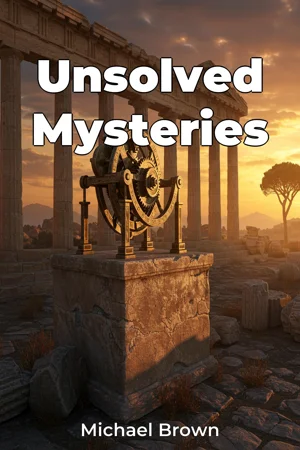
What happened to the Roanoke colonists? Where did the Library of Alexandria's vast knowledge disappear to? Why did the builders of Gobekli Tepe bury it? "Unsolved Mysteries" delves into history's most baffling enigmas, applying scientific rigor to shed light on enduring questions that continue to challenge our understanding of the past. This book examines a range of historical and scientific puzzles, seeking rational explanations where myth and speculation often dominate. We will explore, among other compelling subjects, the mysteries surrounding lost civilizations, focusing on societies like the Indus Valley Civilization, which flourished and then seemingly vanished. The abrupt disappearance of advanced cultures raises crucial questions about environmental factors, societal collapse, and the impact of external forces. We will also examine strange disappearances, such as the infamous Mary Celeste incident, analyzing evidence and exploring plausible, though ultimately unconfirmed, explanations. Another significant topic will be the analysis of unexplained archaeological finds, like the Antikythera mechanism, pushing the boundaries of what was thought possible in ancient technology and examining what specific knowledge was lost. Understanding these mysteries requires an interdisciplinary approach, combining historical analysis with archaeological findings and scientific methodologies. We will delve into climate science to assess the impact of environmental change, employ forensic techniques to re-evaluate evidence from disappearance cases, and explore engineering principles to understand ancient technologies. The central argument of "Unsolved Mysteries" is that even in the face of incomplete information, careful, evidence-based investigation can significantly narrow the realm of possibilities and offer plausible interpretations of unexplained phenomena. This approach is crucial for fostering critical thinking and separating informed speculation from unsubstantiated claims. The book begins by introducing the core principles of investigative analysis, emphasizing the importance of verifiable evidence and the pitfalls of relying on conjecture. It then progresses through a series of case studies, each dedicated to a specific unsolved mystery. These studies are structured around key investigative questions: What do we know for certain? What are the most plausible explanations based on the available evidence? What avenues for further research exist? The methodology relies heavily on documented historical accounts, archaeological reports, scientific analyses of artifacts, and environmental data. Where possible, we will present original research or re-interpretations of existing data, avoiding reliance on anecdotal evidence or unsubstantiated claims. The book draws connections between history, archaeology, and various scientific disciplines, including climatology, forensic science, and materials science. These interdisciplinary links are vital for providing a holistic understanding of complex mysteries. "Unsolved Mysteries" takes a unique approach by emphasizing the process of investigation rather than simply presenting a series of speculative theories. It highlights the importance of critical thinking, evidence-based reasoning, and the ongoing nature of scientific inquiry. The book maintains an accessible yet rigorous tone, presenting complex information in a manner that is engaging and informative for a general audience. It is aimed at readers with an interest in history, science, and the process of unraveling complex puzzles. The book avoids sensationalism, focusing instead on the careful analysis of available evidence and the presentation of well-supported interpretations. The scope of the book is limited to mysteries for which there is a significant body of evidence, but no definitive solution. It does not delve into paranormal phenomena or conspiracy theories lacking credible support. Instead, it focuses on cases that can be approached using established scientific and historical methods. The information presented can be applied to a range of fields, from historical research and archaeological investigation to critical thinking and problem-solving in everyday life. By demonstrating the power of evidence-based reasoning, "Unsolved Mysteries" encourages readers to approach complex questions with a skeptical yet open mind. The book addresses various ongoing debates within the related fields, presenting different perspectives and interpretations while emphasizing the importance of empirical evidence in resolving disagreements.
What happened to the Roanoke colonists? Where did the Library of Alexandria's vast knowledge disappear to? Why did the builders of Gobekli Tepe bury it? "Unsolved Mysteries" delves into history's most baffling enigmas, applying scientific rigor to shed light on enduring questions that continue to challenge our understanding of the past. This book examines a range of historical and scientific puzzles, seeking rational explanations where myth and speculation often dominate. We will explore, among other compelling subjects, the mysteries surrounding lost civilizations, focusing on societies like the Indus Valley Civilization, which flourished and then seemingly vanished. The abrupt disappearance of advanced cultures raises crucial questions about environmental factors, societal collapse, and the impact of external forces. We will also examine strange disappearances, such as the infamous Mary Celeste incident, analyzing evidence and exploring plausible, though ultimately unconfirmed, explanations. Another significant topic will be the analysis of unexplained archaeological finds, like the Antikythera mechanism, pushing the boundaries of what was thought possible in ancient technology and examining what specific knowledge was lost. Understanding these mysteries requires an interdisciplinary approach, combining historical analysis with archaeological findings and scientific methodologies. We will delve into climate science to assess the impact of environmental change, employ forensic techniques to re-evaluate evidence from disappearance cases, and explore engineering principles to understand ancient technologies. The central argument of "Unsolved Mysteries" is that even in the face of incomplete information, careful, evidence-based investigation can significantly narrow the realm of possibilities and offer plausible interpretations of unexplained phenomena. This approach is crucial for fostering critical thinking and separating informed speculation from unsubstantiated claims. The book begins by introducing the core principles of investigative analysis, emphasizing the importance of verifiable evidence and the pitfalls of relying on conjecture. It then progresses through a series of case studies, each dedicated to a specific unsolved mystery. These studies are structured around key investigative questions: What do we know for certain? What are the most plausible explanations based on the available evidence? What avenues for further research exist? The methodology relies heavily on documented historical accounts, archaeological reports, scientific analyses of artifacts, and environmental data. Where possible, we will present original research or re-interpretations of existing data, avoiding reliance on anecdotal evidence or unsubstantiated claims. The book draws connections between history, archaeology, and various scientific disciplines, including climatology, forensic science, and materials science. These interdisciplinary links are vital for providing a holistic understanding of complex mysteries. "Unsolved Mysteries" takes a unique approach by emphasizing the process of investigation rather than simply presenting a series of speculative theories. It highlights the importance of critical thinking, evidence-based reasoning, and the ongoing nature of scientific inquiry. The book maintains an accessible yet rigorous tone, presenting complex information in a manner that is engaging and informative for a general audience. It is aimed at readers with an interest in history, science, and the process of unraveling complex puzzles. The book avoids sensationalism, focusing instead on the careful analysis of available evidence and the presentation of well-supported interpretations. The scope of the book is limited to mysteries for which there is a significant body of evidence, but no definitive solution. It does not delve into paranormal phenomena or conspiracy theories lacking credible support. Instead, it focuses on cases that can be approached using established scientific and historical methods. The information presented can be applied to a range of fields, from historical research and archaeological investigation to critical thinking and problem-solving in everyday life. By demonstrating the power of evidence-based reasoning, "Unsolved Mysteries" encourages readers to approach complex questions with a skeptical yet open mind. The book addresses various ongoing debates within the related fields, presenting different perspectives and interpretations while emphasizing the importance of empirical evidence in resolving disagreements.
"Unsolved Mysteries" explores some of history's most perplexing enigmas, from lost civilizations to strange disappearances, using scientific and historical analysis. The book emphasizes evidence-based investigation and critical thinking to offer plausible interpretations of unexplained phenomena. It delves into mysteries like what happened to the Indus Valley Civilization, an advanced society that seemingly vanished, or the odd case of the Mary Celeste, a ship found adrift and deserted. The book uniquely emphasizes the process of investigation, applying scientific methodologies and historical analysis to archaeological discoveries and more. It examines unexplained finds like the Antikythera mechanism, highlighting lost ancient technology. Beginning with the principles of investigative analysis, the book progresses through case studies, each dedicated to a specific unsolved mystery. By connecting history, archaeology, and sciences like climatology and forensic science, "Unsolved Mysteries" avoids sensationalism, instead focusing on careful analysis and well-supported interpretations. This approach fosters critical thinking, encouraging readers to approach complex questions with a skeptical yet open mind, making it valuable for anyone interested in science, history, and the art of unraveling intricate puzzles.
Book Details
ISBN
9788235263889
Publisher
Publifye AS
Your Licenses
You don't own any licenses for this book
Purchase a license below to unlock this book and download the EPUB.
Purchase License
Select a tier to unlock this book
Need bulk licensing?
Contact us for enterprise agreements.