
About This Book
Did you know that for eleven days in October 1582, much of Europe simply ceased to exist? This book, "Gregorian Reform," delves into the fascinating story of that temporal vanishing act, exploring the transition from the long-used Julian calendar to the Gregorian calendar we predominantly use today. The book examines not only the scientific motivations behind this change, but also the social and political controversies it ignited, and the complex, often piecemeal, process of its global adoption. These three core themes – scientific necessity, societal resistance, and global adaptation – are crucial to understanding how we organize time itself and the profound impact that seemingly technical adjustments can have on society. For over 1600 years, the Julian calendar, implemented by Julius Caesar, served as the standard timekeeping system. However, by the 16th century, its inherent inaccuracies – specifically, a slight overestimation of the solar year – had resulted in a discrepancy of approximately ten days between the calendar and the actual astronomical seasons. This drift had significant implications for the observance of religious holidays, particularly Easter, which is tied to the vernal equinox. "Gregorian Reform" argues that the calendar reform was not simply a scientific correction, but a complex interplay of religious, political, and scientific forces. The book demonstrates how Pope Gregory XIII seized upon the need for reform, commissioning astronomers and mathematicians to devise a more accurate system. The book is structured to first provide a historical overview of calendrical systems leading up to the Julian calendar and then explores the scientific basis for its shortcomings. It details the meticulous calculations undertaken by the Gregorian commission to determine the length of the solar year and devise an accurate and practical system. The core of the book is dedicated to the immediate and often vehement reactions to the Gregorian calendar. Some countries, particularly those with Protestant affiliations, resisted the change for decades, viewing it as a Papist plot. We analyze the arguments made both for and against the new calendar, examining the social, economic, and religious upheaval caused by its implementation. The book concludes by tracing the gradual worldwide adoption of the Gregorian calendar, highlighting the adjustments and compromises made to accommodate local customs and traditions. The arguments presented are supported by extensive research into primary source documents, including papal bulls, scientific treatises, and contemporary accounts of the calendar's implementation. Moreover, the book draws on astronomical data to illustrate the accuracy of the Gregorian calendar compared to its predecessor. The book intersects not only with history and astronomy but also with sociology, exploring how societies grapple with large-scale changes to established systems. It also connects with political science, analyzing the role of power and authority in implementing and resisting such changes. "Gregorian Reform" offers a distinctive perspective, focusing on the lived experiences of those affected by the calendar change. The book avoids overly technical jargon, opting for a clear and engaging style accessible to a broad audience. It targets anyone interested in the history of science, the sociology of time, or the intersection of religion and politics. While the book focuses primarily on the Western world, it acknowledges the limitations of this scope, touching upon the eventual adoption of the Gregorian calendar in other cultures. The book also addresses real-world applications of understanding calendar systems, such as in historical research, where accurate dating is crucial, and in understanding the complexities of global coordination. The book acknowledges the ongoing debates about the need for further calendar reform, with some arguing that the Gregorian calendar, while more accurate than the Julian, is still imperfect and could be improved upon. This book, “Gregorian Reform,” provides a balanced and nuanced account of a pivotal moment in the history of timekeeping, offering insights into the enduring challenges of reconciling scientific accuracy with social acceptance.
Did you know that for eleven days in October 1582, much of Europe simply ceased to exist? This book, "Gregorian Reform," delves into the fascinating story of that temporal vanishing act, exploring the transition from the long-used Julian calendar to the Gregorian calendar we predominantly use today. The book examines not only the scientific motivations behind this change, but also the social and political controversies it ignited, and the complex, often piecemeal, process of its global adoption. These three core themes – scientific necessity, societal resistance, and global adaptation – are crucial to understanding how we organize time itself and the profound impact that seemingly technical adjustments can have on society. For over 1600 years, the Julian calendar, implemented by Julius Caesar, served as the standard timekeeping system. However, by the 16th century, its inherent inaccuracies – specifically, a slight overestimation of the solar year – had resulted in a discrepancy of approximately ten days between the calendar and the actual astronomical seasons. This drift had significant implications for the observance of religious holidays, particularly Easter, which is tied to the vernal equinox. "Gregorian Reform" argues that the calendar reform was not simply a scientific correction, but a complex interplay of religious, political, and scientific forces. The book demonstrates how Pope Gregory XIII seized upon the need for reform, commissioning astronomers and mathematicians to devise a more accurate system. The book is structured to first provide a historical overview of calendrical systems leading up to the Julian calendar and then explores the scientific basis for its shortcomings. It details the meticulous calculations undertaken by the Gregorian commission to determine the length of the solar year and devise an accurate and practical system. The core of the book is dedicated to the immediate and often vehement reactions to the Gregorian calendar. Some countries, particularly those with Protestant affiliations, resisted the change for decades, viewing it as a Papist plot. We analyze the arguments made both for and against the new calendar, examining the social, economic, and religious upheaval caused by its implementation. The book concludes by tracing the gradual worldwide adoption of the Gregorian calendar, highlighting the adjustments and compromises made to accommodate local customs and traditions. The arguments presented are supported by extensive research into primary source documents, including papal bulls, scientific treatises, and contemporary accounts of the calendar's implementation. Moreover, the book draws on astronomical data to illustrate the accuracy of the Gregorian calendar compared to its predecessor. The book intersects not only with history and astronomy but also with sociology, exploring how societies grapple with large-scale changes to established systems. It also connects with political science, analyzing the role of power and authority in implementing and resisting such changes. "Gregorian Reform" offers a distinctive perspective, focusing on the lived experiences of those affected by the calendar change. The book avoids overly technical jargon, opting for a clear and engaging style accessible to a broad audience. It targets anyone interested in the history of science, the sociology of time, or the intersection of religion and politics. While the book focuses primarily on the Western world, it acknowledges the limitations of this scope, touching upon the eventual adoption of the Gregorian calendar in other cultures. The book also addresses real-world applications of understanding calendar systems, such as in historical research, where accurate dating is crucial, and in understanding the complexities of global coordination. The book acknowledges the ongoing debates about the need for further calendar reform, with some arguing that the Gregorian calendar, while more accurate than the Julian, is still imperfect and could be improved upon. This book, “Gregorian Reform,” provides a balanced and nuanced account of a pivotal moment in the history of timekeeping, offering insights into the enduring challenges of reconciling scientific accuracy with social acceptance.
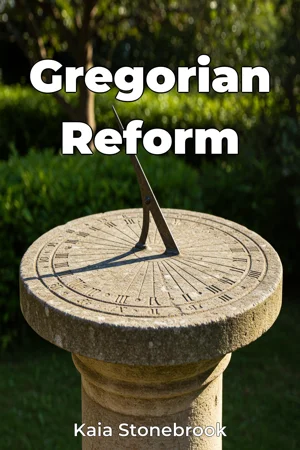
"Gregorian Reform" explores the dramatic shift from the Julian to the Gregorian calendar, a change that briefly erased eleven days in 1582 for many Europeans. This book investigates the scientific, social, and political factors behind this reform, highlighting how a seemingly technical adjustment triggered widespread resistance and gradual global adaptation. For over 1600 years, the Julian calendar miscalculated the solar year, leading to a ten-day discrepancy affecting religious observances like Easter. The book examines the meticulous calculations made by Pope Gregory XIII's commission to devise a more accurate system. It details the vehement reactions to the new calendar, particularly from Protestant countries that viewed it as a "Papist plot," and traces its eventual worldwide adoption. Using primary sources and astronomical data, this book offers a balanced perspective on a pivotal moment in timekeeping history. The book begins with historical context, progresses through the scientific basis and social reactions, and concludes with its global implementation. It is a valuable resource for those intrigued by history of science or the sociology of time.
Book Details
ISBN
9788235263797
Publisher
Publifye AS
Your Licenses
You don't own any licenses for this book
Purchase a license below to unlock this book and download the EPUB.
Purchase License
Select a tier to unlock this book
Need bulk licensing?
Contact us for enterprise agreements.