
About This Book
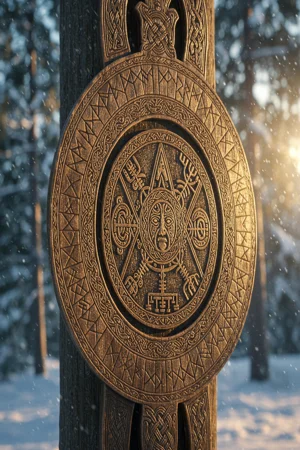
Have you ever wondered how ancient societies, without the aid of modern technology, managed to track the passage of time, predict seasonal changes, and organize their lives around agricultural cycles and important rituals? This book, "Runic Calendars," delves into the fascinating world of timekeeping in Norse and Viking societies, revealing the intricacies of their unique calendrical systems. We will explore how these calendars, far from being primitive, were sophisticated tools that reflected a deep understanding of the natural world and a complex cultural framework. The central argument of "Runic Calendars" is that these calendars were not merely time-tracking devices but integral components of Norse and Viking social, economic, and religious life. Their creation and use demonstrate an advanced level of astronomical observation, mathematical understanding, and symbolic representation. Their impact resonates through understanding agricultural planning, religious observances, and the very fabric of their societal structure. The book will begin by establishing the historical and social context of Norse and Viking societies, providing insights into their worldview and the challenges they faced in managing their lives in often harsh environments. This section will cover the basics of Norse cosmology and the importance of seasonal cycles in their agricultural practices. No prior knowledge of Norse history or runic alphabets is required, as these concepts will be introduced and explained clearly. Following the introduction, the book is structured into three major sections. The first section explores the different types of runic calendars, examining their physical forms (such as stave calendars and primstavs), the runic symbols used to denote days and months, and the numerical systems employed. The second section dissects the astronomical knowledge embedded within these calendars, explaining how the Norse and Vikings tracked the movements of the sun and moon, identified solstices and equinoxes, and calculated the dates of important festivals. We will explore their systems of predicting weather patterns utilizing these calendars as well. The third section investigates the cultural significance of runic calendars, analyzing how they were used to regulate agricultural activities, schedule religious rituals, and commemorate significant historical events. This involves exploring the connection between the calendar and Norse mythology, examining how specific days were associated with particular gods and stories. The evidence presented in "Runic Calendars" draws from a variety of sources, including archaeological finds of actual runic calendars, medieval Norse literature (such as the Eddas and sagas), and comparative studies of other ancient calendar systems. We will also analyze linguistic data to understand the meanings and etymologies of the terms used in the calendars. This book connects to several other fields, including astronomy, archaeology, history of mathematics, and religious studies. By examining runic calendars through these varied lenses, we gain a more complete and nuanced understanding of Norse and Viking society. The book adopts a scholarly yet accessible tone, making it suitable for both academic researchers and general readers interested in Norse history and culture. "Runic Calendars" is intended for anyone with an interest in history, archaeology, ancient cultures, or the history of science. It would be valuable to students, amateur historians, and those interested in learning more about Norse and Viking civilizations. The book deliberately limits its scope to runic calendars and their immediate cultural context, without delving into broader aspects of Viking history that are already well-covered in other literature. This targeted approach allows for a more in-depth and detailed analysis of the calendars themselves. The study of runic calendars also has practical applications today. By understanding how ancient societies tracked time and planned their lives, we can gain insights into the relationship between humans and the environment, and appreciate the ingenuity of pre-modern technologies. While the interpretation of certain runic symbols and calendar fragments can sometimes be debated among scholars, "Runic Calendars" presents a balanced and well-researched overview of the current state of knowledge in the field.
Have you ever wondered how ancient societies, without the aid of modern technology, managed to track the passage of time, predict seasonal changes, and organize their lives around agricultural cycles and important rituals? This book, "Runic Calendars," delves into the fascinating world of timekeeping in Norse and Viking societies, revealing the intricacies of their unique calendrical systems. We will explore how these calendars, far from being primitive, were sophisticated tools that reflected a deep understanding of the natural world and a complex cultural framework. The central argument of "Runic Calendars" is that these calendars were not merely time-tracking devices but integral components of Norse and Viking social, economic, and religious life. Their creation and use demonstrate an advanced level of astronomical observation, mathematical understanding, and symbolic representation. Their impact resonates through understanding agricultural planning, religious observances, and the very fabric of their societal structure. The book will begin by establishing the historical and social context of Norse and Viking societies, providing insights into their worldview and the challenges they faced in managing their lives in often harsh environments. This section will cover the basics of Norse cosmology and the importance of seasonal cycles in their agricultural practices. No prior knowledge of Norse history or runic alphabets is required, as these concepts will be introduced and explained clearly. Following the introduction, the book is structured into three major sections. The first section explores the different types of runic calendars, examining their physical forms (such as stave calendars and primstavs), the runic symbols used to denote days and months, and the numerical systems employed. The second section dissects the astronomical knowledge embedded within these calendars, explaining how the Norse and Vikings tracked the movements of the sun and moon, identified solstices and equinoxes, and calculated the dates of important festivals. We will explore their systems of predicting weather patterns utilizing these calendars as well. The third section investigates the cultural significance of runic calendars, analyzing how they were used to regulate agricultural activities, schedule religious rituals, and commemorate significant historical events. This involves exploring the connection between the calendar and Norse mythology, examining how specific days were associated with particular gods and stories. The evidence presented in "Runic Calendars" draws from a variety of sources, including archaeological finds of actual runic calendars, medieval Norse literature (such as the Eddas and sagas), and comparative studies of other ancient calendar systems. We will also analyze linguistic data to understand the meanings and etymologies of the terms used in the calendars. This book connects to several other fields, including astronomy, archaeology, history of mathematics, and religious studies. By examining runic calendars through these varied lenses, we gain a more complete and nuanced understanding of Norse and Viking society. The book adopts a scholarly yet accessible tone, making it suitable for both academic researchers and general readers interested in Norse history and culture. "Runic Calendars" is intended for anyone with an interest in history, archaeology, ancient cultures, or the history of science. It would be valuable to students, amateur historians, and those interested in learning more about Norse and Viking civilizations. The book deliberately limits its scope to runic calendars and their immediate cultural context, without delving into broader aspects of Viking history that are already well-covered in other literature. This targeted approach allows for a more in-depth and detailed analysis of the calendars themselves. The study of runic calendars also has practical applications today. By understanding how ancient societies tracked time and planned their lives, we can gain insights into the relationship between humans and the environment, and appreciate the ingenuity of pre-modern technologies. While the interpretation of certain runic symbols and calendar fragments can sometimes be debated among scholars, "Runic Calendars" presents a balanced and well-researched overview of the current state of knowledge in the field.
"Runic Calendars" explores the fascinating timekeeping methods of Norse and Viking societies, revealing sophisticated systems far beyond simple record-keeping. These calendars were integral to their social, economic, and religious lives, demonstrating advanced astronomical observation, mathematical understanding, and symbolic representation. One intriguing aspect is how these societies tracked the movements of the sun and moon to identify solstices and equinoxes, crucial for predicting weather and planning agricultural activities. Furthermore, the calendars' connection to Norse mythology highlights how specific days were associated with particular gods and stories, deeply weaving timekeeping into their cultural fabric. The book begins by establishing the historical and social context of Norse and Viking societies, then proceeds across three major sections. First it will explore the different types of runic calendars, then it will dissect the astronomical knowledge embedded within, and finally it will investigate the cultural significance. By examining archaeological finds, medieval Norse literature, and linguistic data, "Runic Calendars" offers a nuanced understanding of these ancient timekeeping devices. This targeted approach provides an in-depth analysis valuable to anyone interested in history, archaeology, or the history of science.
Book Details
ISBN
9788235263612
Publisher
Publifye AS
Your Licenses
You don't own any licenses for this book
Purchase a license below to unlock this book and download the EPUB.
Purchase License
Select a tier to unlock this book
Need bulk licensing?
Contact us for enterprise agreements.